Cho con một ly … nha
The polite ordering frame when talking to cô (a lady a generation older): cho con (give me) + number + ly + drink + nha (friendly particle). Cô and con always go together.

Vietnamese Podcast A1 · Episode 1
The coconut that became a melon — tones at the smoothie cart
 Hosted by Nam
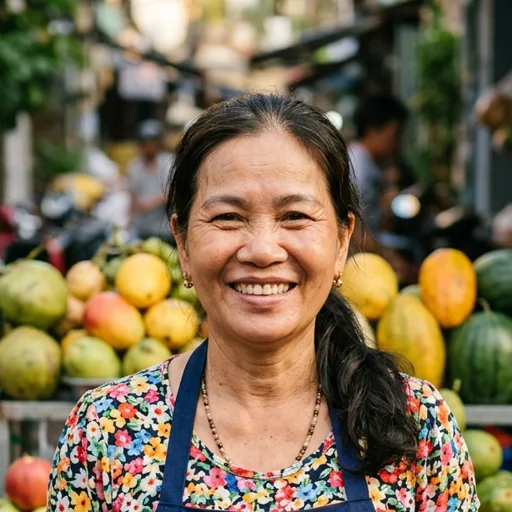
A blazing dry-season afternoon at a sinh tố cart in a Quận 3 hẻm. Ben is very thirsty and all he wants is coconut water. Cô Ba, the smoothie lady, calls everybody con and cưng. Ben asks for one fruit… and a very different fruit lands in the blender.
The polite ordering frame when talking to cô (a lady a generation older): cho con (give me) + number + ly + drink + nha (friendly particle). Cô and con always go together.
Drinks are counted with ly (glass); fruits are counted with trái: một ly sinh tố, một trái dừa.
Welcome to Vietnamese Podcast A1, created by SVFF — Tiếng Việt giọng miền Nam cho người nước ngoài.
Podcast number one — The coconut that became a melon — Dừa hay dưa? Lộn trái cây rồi!
Hello everybody, my name is Nam and I will be your host today.
In this lesson, you will learn how to order a drink at a street cart with the frame Cho con một ly … nha. You will learn two little counting words: ly for a glass, and trái for a fruit. And most important — you will train your ear to hear three tones: the flat tone, the falling tone, and the rising tone, inside three real fruit words. Because one wrong tone, and your coconut becomes a watermelon. Really. You will hear it happen today.
Our story happens at a sinh tố cart — a smoothie cart — in a small hẻm, an alley, in Quận 3, Sài Gòn, on a blazing hot dry-season afternoon. Ben, our learner, is very thirsty, and all he wants is coconut water. The smoothie lady, Cô Ba, calls everybody con or cưng — that is the warm Southern vendor way. Ben asks for one fruit… and a very different fruit lands on the cart. Listen for the moment it goes wrong.
Now, let's listen to the conversation. Slow speed first. Don't worry about understanding everything — just follow the little word dưa. It causes all the trouble.
Dialogue — slow passDid you hear it? Ben wanted a coconut. He got a watermelon smoothie. Poor Ben. But by the end — ngon quá, so delicious — everybody is happy. Let's find out what happened, one building block at a time.
First word: uống. To drink. Uống.
Cô Ba asks Ben: Uống gì? — drink what? What will you drink? At every drink cart in Sài Gòn, you will hear this question. Uống gì?
Next: sinh tố. A smoothie — fruit blended with ice and a little sweet milk. The star of every Sài Gòn street corner. Sinh tố.
Now a very useful little word: ly. A glass — the glass your drink comes in. In the South, a glass is always ly. And when you count drinks, you count with ly: một ly — one glass. Một means one. Ly.
So — how would you say one glass of smoothie? Một…
Một ly sinh tố.
Drinks come in ly. Fruits come with another little counting word: trái. One fruit is một trái. Some textbooks teach you a different counting word for fruit — but in Sài Gòn, at the market, at the cart, you will hear trái. So we learn trái. Trái.
Now — the heart of this lesson. Three fruits. The same sound — d, ư, a — but three different tones, and three completely different fruits. This is exactly why Ben got the wrong drink. Ready? Ear training time.
Tone number one: the flat tone — thanh ngang. The word has no mark. Your voice stays level, like a table top. Dưa. Flat. Dưa.
This flat dưa is the melon family. Add hấu, and you get dưa hấu — watermelon. The big green one, bright red inside. Dưa hấu.
Tone number two: the falling tone — thanh huyền. The mark is a little slide going down. Let your voice drop — like a coconut dropping from the tree. Boom. Dừa. Coconut. Dừa.
And coconut water — the drink Ben wanted so badly on that hot afternoon — is nước dừa. Nước means water. Nước dừa.
Tone number three: the rising tone — thanh sắc. Your voice goes up, like when you ask, huh? Dứa. Many textbooks will tell you dứa means pineapple. And Ben's textbook told him that too.
But here is the Sài Gòn secret: at a Sài Gòn fruit cart, nobody says dứa. In the South, the pineapple is thơm. And thơm also means fragrant — smells good. The pineapple is the fragrant one. Isn't that cute? Thơm.
Now, a listening game. I say one word — you catch the fruit. First one: dừa. Which fruit is it?
The voice fell down — falling tone — coconut! Next one: dưa. Which fruit?
Flat, level, no movement — the melon family! One more, the tricky one: dứa. The voice went up — that is the textbook pineapple word. But what do we call it in Sài Gòn?
Thơm! Trái thơm. Perfect. Your ears are waking up.
Now let's learn to order like Ben — well, better than Ben. The magic frame is: Cho con một ly … nha. Cho con means give me — a soft, polite way to ask. You say con — child — because you are talking to cô, a lady a generation older. Cô and con go together, always. Then the number, then ly, then your drink. And nha at the end — a friendly little particle that makes your request sweet, not bossy. Cho con.
So — how would you order one glass of watermelon smoothie? Cho con…
Cho con một ly sinh tố dưa hấu nha.
You will also hear nghen instead of nha — Cô Ba says nghen. Same friendly job, very Southern, very warm.
Three small words to finish — and they will save your teeth. Đá — ice. On a hot day: nhiều đá — lots of ice. Đá.
Đường — sugar. Street drinks in Sài Gòn get a lot of it. Đường.
And the most powerful phrase at any drink cart: ít ngọt — less sweet. Ít means little, ngọt means sweet. Ít ngọt.
The lady is reaching for the sugar. You want less. What do you say?
Ít ngọt. She will smile — locals say it too.
Two more feelings. Nóng — hot. Ben's very first words: Trời nóng quá — it's so hot! Quá after a word means so, very. Nóng.
And ngon — delicious. When that first sip of nước dừa lands on a hot afternoon: Ngon quá! Ngon.
Now let's analyze the conversation with me, line by line.
Dạ — the polite little sound Southern speakers put at the front of almost everything. Chào cô — hello, cô — Cô Ba is a generation older — think of your aunt — so Ben calls her cô, and calls himself con. Cô and con — that pair always travels together. Trời nóng quá — it's so hot!
She calls him con — child — and cưng — sweetie. That is the warm vendor voice of the South. Uống gì hông — will you drink something? Hông is the casual Southern not-or-no. You will hear hông all day in Sài Gòn.
There is our frame: cho con một ly … nha. But listen to the fruit: dưa. Flat. Ben means dừa — falling tone, coconut — but his voice stayed level. So what Cô Ba hears is… melon.
Dưa hấu hả? — watermelon, right? Hả is the little right? — checking. And nè — here it is, look! — she is already grabbing the watermelon. The mix-up is happening in real time.
Ủa — the great Southern sound of surprise. Dạ hông — a soft, polite no. Con muốn trái này — I want this fruit — con again, because he is talking to cô. Muốn means to want, and there is our fruit word trái. He is pointing at the coconut. Á at the end is just a little Southern emphasis.
À — I see! Trái dừa — the coconut. And then the lesson of the day, from the smoothie lady herself: Dừa, hông phải dưa — dừa, not dưa. Falling tone, not flat tone. One tone — one whole different fruit.
Ben is brave — he tries another fruit. Còn trái này — and this fruit? Còn means and, how about. Là dứa, phải hông? — it's dứa, right? Phải hông is the Southern right? tag. That dứa is straight from his textbook. Watch what happens.
Ở đây — here. Kêu là — we call it — kêu is the Southern way to say call. Here we call it thơm. This time the tone was not the problem — in the South it is a completely different word!
And now — the perfect order. The frame cho con, the counting word ly, the falling tone landing right on dừa, and ít ngọt — less sweet. Beautiful, Ben.
She repeats the order back — nước dừa, ít ngọt — and adds nhiều đá — lots of ice, exactly what a nóng afternoon needs — then closes with that warm nghen.
The first sip. Ngon quá — so delicious! And cô ơi — that little ơi is how you call out to someone warmly. Cô ơi!
Uống đi — drink up! Đi after a verb makes a friendly little push. And her goodbye is your homework: dừa, dưa, thơm — nhớ nghen — remember them!
Now let's listen to the conversation one more time — natural speed, like a real Quận 3 afternoon. Can you catch the exact moment the tone goes flat and the coconut becomes a melon?
Dialogue — natural speedGood. Now let's move to the practice part. I give you a situation in English — you say it in Vietnamese, out loud, tones and all. Then I give you the answer.
Number one. You are at the cart, and you want one glass of coconut water — friendly, with nha. How would you order?
Dạ, cho con một ly nước dừa nha.
Number two. One watermelon smoothie, please — and you want it less sweet. How would you say that?
Cho con một ly sinh tố dưa hấu, ít ngọt nha.
Number three. Order a pineapple smoothie — the Sài Gòn way. Careful with the fruit word!
Cho con một ly sinh tố thơm nha. Thơm — not the textbook word. You sound like a local now.
Number four. You take the first sip. It is wonderful. Tell Cô Ba — so delicious!
Ngon quá! Or warm and Southern: Ngon quá cô ơi!
Next, let's move to the vocabulary. You will hear the English, then the Vietnamese two times. Repeat with me. Vocabulary.
To drink.
Smoothie.
A glass — the counting word for drinks.
The counting word for fruits.
Watermelon — flat tone.
Coconut — falling tone.
Coconut water.
Pineapple — the Sài Gòn word.
Ice.
Sugar.
Less sweet.
To want.
Hot.
Delicious.
So that is our first episode. Today you learned the ordering frame — Cho con một ly … nha — the counting words ly for drinks and trái for fruits, the life-saving phrase ít ngọt, and three fruits that live one tone apart: dưa, flat, the melon; dừa, falling, the coconut; and the pineapple that is not dứa here at all — it is thơm, the fragrant one. And if you ever mix them up at a real cart, don't worry. You saw what happens: you get a smoothie, a smile, and a free tone lesson from a lady in a hẻm.
On the lesson page for this episode you will find the full transcript, and every Vietnamese word is tap-to-play — tap dừa, hear dừa, as many times as your ears need. Train that falling tone before your next smoothie run.
This is the end of podcast number one. I will see you in podcast number two. Chào bạn.
Nghe xong tập rồi làm bài nha — điểm chấm theo từng kỹ năng nghe, không chỉ một con số.
Your rating helps us make the next episodes better.