What it means
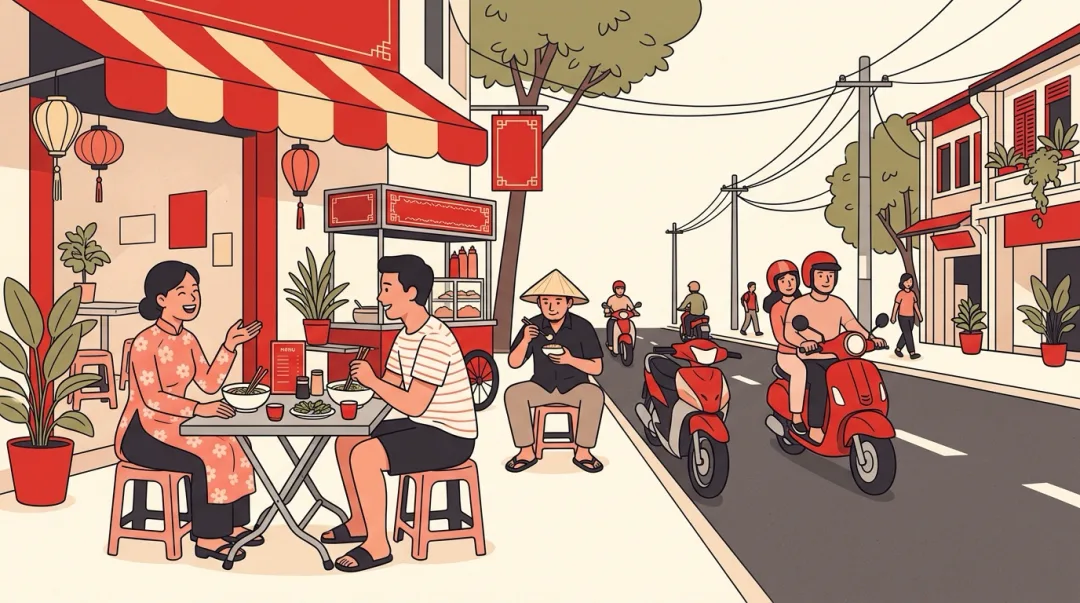
The three neutral "I/you" pronouns Vietnamese reaches for when no kinship relationship is set yet. "Tôi" is the formal, distance-keeping "I"; "mình" is the warm, friendly "I"; "bạn" is "you" between equals.
Ba đại từ "tôi / bạn / mình" dùng khi chưa xác định vai vế trong nhà. "Tôi" trang trọng, giữ khoảng cách; "mình" thân mật; "bạn" gọi người ngang hàng.
How the sentence is built
In real Southern Vietnamese
8 sentences with audio and word-by-word gloss.
-
Southern
Dạ chào anh, tôi tên Phúc, mới chuyển tới khu này.
Hi, my name is Phúc, I just moved to this area.
Word-by-word gloss
Dạ POLITE chào greet anh you , , tôi I tên name Phúc Phuc , , mới just chuyển tới move.to khu area này this . . -
Southern
Mình với bạn học chung lớp tiếng Anh hồi đó, nhớ hông?
You and I were in the same English class back then, remember?
Word-by-word gloss
Mình I/we với with bạn you/friend học chung study.together lớp class tiếng Anh English hồi đó back.then , , nhớ remember hông Q ? ? -
Southern
Bạn cho mình hỏi nhà sách gần đây ở đâu vậy?
Can I ask you where the nearest bookstore is?
Word-by-word gloss
Bạn you cho let/give mình me hỏi ask nhà sách bookstore gần đây nearby ở đâu where vậy so/SFX ? ? -
Southern
Trong đơn này, xin bạn điền đầy đủ họ tên.
In this form, please fill in your full name.
Word-by-word gloss
Trong in đơn form này this , , xin please bạn you/friend điền fill.out đầy đủ fully họ tên full.name . . -
Southern
Tôi xin phép có ý kiến một chút ạ.
May I share a quick opinion.
Word-by-word gloss
Tôi I xin phép ask.permission có have ý kiến opinion một chút a.little ạ POLITE . . -
Southern
Mình thấy quán đó được, bạn đi với mình hông?
I think that place is nice, want to come with me?
Word-by-word gloss
Mình I/we thấy see/think quán shop/restaurant đó that được good/fine , , bạn you/friend đi go với with mình me hông Q ? ? -
Southern
Tui hông biết bạn ở đâu nữa.
I don't even know where you are.
Word-by-word gloss
Tui I hông NEG biết know bạn you/friend ở at/be.at đâu where nữa anymore . . -
Southern
Tôi là giáo viên dạy tiếng Việt.
I'm a Vietnamese language teacher.
Word-by-word gloss
Tôi I là COP giáo viên teacher dạy teach tiếng Việt Vietnamese . .
Everything you need to use it like a local
The three "safe" pronouns when you don't know the relationship yet
Vietnamese normally builds "I" and "you" out of family words (anh, chị, em…). But before you've figured out who's older, you need pronouns that don't claim any rank. That's what tôi, mình and bạn are for.
tôi vs mình — same meaning, very different temperature
Both mean "I," but they live in different rooms:
| tôi | mình | |
|---|---|---|
| feel | formal, neutral, a bit distant | warm, friendly, casual |
| use it for | strangers, officials, writing, complaints | new friends, people your age, soft requests |
| pairs with | bạn / anh / chị | bạn / the other person's name |
Say tôi to a government clerk, in a survey, or when you want to sound firm. Say mình to someone you'd happily grab a coffee with. Using tôi with a close friend can sound cold — like you're suddenly upset.
bạn — "you" between equals, but lighter than it looks in textbooks
Bạn literally means "friend," and it's the natural "you" when two people are roughly the same age and no family rank applies. It shines in writing and broadcasting — surveys, app prompts, announcements, a teacher addressing the class. In a real one-on-one chat, Vietnamese speakers slip to a name or a kinship term fast, so don't over-rely on bạn face to face.
Why not just memorize "tôi = I, bạn = you" and stop?
Because the moment you learn the other person is older or younger, you're expected to switch. A 20-year-old meeting a 35-year-old will quickly drop tôi/bạn and move to em (for self) and anh/chị (for the other). The neutral trio is your opening move, not your whole game — it buys you time until the relationship is clear.
Southern note: in everyday Saigon talk, mình does a lot of heavy lifting for friendly "I," far more than the textbook-favorite tôi. Lead with mình when you want to sound easy and approachable.
Khi mới học tiếng Việt, bạn thường dùng từ "tôi" trong mọi tình huống để dịch từ "I" trong tiếng Anh. Thói quen này xuất phát từ việc tiếng Anh chỉ có một đại từ nhân xưng duy nhất cho ngôi thứ nhất là "I" mà không phân biệt mức độ thân mật. Trong tiếng Việt miền Nam, việc lạm dụng "tôi" sẽ tạo ra cảm giác xa cách và quá trang trọng khi trò chuyện với người bằng tuổi. Thay vào đó, bạn nên dùng "mình" để xưng hô thân thiện và tự nhiên hơn khi nói chuyện với "bạn".
Don't: Chào bạn, tôi rất vui được gặp bạn.
Do: Dạ chào bạn, mình rất vui được gặp bạn.
Don't confuse it with…
-
mình A warm, friendly "I" for casual talk between equals — and also the reflexive "-self" (myself, himself, herself). Softer and friendlier than the formal "tôi".
-
em/ anh The most common everyday "I/you" pair, borrowed from family words: "anh" = older male, "em" = younger person. Both speakers fix their pronouns to the relations…
-
em/ chị The "I/you" pair for an older female and a younger person: "chị" = older sister/woman, "em" = the younger one. Like anh/em, both speakers fix to the relationsh…
Check yourself
-
1You meet someone clearly your own age at a language meetup. Most natural opener?
Answer: Chào bạn, mình tên Lan.
Equal age + friendly setting → mình (warm "I") with bạn ("you"). tôi would feel oddly formal at a casual meetup.
-
2Which "I" fits a formal complaint at an office?
Answer: tôi
tôi is the neutral/formal "I" for officials, writing and firm situations.
-
3Soft, friendly request: "Can I ask you something?" → ___ cho ___ hỏi chút nha.
Answer: Bạn cho mình
Friendly register pairs bạn ("you") with mình ("I").
-
4A learner says this to their boyfriend. Make it natural: "Tôi nhớ bạn."
Answer: Em nhớ anh.
Couples use kinship terms, not tôi/bạn. (Swap to Anh nhớ em if the speaker is the older partner.)
-
5Arrange into a natural sentence:Tap the words in order…
Answer: Mình tên là Phúc nha
Friendly self-introduction: "Mình tên là Phúc nha." — nha softens it, very Southern.
-
6Match each to its use:
Correct pairs:
- tôi → formal / distant "I"
- mình → warm, casual "I"
- bạn → "you" between equals
Same trio, three different temperatures.
Trả lời hết các câu rồi bấm Chấm điểm để lưu kết quả.
Bạn được 0 / 0
Learned it? Prove it.
Part 1: pick the right answer. Part 2: type it yourself — no hints. Scored by skill, so you can see exactly what you've mastered. Phần 1 chọn đáp án; phần 2 tự gõ — chấm theo từng kỹ năng.
Part 1 — Multiple choice · Chọn đáp án
Part 2 — Type it yourself · Tự viết (no hints) Ready? Open the challenge →
Tip: these sentences are not in the lesson above — try from memory before scrolling back. Các câu này không có trong bài — thử tự nhớ nha.
Where to go next
Also in "Possessives — Using *Của* (and When to Drop It)"
Nearby in the A-Z
Your vote helps us improve this grammar reference.
