What it means
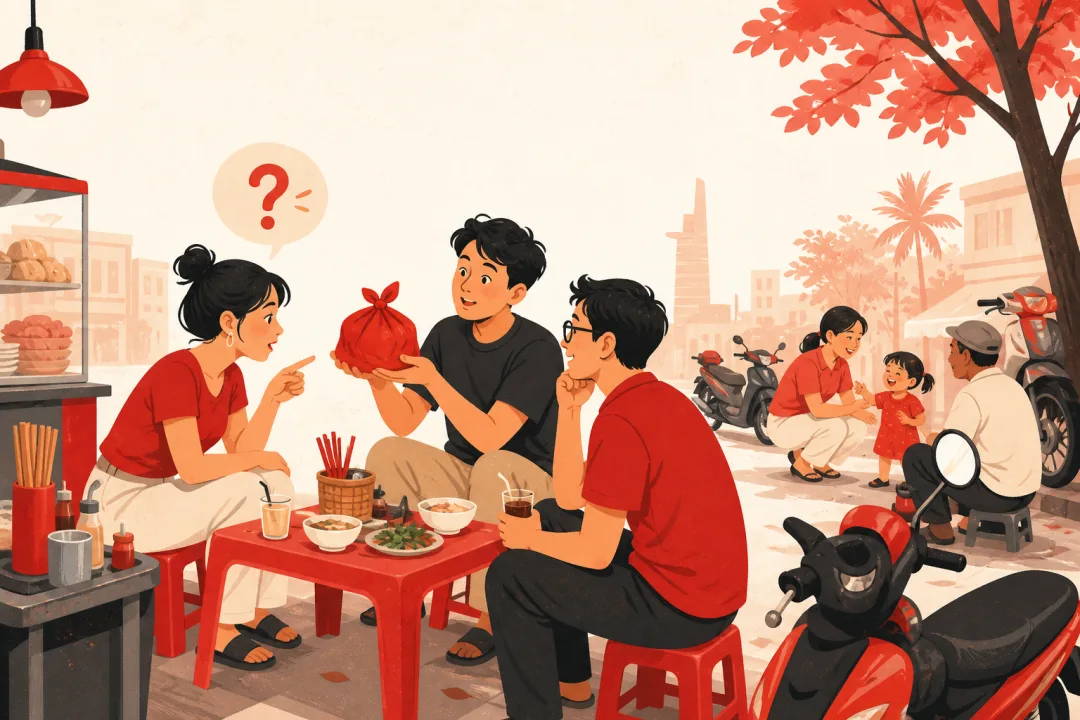
"Gì" is the open-ended question word "what". It stays exactly where the answer would go — Vietnamese never fronts the question word. After a noun it means "what kind of"; as a sentence subject use "cái gì"; after "là" it asks a name ("Tên bạn là gì?").
"Gì" là từ để hỏi "cái gì / what", đứng ngay chỗ câu trả lời sẽ nằm (tiếng Việt không đẩy từ hỏi ra trước). Sau danh từ nghĩa là "loại gì"; làm chủ ngữ thì dùng "cái gì"; sau "là" thì hỏi tên.
How the sentence is built
In real Southern Vietnamese
8 sentences with audio and word-by-word gloss.
-
Southern
Bạn ăn gì?
What are you eating?
Word-by-word gloss
Bạn you ăn eat gì what ? ? -
Southern
Tên bạn là gì?
What's your name?
Word-by-word gloss
Tên name bạn you/friend là COP gì what ? ? -
Southern
Cái gì làm bạn vui vậy?
What made you so happy?
Word-by-word gloss
Cái gì what làm make bạn you vui happy vậy so ? ? -
Southern
Bạn thích đọc sách gì?
What kind of books do you like to read?
Word-by-word gloss
Bạn you thích like đọc read sách book gì what ? ? -
Southern
Cái này tiếng Việt gọi là gì?
What's this called in Vietnamese?
Word-by-word gloss
Cái CLF này this tiếng Việt Vietnamese gọi là called gì what ? ? -
Southern
Tối nay bạn định làm gì?
What are you planning to do tonight?
Word-by-word gloss
Tối nay tonight bạn you/friend định plan làm do gì what ? ? -
Southern
Trong bánh này có gì vậy?
What's in this cake?
Word-by-word gloss
Trong in bánh cake này this có have gì what vậy so ? ? -
Southern
Má đang nấu gì đó?
What are you cooking, Mom?
Word-by-word gloss
Má mother đang PROG nấu cook gì đó something ? ?
Everything you need to use it like a local
"Gì" sits where the answer sits
The hardest habit to break for English speakers is fronting. In English the question word jumps to the front: What are you eating? Vietnamese does the opposite — gì stays exactly where the answer would go. You build the normal sentence, then drop gì into the slot you're asking about.
- Bạn ăn gì? — What are you eating? (answer: Mình ăn phở → swap phở for gì)
- Bạn mua gì rồi? — What did you buy?
Notice there is no "do/did", no word order change, nothing extra. That's the whole trick: the question word is in place.
Asking "what kind of": noun + gì
Put gì right after a noun and it means "what kind of":
- Bạn thích đọc sách gì? — What kind of books do you like to read?
- Quán này bán cà phê gì? — What kind of coffee does this place sell?
"Cái gì" as a standalone subject
When "what" is the subject of the sentence, Vietnamese prefers cái gì (literally "what thing") rather than bare gì:
- Cái gì làm bạn vui vậy? — What made you so happy?
- Cái gì ở trong hộp đó? — What's in that box?
Bare gì alone rarely starts a sentence; lean on cái gì for the subject slot.
"Là gì" — naming things
After là (to be), gì asks for a name or identity. This is one of the first patterns every learner needs:
- Tên bạn là gì? — What's your name?
- Cái này tiếng Việt gọi là gì? — What's this called in Vietnamese?
Answering
You answer a gì-question by putting the real word in the same slot gì occupied:
- Bạn uống gì? — Mình uống trà đá. (trà đá replaces gì)
Keep the rest of the sentence identical. That mirror-image relationship between question and answer is the clearest proof that, in Vietnamese, the question word never moves.
Một lỗi rất phổ biến khi bạn dùng từ "gì" là đặt nó ở đầu câu. Người học tiếng Anh hay mắc lỗi này vì thói quen đưa từ hỏi "what" lên trước trong cấu trúc câu tiếng Anh. Trong tiếng Việt, từ hỏi phải đứng ngay vị trí của thông tin mà bạn muốn hỏi, thường là ở cuối câu.
Để hỏi ai đó đang ăn món gì, bạn không được dịch từ từ từng chữ theo kiểu tiếng Anh. Hãy nhớ đặt từ "gì" sau động từ để câu nói tự nhiên đúng chuẩn người miền Nam.
Don't: Gì bạn ăn?
Do: Bạn ăn gì?
Don't confuse it with…
Check yourself
-
1How do you say "What are you eating?" the natural Vietnamese way?
Answer: Bạn ăn gì?
The question word stays in place — where the answer (e.g. phở) would go. No fronting like English.
-
2Which is correct for "What made you so happy?" (what = subject)?
Answer: Cái gì làm bạn vui vậy?
When "what" is the subject, Vietnamese uses cái gì, not bare gì.
-
3Fill the blank for "What's your name?": Tên bạn là ___?
Answer: gì
After là (to be), gì asks for a name or identity: Tên bạn là gì?
-
4Translate to natural Southern Vietnamese: "What kind of coffee does this place sell?"
Answer: Quán này bán cà phê gì?
Noun + gì = "what kind of". Gì follows the noun cà phê and stays in place.
-
5Tap the words in order to ask "What did you buy?"Tap the words in order…
Answer: bạn mua gì rồi
Bạn mua gì rồi? — the question word gì sits in the object slot, not the front.
-
6Match each Vietnamese question to its English meaning:
Correct pairs:
- Bạn ăn gì? → What are you eating?
- Tên bạn là gì? → What is your name?
- Cái gì đây? → What is this?
- Bạn thích sách gì? → What kind of books do you like?
Gì covers open-ended "what" and, after a noun, "what kind of".
Trả lời hết các câu rồi bấm Chấm điểm để lưu kết quả.
Bạn được 0 / 0
Learned it? Prove it.
Part 1: pick the right answer. Part 2: type it yourself — no hints. Scored by skill, so you can see exactly what you've mastered. Phần 1 chọn đáp án; phần 2 tự gõ — chấm theo từng kỹ năng.
Part 1 — Multiple choice · Chọn đáp án
Part 2 — Type it yourself · Tự viết (no hints) Ready? Open the challenge →
Tip: these sentences are not in the lesson above — try from memory before scrolling back. Các câu này không có trong bài — thử tự nhớ nha.
Where to go next
More in Questions
Nearby in the A-Z
Your vote helps us improve this grammar reference.
