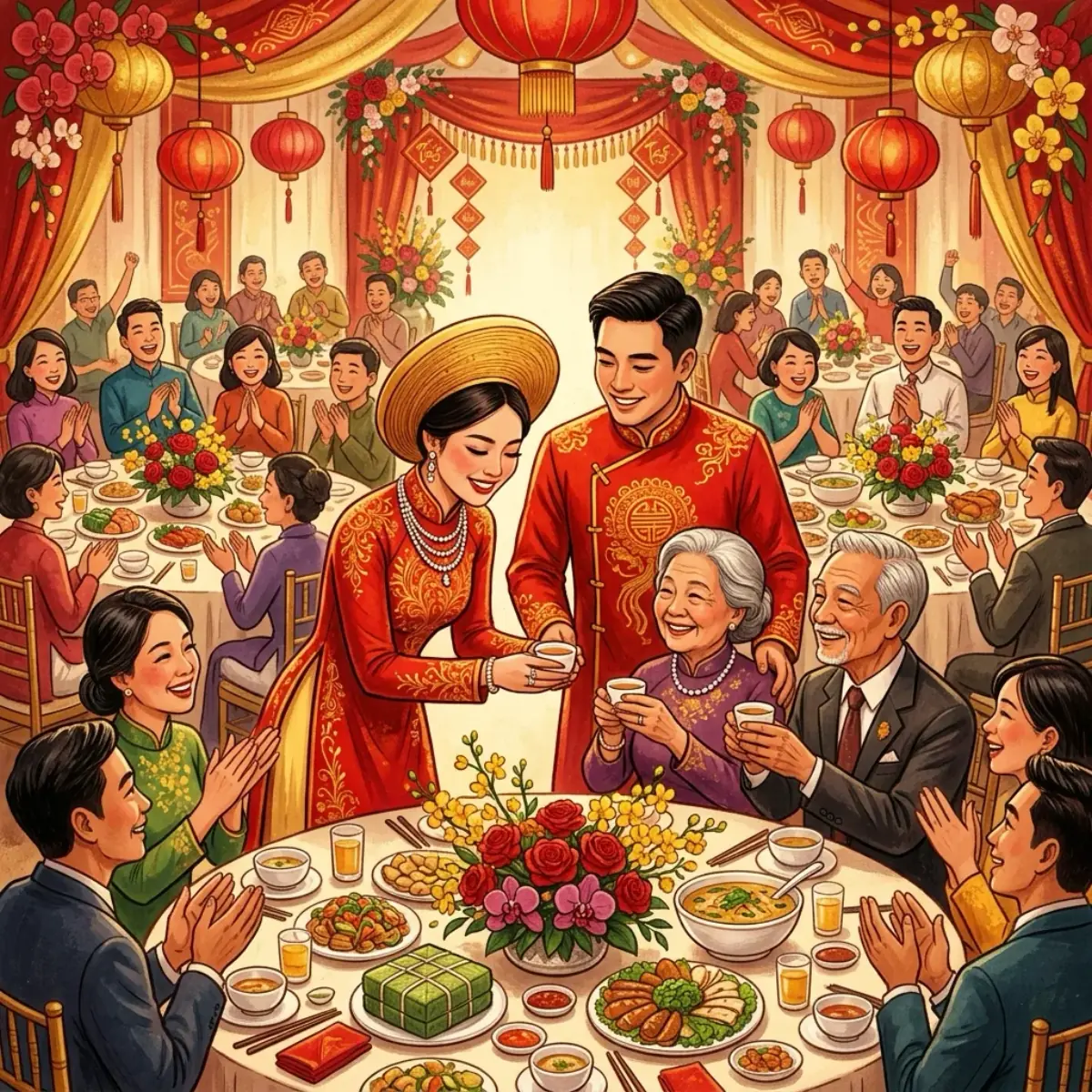
One day your coworker walks over, smiling too much, and hands you a stiff red-and-gold card. You have been invited to a Saigon wedding. Now the panic starts: what do I say? what do I wear? and the big one — how much money do I put in that envelope? Relax. Sit down, get a ly cà phê sữa đá, and let's go through it like friends.
Quick answer: Say chúc mừng hạnh phúc, put your cash in the bao thư (also called phong bì), drop it in the box at the door — and in Saigon a normal guest gives around 500 ngàn to 1 triệu per person.
The two events: đám hỏi and đám cưới
A Vietnamese wedding is not one day. It's a small season. The two you'll hear about most:
The đám hỏi is usually family only. If they invite you to that, you're basically family now, congratulations.
Who's who at the wedding
Two verbs you'll hear constantly. Cưới is the whole marrying thing, and lấy chồng / lấy vợ is "to take a husband / take a wife."
Good to know
In Saigon people also say đi đám cưới — "go to a wedding" — as a whole activity, the way English says "going to a wedding." And if someone says tui đi ăn cưới ("I'm going to eat wedding"), that's not a typo. Eating is the event.
The envelope: bao thư and mừng cưới
Here's the part everybody stresses about. There's no wedding registry, no toaster, no plates. You give cash, in an envelope, and that's it. In Saigon the everyday word for an envelope is bao thư; for wedding money specifically you'll hear phong bì just as often, and both are fine at the door.
So how much do I give?
Honest answer: enough to cover your seat, plus a bit. The families are paying per head at the restaurant, so a stingy envelope literally costs them money. Rough Saigon numbers as of now:
The realest way to handle it: ask a mutual friend. Nobody will judge you. Everybody asks.
Local tip
Use crisp new notes if you can, and give an even, round number. Nobody counts it in front of you, but new money looks like you cared. Also: if you genuinely can't attend, you still send the envelope — through a friend, or by bank transfer with a message like Chúc mừng hạnh phúc nha, tiếc quá tui hông đi được ("Congrats, so sorry I can't come").
What to actually say
Good news: there are basically four lines and they cover 95% of the night.
And when the couple comes to your table with glasses — they will, every table, all night — you stand up and say:
Common mistake
Don't say chúc mừng sinh nhật at a wedding — that's "happy birthday," and yes, learners do it. Also avoid wishing them anything with chia ("divide/split") in it. Weddings are all about trăm năm ("a hundred years"), never about splitting anything.
North vs South: the words that differ
Most wedding vocabulary is the same nationwide. A handful of everyday words around it aren't:
| Meaning | Southern (Saigon) | Northern (Hanoi) |
|---|---|---|
| the engagement ceremony | đám hỏi | lễ ăn hỏi |
| envelope (everyday word) | bao thư | phong bì |
| parents (talking about yours) | ba má | bố mẹ |
| cheers! (toasting) | dô! | vô! / một hai ba, vô! |
| expensive (that hotel!) | mắc | đắt |
| bowl of soup at the banquet | tô | bát |
| friendly sentence-ender | nha / nghen / hen | nhé |
Surviving the banquet
The banquet has a rhythm. Doors open, but the food starts late — often an hour after the time on the card. Everyone knows this. Nobody arrives on time except foreigners.
Local tip
Leaving early is totally fine after the couple has visited your table and the last dish is out. Say Tui về trước nha to your tablemates, wave at the couple, done. Nobody will chase you. Well — the uncle with the beer might.
Talking about it afterwards
Try it yourself
- Your coworker just announced her wedding. React in one sentence.
- Say "I'm going to a wedding on Saturday" in casual Saigon speech.
- Ask a friend how much they're putting in the envelope.
- Toast the couple at your table.
- Tell your tablemates you're heading home first.
Answers: 1. Trời ơi, chúc mừng nha! · 2. Thứ bảy tui đi đám cưới. · 3. Ông bỏ bao thư bao nhiêu vậy? · 4. Dô! Chúc mừng hạnh phúc nha! · 5. Thôi tui về trước nha.
Frequently asked questions
Do I hand the envelope to the couple directly?
No need. Drop it in the thùng tiền mừng at the entrance, where someone will write your name in the sổ ghi tiền mừng. Handing it over personally is fine at small family weddings, but the box is the normal move in Saigon.
What do I wear?
Anything neat — no white for women, no all-black. Bright colours are welcome. Vietnamese weddings are not shy about colour.
Can I bring my partner if the card only has my name?
Ask first: Tui dẫn theo bạn được hông? ("Can I bring a friend along?"). If yes, bump the envelope up, because that's another seat and another meal.
What's the difference between đám cưới and tiệc cưới?
Đám cưới is the whole wedding as an event. Tiệc cưới is specifically the banquet part. In practice people say đi đám cưới for everything.
Is it rude that they write down how much I gave?
Not at all — it's bookkeeping, not judgement. When you get married, they'll give back a similar amount. It's a lifelong loop, and it's genuinely kind of beautiful once you see it that way.
Where can I practise this before the big day?
Say the lines out loud with a real Saigon speaker. When you learn Southern Vietnamese online with a native teacher, you can rehearse the toast, the congratulations and the small talk until they come out automatically — which matters when the couple is standing right there with a glass.
Learn Southern Vietnamese online with people who actually speak it
SVFF is the school built entirely around the Southern (Saigon) dialect — native teachers from Ho Chi Minh City, since 2014.
- Listen to the SVFF podcast — real Southern Vietnamese, free.
- Book a free trial lesson — 30 minutes 1-on-1 with a native Saigon teacher.
- Browse our courses — structured A0–C1, all Southern dialect.
- Go Unlimited — every course and e-textbook, one payment.








0 Comments
Log in to leave a comment.