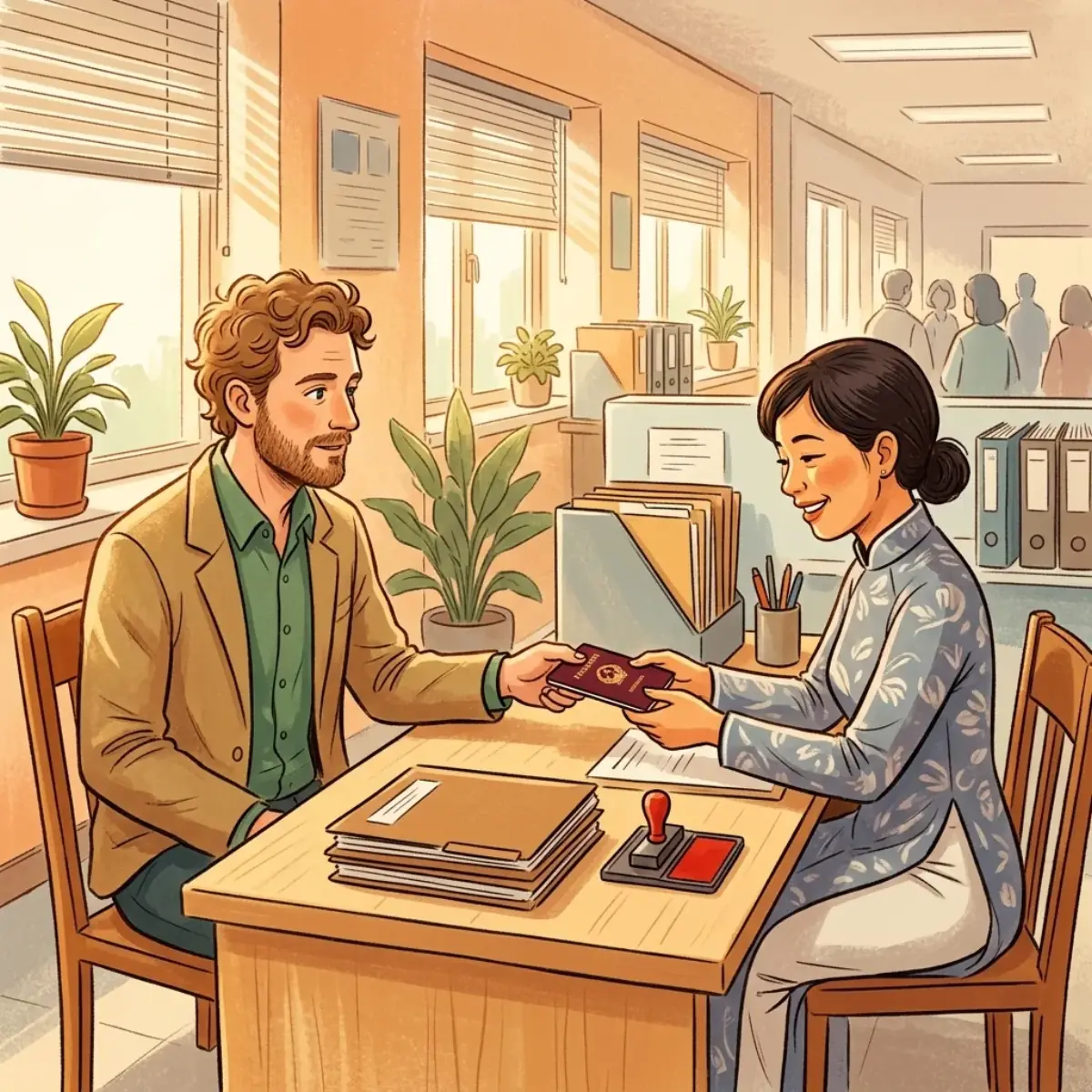
Nobody warns you about this part. You move to Saigon for the coffee, the motorbikes, the bánh mì at 6am — and then one day you're standing in a beige room holding a number ticket, and a very calm woman behind a counter says something to you at speed, and you realise every Vietnamese lesson you ever took was about ordering noodles.
Good news: office Vietnamese is actually easier than street Vietnamese. It's a small vocabulary. It repeats. And clerks in Saigon are usually way friendlier than their desks look — the second you try in Vietnamese, the whole room warms up about ten degrees.
Quick answer: Learn four words — giấy tờ (documents), hồ sơ (the file/application), gia hạn (extend), tạm trú (temporary residence) — start everything with dạ, soften your requests with nha or nghen, and close your questions with vậy chị or hông chị. That's 80% of surviving a Vietnamese government office.
The three-second opener that saves you
Before anything else: you need a way to walk up to a counter and not freeze. Here's the line. Memorise it like a phone number.
Swap the last bit for whatever you're there for and you've got a whole toolkit:
Local tip
Look at the person before you pick your word. Roughly your age or a bit older → chị or anh. Clearly older, parents' generation → cô or chú. Guessing slightly up is polite; guessing down is the risky one. And dạ at the front of everything is free insurance.
The words on the paper
Half the stress is not knowing what the form is asking for. Here's the vocabulary that actually shows up, grouped so it sticks.
Good to know
Tạm trú is the one foreigners forget. It's not about your visa — it's the paper saying "this human sleeps at this address." Your landlord or hotel usually files it. Ask them straight: Anh khai tạm trú giùm tui chưa vậy? — "Have you registered my temporary stay for me yet?"
Asking the only question that really matters: how long?
Everything else is details. What you desperately want to know is when you get your passport back. Two ways, both very Saigon:
And the answers you'll hear back, so they don't sound like noise:
Common mistake
Learners hear bổ sung and panic — it sounds enormous. It just means "add the missing bit." Nothing is rejected. The correct response is a cheerful Dạ, mai tui đem lên liền nha chị. — "Sure, I'll bring it up first thing tomorrow."
Four things to say when you don't understand
This is the real skill. Not understanding is normal; the trick is having a graceful line ready instead of a blank stare.
That last one is gold. Ask it every single time, even when you think you're done. It has saved me more return trips than any other sentence in Vietnamese.
North vs South at the counter
The formal paperwork words are identical nationwide — hồ sơ is hồ sơ in Hà Nội too. What changes is the human wrapping around them: the pronouns, the particles, the small verbs.
| Meaning | Southern (Saigon) | Northern (Hanoi) |
|---|---|---|
| I (neutral, everyday) | tui | tôi |
| …for me, do me a favour | giùm | hộ / giúp |
| no / not (in questions) | hông | không |
| softening particle | nha / nghen / hen | nhé / nhá |
| go in / enter (the office) | vô | vào |
| look, check | coi | xem |
| expensive (the fee!) | mắc | đắt |
A Hanoi clerk will understand your Saigon version perfectly. But giùm and nghen in a District 1 office make you sound like you live here, not like you're reading a phrasebook.
Common mistake
Learners grab hen and nghen and then bolt them onto everything, including questions: Chừng nào xong hen chị? sounds off. Those particles soften statements, requests and suggestions — Mai tui lên nghen, Chờ chút nha. For a real question, close with vậy chị (what/when/how questions) or hông chị (yes/no questions).
The photocopy shop is your best friend
Every Vietnamese office is orbited by a little shop doing photo and công chứng. Learn these and you'll never queue twice:
Local tip
Fees get quoted in ngàn, not nghìn, down here. Ba chục ngàn một bản is 30,000 a copy. If it sounds mắc quá trời, that's fine to think — but say it with a laugh, not a frown.
The apology that fixes almost everything
Sometimes you're late. Sometimes your visa quietly expired while you were at a beach in Phú Quốc. Sometimes you brought the wrong paper for the second time. Here's the tone to take — soft, a bit self-deprecating, never defensive:
That last line, said sincerely on the way out, is the single highest-return sentence in this whole post. Say it and watch the face change. Come back next week and she'll remember you.
Try it yourself
- You want to extend your visa. Open the conversation politely with the woman at the counter.
- Ask when you can come back and pick up your passport.
- Ask what other documents you need to bring.
- Ask the photocopy shop for two notarised copies.
- Thank the clerk warmly on your way out.
Answers: 1. Dạ chào chị, cho tui hỏi về gia hạn visa nha. 2. Chừng nào tui lấy lại hộ chiếu được vậy chị? 3. Dạ tui cần đem thêm giấy gì nữa hông chị? 4. Dạ cho tui công chứng cái này hai bản nha. 5. Dạ cảm ơn chị nhiều nghen!
Frequently asked questions
Do I really need Vietnamese at the immigration office?
Strictly, no — many counters have someone who manages some English, and most people go through an agent anyway. But the difference in speed and warmth when you open in Vietnamese is enormous. You stop being a problem and start being a person.
What's the difference between giấy tờ and hồ sơ?
Giấy tờ = the individual papers, your documents in general. Hồ sơ = the assembled file you hand over as one application. So you gather giấy tờ to build a hồ sơ, then you nộp hồ sơ.
Is tui okay in a government office, or too casual?
Tui is completely fine and completely Southern — it's neutral, everyday, and slightly warmer than the textbook form. If the room feels very formal, just lean harder on dạ at the front of your sentences. That does all the politeness work you need down here.
What if the clerk speaks too fast and I get nothing?
Don't nod and hope. Use Dạ chị ghi ra giấy giùm tui được hông? — asking for it in writing. Nobody minds, and you walk out with the answer in your hand instead of in your imagination.
How do I say a date is a deadline?
Visa tui hết hạn ngày mười lăm. — "My visa expires on the 15th." Then follow with Tui gia hạn được hông chị? — "Can I extend it?" Short sentences beat one long one every time.
Where can I practise this before I actually go?
Roleplay it with a teacher — this is exactly the sort of thing that's ten times easier after one rehearsal. If you learn Southern Vietnamese online with a native Saigon teacher, ask them to play the clerk and be deliberately unhelpful. Ten minutes of that beats an hour of vocabulary lists.
Learn Southern Vietnamese online with people who actually speak it
SVFF is the school built entirely around the Southern (Saigon) dialect — native teachers from Ho Chi Minh City, since 2014.
- Listen to the SVFF podcast — real Southern Vietnamese, free.
- Book a free trial lesson — 30 minutes 1-on-1 with a native Saigon teacher.
- Browse our courses — structured A0–C1, all Southern dialect.
- Go Unlimited — every course and e-textbook, one payment.








0 Comments
Log in to leave a comment.