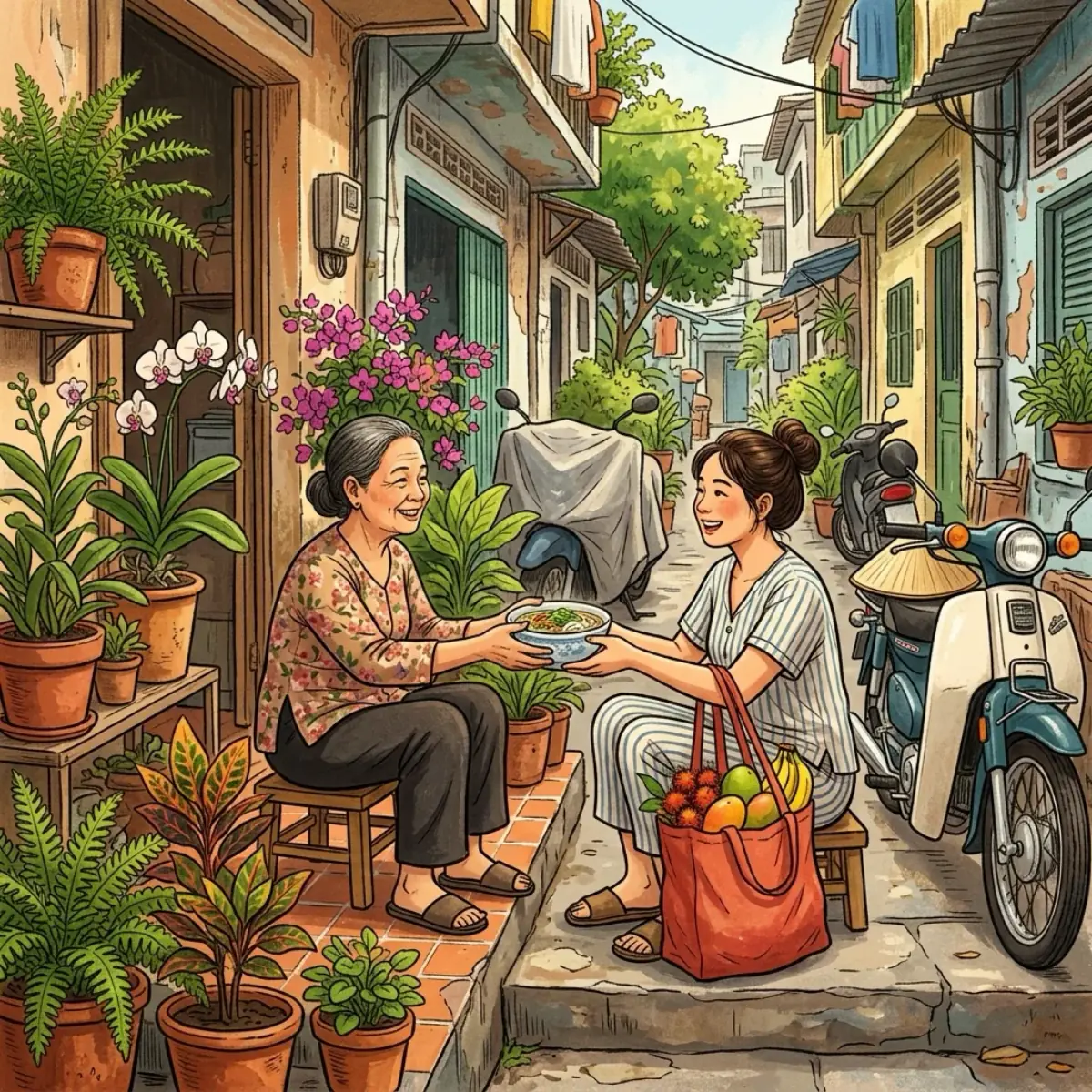
You're at a friend's house in Saigon. Somebody hands you a bowl, somebody else waves at the fruit plate, and in about four seconds you hear tự twice and nhau three times. These are tiny words — one syllable each — but they carry the whole idea of "by myself" and "each other." Get them right and you suddenly sound like a person, not a phrasebook.
Quick answer: Put tự before the verb for "do it myself," stick nhau after the verb for "each other," and use với nhau when the verb already likes a partner — nói chuyện với nhau, never nói chuyện nhau.
tự — the "no help needed" word
Tự sits right in front of the verb. That's it. No conjugation, no agreement, nothing to memorise. It means the subject did the thing without anyone else doing it for them.
Want to push harder — "I did it myself, thank you very much"? Add mình: tự mình.
Common mistake
tự is not the same as một mình. Tui đi một mình = I went alone, nobody came with me. Tui tự đi = I got there under my own steam, nobody drove me. You can absolutely say Tui với nhỏ bạn tự đi, hông ai chở — we got ourselves there, but we weren't alone.
tự nhiên — one word, three completely different jobs
This one confuses everybody, so let's be blunt about it. Tự nhiên has three lives in Saigon speech, and context tells you which one you're hearing.
Local tip
That third meaning — "out of nowhere, for no reason" — is everywhere in daily Saigon chatter and almost never in beginner textbooks. If someone starts a story with Tự nhiên…, buckle up, something random is coming.
tự glued onto other words
Tự also lives inside a bunch of fixed words. Don't try to pull them apart — just learn them whole.
lấy — the old-school "on your own"
Here's the one nobody explains properly. Besides its day job ("take, get"), lấy can sit after a verb and mean "for oneself, by oneself, without relying on anyone." It has a slightly stern, parental, proverb-ish flavour.
Good to know
Be honest with yourself about this one: in everyday Saigon speech, plain tự does 95% of the work. lấy shows up mostly in set phrases, in sayings, and when an older relative is giving you A Talk. Learn to recognise it; keep saying tự yourself and you'll never sound wrong.
And don't panic about ambiguity — position sorts it out. Lấy giùm tui cái muỗng. ("Pass me a spoon.") is the ordinary verb: it comes first and takes an object. Only when lấy trails another verb with nothing after it does it flip into "by oneself." (Yes, lấy chồng / lấy vợ = get married, that's a whole other job for the same poor word.)
nhau — the "each other" word
Now the fun half. Nhau goes straight after the verb and means the people involved did it to each other. There's no "we/us/them" object needed — nhau is the object.
Common mistake
The subject has to be plural. Tui gặp nhau bạn. ✗ — that's nonsense. Say Tui gặp bạn. (I met my friend) or Tụi tui gặp nhau. (we met each other). Also: nhau never goes before the verb. Nhau giúp ✗ → giúp nhau ✓.
với nhau — when the verb needs a partner
Some verbs can't just grab nhau bare; they need the little bridge với first. The classic is nói chuyện (to chat) — you talk with someone, so it's always nói chuyện với nhau.
There's also cùng nhau = "together, side by side, all of us doing the same thing." It's a touch warmer and more formal — great for family stuff and speeches. In casual talk people often just say chung: Đi chung cho vui.
lẫn nhau — the dressed-up version
Lẫn nhau means the same thing as nhau but with a tie on. It emphasises the mutual, both-directions nature of the action. You'll hear it in wedding toasts, work meetings, and anything slightly official.
Local tip
Over iced coffee, just say nhau. Tụi mình giúp nhau nha sounds friendly; Tụi mình giúp đỡ lẫn nhau nha sounds like you're opening a conference. Save lẫn nhau for the toast at the wedding.
Mixing tự and nhau in one sentence
They stack happily: tự in front, nhau at the back.
Does this change up North?
Honestly, the grammar itself is identical nationwide — tự before, nhau after, same everywhere. What changes is the verbs and particles you pack around them, and that's very audible.
| Meaning | Southern (Saigon) | Northern (Hanoi) |
|---|---|---|
| help each other | giúp nhau / phụ nhau | giúp nhau / đỡ nhau |
| do it for each other | làm giùm nhau | làm hộ nhau |
| tell each other | biểu nhau | bảo nhau |
| look for each other | kiếm nhau | tìm nhau |
| Do it yourself, okay? | Tự làm đi nghen. | Tự làm đi nhé. |
| They don't talk to each other | Tụi nó hông nói chuyện với nhau. | Chúng nó không nói chuyện với nhau. |
Try it yourself
- Tell someone you can carry your own bag, no help needed.
- A guest just sat down at your table. Invite them to help themselves.
- Say: "We got to know each other while working together."
- Fix this: Tụi mình nói chuyện nhau nha.
- Fix this: Tui gặp nhau nhỏ bạn ở chợ.
- Say: "Out of nowhere it started raining."
Answers: 1. Tui tự xách được, khỏi phụ. · 2. Tự nhiên đi nghen! · 3. Tụi tui quen nhau hồi làm chung. · 4. Tụi mình nói chuyện với nhau nha. · 5. Tui gặp nhỏ bạn ở chợ. (or Tui với nhỏ bạn gặp nhau ở chợ.) · 6. Tự nhiên trời đổ mưa.
Frequently asked questions
Is tự the same as một mình?
No. một mình = physically alone. tự = without help. Tui tự đi can be true even with five friends beside you, as long as nobody gave you a ride.
When do I actually need lẫn nhau instead of plain nhau?
Almost never in casual speech. Use it when you want to underline mutuality in a formal setting — tôn trọng lẫn nhau, giúp đỡ lẫn nhau. Otherwise nhau is what people say.
How do I know if a verb needs với nhau or just nhau?
Ask whether the verb takes với with a normal person. You say nói chuyện với ba, so it's nói chuyện với nhau. You say gặp bạn (no với), so it's gặp nhau. The pattern follows the verb, not a rule you have to memorise.
Is lấy worth learning as "by oneself"?
Worth recognising, not worth forcing. You'll meet it in sayings and in older relatives' advice. Produce tự instead and nobody will blink.
Does tự nhiên really mean "suddenly"?
Yes, and it's extremely common in daily Saigon talk. Tự nhiên nó nghỉ làm = "out of nowhere, he quit." Same word, totally different vibe from "natural" — the sentence tells you which.
Can I practise this with a real Saigon speaker?
That's the fastest fix. These words are pure reflex, not theory — you need someone to hear you say tụi mình gặp nhau nha and nod. If you want to learn Southern Vietnamese online with teachers who grew up saying exactly this, that's literally what SVFF does.
Learn Southern Vietnamese online with people who actually speak it
SVFF is the school built entirely around the Southern (Saigon) dialect — native teachers from Ho Chi Minh City, since 2014.
- Listen to the SVFF podcast — real Southern Vietnamese, free.
- Book a free trial lesson — 30 minutes 1-on-1 with a native Saigon teacher.
- Browse our courses — structured A0–C1, all Southern dialect.
- Go Unlimited — every course and e-textbook, one payment.








0 Comments
Log in to leave a comment.