Tiếng Việt Của Con — Southern Vietnamese for Kids by SVFF
If you have ever tried to explain to a child why ba (dad) and bà (grandma) mean different things just because your voice drops, you know how tricky Vietnamese tones can be. While early exposure to the language helps build vocabulary, teaching tones doesn't mean repeating a word twenty times until the child gets frustrated. For young learners of Southern Vietnamese, the secret to mastering tones is listening, playing, and making it a normal part of the family routine.
Spoken tone versus written mark
Before jumping into games, it helps to understand the difference between how a tone sounds and how it is written. If you learned Vietnamese in a formal setting, you might remember memorizing six tone marks. However, if your family speaks the Southern Vietnamese dialect, there is a helpful shortcut: there are only five spoken tones.
In Southern Vietnamese speech, the hỏi (asking) tone and the ngã (tumbling) tone sound identical. They both dip down and then rise slightly. Because of this, a child learning the Southern accent only needs to hear and reproduce five distinct sounds.
When teaching young children, the focus should be entirely on the "spoken tone." Do not worry about the "written mark" yet. Young minds absorb language through context and connection. When they hear their family members speaking, they are taking in the musicality of the language. If they can recognize the sound and match it to a meaning, they have successfully learned the tone!
For a deeper dive into the mechanics of the tones, parents can read our full Vietnamese tones guide. But for your child, keep it simple: just listen and speak.
Listen to ba, bà, má with Southern audio
The easiest way to start practicing tones is with words your child already cares about: their family. The basic decodable words for family members in Vietnamese offer a perfect, natural contrast between three different tones.
Let's look at three essential words built around the "a" sound:
- Ba (dad) uses the flat tone. The voice stays steady and even.
- Bà (grandma) uses the falling tone (dấu huyền). The voice starts low and drops a bit deeper.
- Má (mom) uses the rising tone (dấu sắc). The voice starts high and goes up sharply.
You can create a listening routine by playing these words and having your child repeat them.
Start by sitting together and saying the words clearly. Ask your child, "Who is this?" If they answer correctly, celebrate! Make it a call-and-response game. You say "Ba ơi!" (Dad!) and they can answer "Dạ!" (Yes / a polite response used by children). Using a natural phrase like Dạ gives them practice with the heavy or drop tone (dấu nặng) without even realizing it.
Match voice to picture
Once your child is comfortable hearing the tones, you can turn it into a physical game. Children learn best when they can move and interact, so a "Match Voice to Picture" activity is a fantastic way to practice without pressure.
Gather a few photos of your family members or draw simple pictures of Ba, Má, and Bà ngoại (maternal grandmother). Lay them out on a table or the floor.
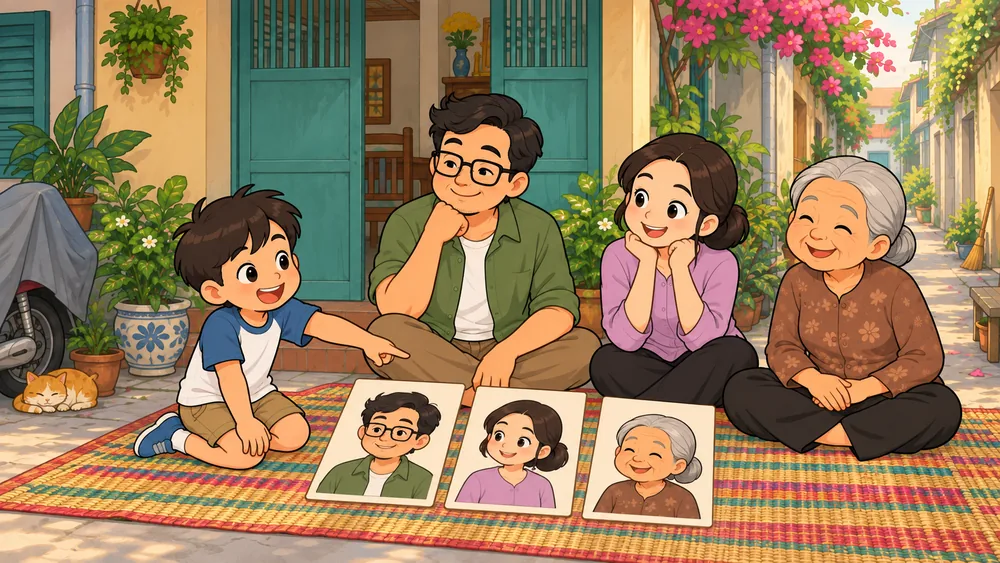
If they tap "Má" when you said "Ba," do not say "No, that's wrong." Instead, smile and say, "That is Má! Where is Ba?"
You can expand this game by adding short, fun phrases. Try saying "Ba đi làm" (Dad goes to work) or "Má đi chợ" (Mom goes to the market). The context of the sentence helps reinforce the tone of the name. If your child is having fun, they will want to play again, which means more natural exposure to the sounds.
Give gentle feedback
When a child is first trying to speak Vietnamese, their tones will not be perfect. They might use an English intonation, turning a flat tone into a rising question. This is completely normal for a heritage learner.
The key to keeping your child engaged is giving gentle feedback. Avoid stopping a conversation to correct a single tone. If a child feels like they are constantly failing a test, they will simply stop trying to speak the language, reverting to English where they feel confident.
Instead of drilling, use positive reinforcement and natural modeling. If your child points to their dad and says "Bá" (with a rising tone instead of a flat one), you can respond naturally: "Dạ, đúng rồi, ba! Ba đang đọc sách." (Yes, that's right, dad! Dad is reading a book.)
You have validated their effort by saying đúng rồi (that's right) while providing the correct pronunciation of ba in a meaningful sentence. You can also use familiar filler words like nha (a soft particle used at the end of sentences, like "okay?") or hông (the Southern spoken version of "không", meaning "no" or "not") to keep the conversation flowing naturally. For instance, "Con gọi ba nha?" (You call dad, okay?).
When to add print
Parents often wonder when they should start showing their child the written tone marks. If your child is a preschooler (ages 3 to 5), skip the text entirely. Their focus should be 100% oral.
Once a child is older, usually around ages 6 to 8, they have developed the phonemic awareness necessary to connect sounds to symbols. If they already have a solid spoken vocabulary from hearing the language at home, introducing the written tone marks will make sense to them.
In our structured curriculum, children aged 6 to 8 begin in Level 1. At this stage, we introduce the letters and the tone marks gradually, using words they already know how to say. We show them that the little mark going up (dấu sắc) matches the sound they make when they say Má. Because they already know the sound, the symbol simply becomes a visual anchor for what is already in their head.
Learning Vietnamese tones for kids doesn't require flashcards or frustration. By starting with family words, playing matching games, and keeping corrections gentle, you give your child a joyful foundation in their heritage language.
If you are ready to give your child structured, engaging practice with native-speaking teachers, explore our full program and book a free trial for my child today!
Frequently asked questions
Does Southern Vietnamese have five or six tones?
Written Vietnamese has six tone marks, but spoken Southern Vietnamese merges the 'hỏi' (asking) and 'ngã' (tumbling) tones into one sound. So, when listening and speaking in the Southern accent, your child only needs to learn five distinct tones.
Should I correct every mistake?
No, correcting every mistake can make children hesitant to speak. Instead, offer gentle feedback by repeating the word correctly in a natural sentence, praising their effort, and keeping the focus on communication rather than perfection.
Can a child learn tones before reading?
Absolutely! In fact, learning the spoken tone through listening and playing games is the best first step. Children should learn to hear and say the tones naturally before they are introduced to the written marks at around age 6 to 8.



0 Comments
Log in to leave a comment.