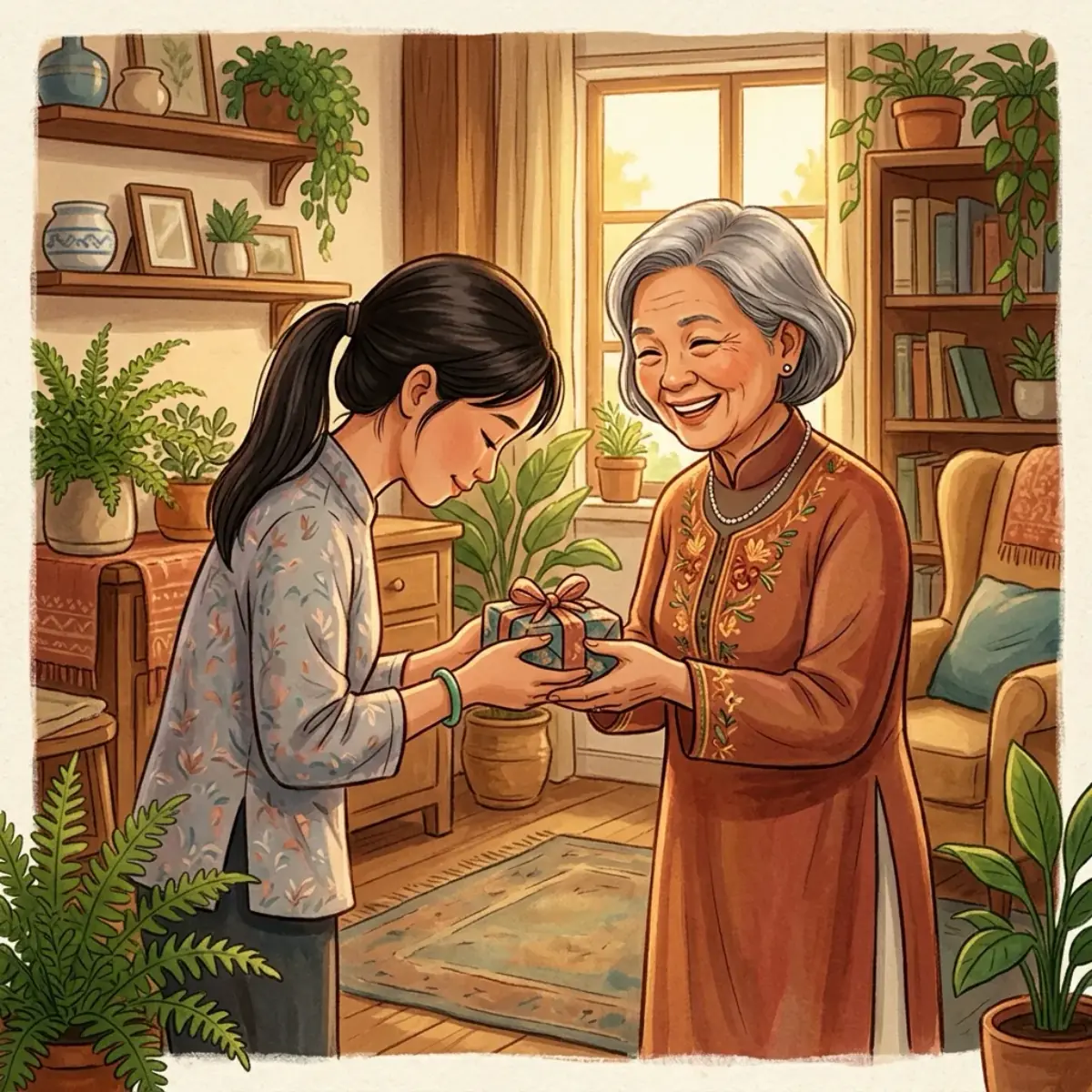
You learn cảm ơn on day one. Then you land in Saigon, say it eleven times before lunch, and slowly notice people looking at you a little funny. Nobody's offended. It's just that thank-yous here work differently — they're real, but they're rationed. Let me show you.
Two neighbours, same building, one hands the other a plastic bag of mangoes:
Quick answer: In Saigon you say cám ơn — usually cám ơn nghen — to strangers and for real favours, and you answer a thank-you with hổng có chi or có gì đâu. But with family and close friends, Vietnamese thanks far less than English does, so the skill isn't saying it more. It's knowing when to skip it.
First: cảm ơn or cám ơn?
Books write cảm ơn. Saigon mouths say cám ơn, and plenty of people write it that way too — signs, Zalo messages, café receipts. Both are correct. Down here, cám ơn is what you'll actually hear, so that's what I'll use all the way through.
Move 1: the plain thank you
Bare cám ơn on its own is fine, but it's a bit flat — like saying "thanks" with no eye contact. Add the person and it warms up instantly.
That little dạ in front is your best friend when you're talking up — to an older person, a customer, your partner's mother. It costs one syllable and buys a lot of goodwill.
Move 2: soften it so you don't sound like a form letter
A bare cám ơn can land oddly formal. Southerners round it off with nghen, nha or hen. Same job, different flavour of friendliness.
Move 3: turn the volume up
Someone actually went out of their way for you? Now you stack.
Good to know
There's a heavier word, biết ơn — closer to "I'm indebted to you." Save it for the doctor who saved your dad or the family who took you in. Use it for a free coffee and everyone will laugh at you.
Move 4: say what you're thanking for
The pattern is easy: cám ơn + person + đã + what they did. And notice giùm sneaking in — that's the Southern "did it for me" word, and it makes any sentence sound local.
Move 5: thank someone without saying cám ơn
This is the part that makes you sound like you've lived here. Half the gratitude in Saigon never uses the word at all. It comes out as praise, as promising to return the favour, or as a single soft dạ while you take the thing with both hands.
Local tip
When an older person hands you something — money, food, a gift — take it with two hands, or one hand with the other touching your forearm. Do that plus a small dạ and you've said "thank you" more convincingly than any sentence.
Move 6: replying when someone thanks you
English gives you "you're welcome." Vietnamese gives you a whole shrug family, and Saigon's favourite is hổng có chi — that hổng instead of không is pure Southern spoken register.
Between close friends you can also just go ờ with a nod. That's a complete answer. Really.
So how much thanking is normal? Less than you think
Here's the cultural bit that trips up almost every learner. In Vietnamese, saying cám ơn marks a small social distance — it says "you did something for me that wasn't automatically expected." Which is exactly right for a stranger, a shopkeeper, a colleague. It's wrong for the people closest to you.
Your má cooks dinner. You don't say cám ơn má. You say con mời má ăn cơm, or you just eat with visible joy and tell her ngon quá trời. Your best friend pays for the iced coffee — you don't thank her, you say bữa sau tui trả. Thanking family for ordinary family things sounds like you've suddenly become a guest in your own house.
Common mistake
Over-thanking. Foreigners thank the waiter for every plate, thank their partner for passing the salt, thank a friend four times for one favour. The Vietnamese word for this vibe is khách sáo — overly formal, treating people like guests. It's not rude, it's just cold. If someone tells you khách sáo quá!, that's your cue to relax.
Rule of thumb for daily Saigon life: thank strangers, thank people who did something outside their job, thank for gifts and real favours. For everything else, a smile, a dạ, or "I'll get you next time" does the work.
| What you want to say | Southern (Saigon) | Northern (Hanoi) |
|---|---|---|
| Thank you (everyday) | cám ơn nghen / cám ơn nha | cảm ơn nhé |
| Usual spelling & sound | cám ơn | cảm ơn |
| You're welcome | hổng có chi / có gì đâu | không có gì |
| Thanks a lot | cám ơn nhiều nghen | cảm ơn nhiều nhé |
| Don't mention it | khỏi cám ơn | không cần cảm ơn đâu |
Thanking on Zalo
Texting is shorter and softer. Cám ơn nha and cám ơn nhen are the workhorses. To someone older or a customer, dạ em cám ơn anh nhiều nha. Younger people type cám ơn nhìu nha or just tks with a sticker, and honestly the sticker is doing most of the talking.
Try it yourself
- A cô at the market gives you an extra bunch of herbs for free. Thank her warmly.
- Your Grab driver carries your suitcase up the stairs. Thank him and mention what he did.
- A younger colleague says cám ơn anh after you helped fix her laptop. Brush it off casually.
- Your friend's mother thanks you for a gift. Reply politely, with dạ.
Answers: 1. Dạ cám ơn cô nhiều nghen! · 2. Cám ơn anh đã xách vali lên giùm tui nha. · 3. Chuyện nhỏ mà, có gì đâu. · 4. Dạ hổng có chi cô.
Frequently asked questions
Is cám ơn or cảm ơn the "correct" one?
Both. Cảm ơn is the standard written form; cám ơn is what most Southerners say and very often write. Nobody will correct you either way in Saigon.
Do I thank the waiter every time?
Once at the end is plenty — cám ơn em nghen as you pay. Thanking for each dish that lands on the table is the classic foreigner tell.
Can I just say không có gì instead of hổng có chi?
Yes, everyone understands it. But hổng có chi and có gì đâu are what a Saigon person's mouth reaches for first, and using them makes you sound local instead of textbook.
What if I thank someone and they seem uncomfortable?
You've probably thanked a friend or family member for something they consider normal. Downgrade to a compliment (anh tốt quá!) or a promise to return the favour, and everyone relaxes.
Is there a formal thank you for work emails?
Yes: Cám ơn anh rất nhiều or Xin chân thành cám ơn. Keep those for writing — say xin chân thành cám ơn out loud to a coffee vendor and you'll sound like a TV announcer.
What's the fastest way to get comfortable with all this?
Hearing it live. Reading a list is one thing; catching a real hổng có chi mid-conversation is another. If you want to learn Southern Vietnamese online with people who use these words all day, practising with a Saigon teacher gets you there far quicker than any list.
Learn Southern Vietnamese online with people who actually speak it
SVFF is the school built entirely around the Southern (Saigon) dialect — native teachers from Ho Chi Minh City, since 2014.
- Listen to the SVFF podcast — real Southern Vietnamese, free.
- Book a free trial lesson — 30 minutes 1-on-1 with a native Saigon teacher.
- Browse our courses — structured A0–C1, all Southern dialect.
- Go Unlimited — every course and e-textbook, one payment.








0 Comments
Log in to leave a comment.