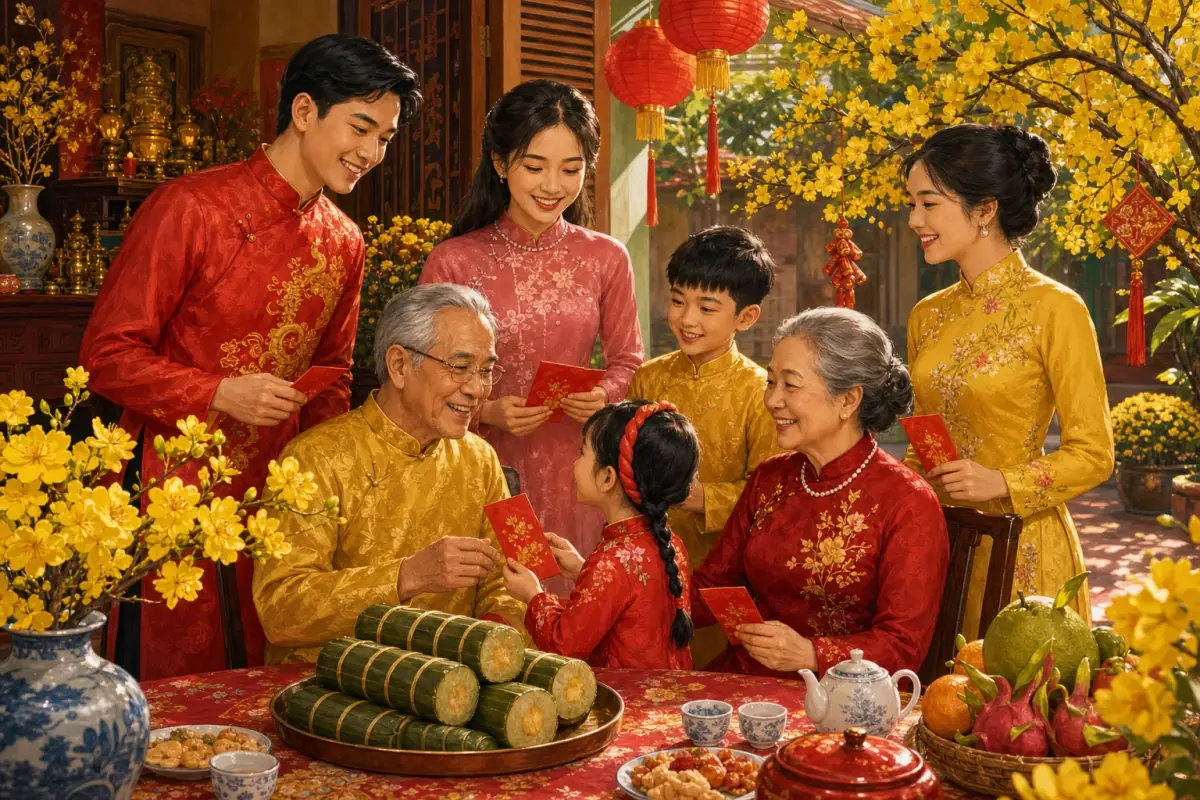
Around the 25th of the twelfth lunar month, something weird happens to Saigon. The traffic thins out. Half the quán on your street shut with a handwritten sign taped to the shutter. Your neighbour drags a yellow flowering tree up three flights of stairs. And everybody, everybody, is asking you the same question: "Tết này em về quê hông?"
If you live here, Tết is not optional knowledge. You will be fed. You will be handed a red envelope. Someone's bà ngoại will ask how old you are and whether you're married yet. So let's get you the words — and more importantly, the sentences you say back.
Quick answer: The one phrase that carries you through the whole holiday is "Chúc mừng năm mới!" — Happy New Year — and if you can add "Chúc bác năm mới nhiều sức khỏe", you're officially doing better than most foreigners in Saigon.
First, the big one: Tết
Tết is Lunar New Year. Full name Tết Nguyên Đán, but nobody says that out loud unless they're reading the news. It moves around — late January, mid February — because it follows the lunar calendar, âm lịch. The everyday Gregorian one is dương lịch.
Notice về quê — going back to the hometown. Saigon is a city built out of people from somewhere else, so a week before Tết the whole place empties. Bus stations look like a disaster movie. Then for about four days the city is the most pleasant it will ever be, and you can actually park.
The night it turns over: giao thừa
Giao thừa is the moment the old year hands over to the new one — midnight on New Year's Eve. Families eat, someone lights incense, and the whole neighbourhood goes outside to look at nothing in particular.
Pháo bông is the Southern word for fireworks. And đi chùa — going to the pagoda — is a huge part of the first days. People go to pray for sức khỏe (health), bình an (peace), and let's be honest, làm ăn phát tài (business booming).
Good to know
The days of Tết are counted with mùng: mùng một, mùng hai, mùng ba — day one, two, three. There's an old saying about who you visit on which day, but in practice people just say "mùng mấy anh rảnh?" — which day of Tết are you free?
Lì xì: the red envelope situation
Lì xì is both the red envelope and the act of giving it. Cash inside, crisp new notes, given by older people to kids — and to unmarried young adults, which is why "chừng nào cưới?" gets asked so much.
Common mistake
Don't open the envelope in front of the person who gave it to you. Take it with two hands, say "Dạ con cảm ơn", add a wish, put it in your pocket. Opening it on the spot reads as "let me count how much you love me." Kids get away with it. You won't.
Chúc Tết: the actual sentences
Chúc Tết means to give New Year wishes. The pattern is dead simple and you can build a hundred sentences from it:
Chúc + who + the good thing.
Local tip
Match the wish to the person. Old people get sức khỏe and sống lâu. Shop owners and anyone with a business get phát tài or buôn may bán đắt (may your goods sell fast). Students get học giỏi. Single friends get năm nay có người yêu nha — and yes, they will groan.
What's on the table (and in the vase)
Here's where the South parts ways with the North, and it matters. In Saigon you eat bánh tét — the long cylindrical sticky-rice cake, wrapped in banana leaf, sliced into rounds. The square one, bánh chưng, is a Northern thing. Say bánh chưng at a Southern family's table and someone will gently correct you.
And the flower. Northern homes get pink peach blossom. Saigon gets mai vàng — yellow apricot blossom — and the whole city turns gold for a week. Getting the buds to open on exactly mùng một is a genuine competitive sport among Vietnamese dads.
| Thing | Southern (Saigon) | Northern (Hanoi) |
|---|---|---|
| Tết rice cake | bánh tét (long, sliced into rounds) | bánh chưng (square) |
| Tết flower | mai vàng (yellow) | hoa đào (pink) |
| Signature Tết dish | thịt kho hột vịt | thịt đông |
| Fireworks | pháo bông | pháo hoa |
| Pickled side dish | dưa món | dưa hành |
The rest of the calendar
Tết is the giant, but a few others come up in normal conversation.
Trung Thu — Mid-Autumn, the eighth lunar month. Lanterns, mooncakes, kids running around the alley making a racket. It's a kids' holiday, but every office in Saigon still sends out boxes of bánh trung thu.
Giỗ — the death anniversary of a family member. Not sad in the way you'd expect. It's a meal, a full house, incense on the altar, and honestly some of the best home cooking you'll ever get invited to. If a Vietnamese friend invites you to đám giỗ, say yes.
Good to know
Two others you'll hear: Giỗ Tổ Hùng Vương (Hùng Kings' commemoration, a public day off on the tenth day of the third lunar month) and rằm — the full moon of each lunar month, when a lot of people eat vegetarian, ăn chay. If your favourite quán cơm is suddenly all veggie, check the lunar date.
Small Tết things that trip people up
Common mistake
Learners say "Chúc mừng Tết". Nobody says that. It's "Chúc mừng năm mới" — congratulations on the new year. Tết stays out of that particular phrase.
Two more habits worth stealing. Don't sweep the floor on mùng một — you're sweeping out the luck. And people care about xông đất: the first person to step into the house in the new year sets the tone. If you're loud, cheerful, and doing well in life, you may find yourself politely invited to arrive first.
Try it yourself
- Your landlady hands you a red envelope. What do you say?
- Wish the owner of your regular quán cà phê a good business year.
- Ask a colleague whether they're going back to their hometown this Tết.
- Tell a friend the mai tree at your place bloomed too early.
- Name the Southern Tết cake — and the flower.
Answers: 1. Dạ con cảm ơn cô, chúc cô năm mới nhiều sức khỏe. · 2. Chúc chị năm mới buôn may bán đắt nha. · 3. Tết này anh về quê hông? · 4. Cây mai nhà tui nở sớm quá trời. · 5. bánh tét and mai vàng.
Frequently asked questions
How much money should I put in a lì xì?
For kids in the neighbourhood, small crisp notes are fine — the ritual matters more than the amount. For close family kids, more. The rule people actually follow is: new notes, even-ish round numbers, and never an amount that makes anyone feel weird. If you're unsure, ask a Vietnamese friend what they're giving and match it.
Can I say "Chúc mừng năm mới" to anyone?
Yes — it's the safe universal one, works with your boss, the security guard, the lady who sells you bánh mì. Add a pronoun and a wish to make it warmer: "Chúc chú năm mới mạnh khỏe."
Is everything really closed during Tết?
A lot of it, yes — usually from around mùng một to mùng bốn or later, and small family quán can stay shut a full week. Big supermarkets and chains reopen fast. Anything that does open charges a Tết surcharge and will tell you so cheerfully.
Why does everyone ask my age at Tết?
Partly because pronouns depend on relative age, partly because Vietnamese zodiac years come up constantly, and partly because bà wants to know if you're old enough to be asked about marriage. Answer with a smile and redirect: "Dạ con ba mươi rồi bác. Bác năm nay khỏe hông bác?"
What's the difference between bánh tét and bánh chưng again?
Same core idea — sticky rice, mung bean, pork, banana leaf — different shape and different region. Bánh tét is the long cylinder you slice into rounds and it's what the South makes. Bánh chưng is the Northern square. In Saigon, you want bánh tét.
Where can I practise this before Tết arrives?
Honestly, with a real person. Holiday language is full of tone and timing that a word list won't give you — when to add dạ, how to receive the envelope, how to deflect the marriage question. If you learn Southern Vietnamese online with a Saigon teacher, you can rehearse the whole family-visit script before you're standing in someone's living room with everyone watching.
Learn Southern Vietnamese online with people who actually speak it
SVFF is the school built entirely around the Southern (Saigon) dialect — native teachers from Ho Chi Minh City, since 2014.
- Listen to the SVFF podcast — real Southern Vietnamese, free.
- Book a free trial lesson — 30 minutes 1-on-1 with a native Saigon teacher.
- Browse our courses — structured A0–C1, all Southern dialect.
- Go Unlimited — every course and e-textbook, one payment.








0 Comments
Log in to leave a comment.