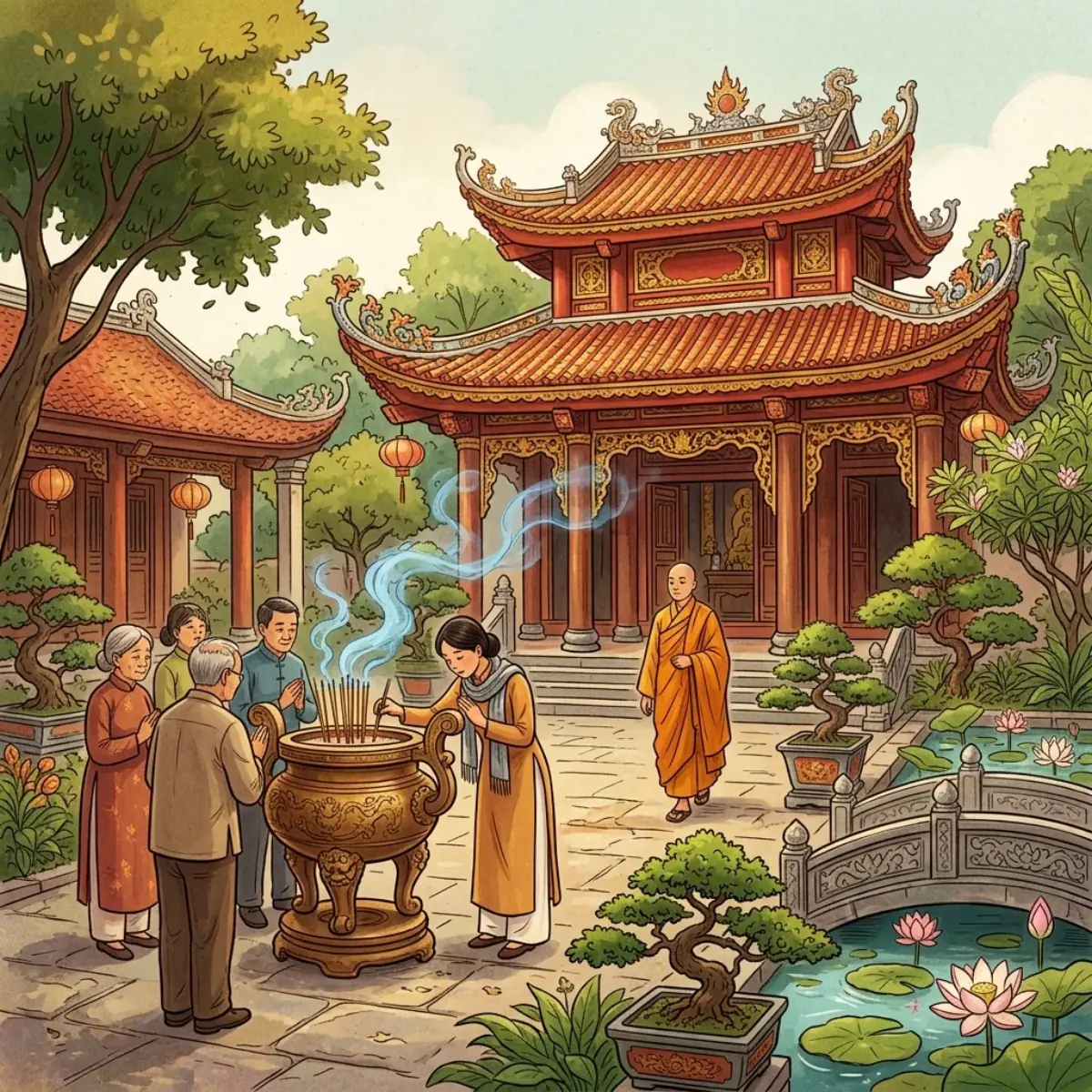
Sooner or later a Vietnamese friend, a coworker, or your girlfriend's má is going to say the magic words: "Đi chùa hông?" And you'll say yes, because of course you will, and then you'll spend the whole ride there quietly panicking about your shorts. Relax. Nobody's grading you. But a few small things will make you look like someone who's been here a while instead of someone who wandered in off the street.
Quick answer: Cover your shoulders and knees, take three sticks of nhang, put your palms together, bow, and pray silently — that's 90% of đi chùa right there.
What đi chùa actually means down here
In the South, đi chùa is less of a Big Religious Event and more of a habit. Lots of families go on mùng một (the 1st of the lunar month) and rằm (the 15th, full moon). Some go whenever something's on their mind — an exam, a sick relative, a new business. It's normal, casual, and often ends with cheap vegetarian food.
What to wear (this is the part people get wrong)
The rule is simple: mặc kín đáo — cover up. Long-ish pants or a long skirt, sleeves on your shoulders. That's it. Nobody expects áo dài unless it's a wedding or a big ceremony.
Local tip
Wear sandals you can kick off in one second. You'll be taking them on and off at every hall, and hopping around on one foot in front of a row of grandmothers is not the entrance you want.
Thắp nhang — the incense part
Down here it's nhang, not the other word you may have learned from a Hanoi textbook. Usually you take three sticks — ba cây nhang. Light them, let the flame go out (wave your hand, don't blow with your mouth), hold them between your palms at chest or forehead height, bow, then plant them in the lư hương.
Common mistake
Grabbing a giant fistful of incense to be extra respectful. It's not extra respectful, it's just smoke. Some pagodas now ask for one stick only, or none at all inside the hall. Look at what everyone else is holding and copy that.
Lạy, vái, xá — the body language
Three different moves, and people mix them up constantly:
Nobody will correct you if you just chắp tay and bow quietly. Honestly that's what half the young people do.
What you bring: cúng and công đức
At a Buddhist chùa, offerings are vegetarian. Fruit, flowers, incense, sometimes sticky rice or sweets. No meat, no beer. (At a miếu or a đình the rules are looser, but that's a different trip.)
Good to know
Tùy tâm is the phrase you'll hear over and over — "as your heart decides." Twenty or fifty ngàn in the box is completely normal. Nobody is watching the amount.
What to actually say
Praying is silent. You stand there, hold the incense, and talk in your head. But out loud, around the pagoda, here's the useful stuff — including how to talk to a monk or a nun. Call yourself con and call them thầy (monk) or sư cô (nun), no matter how old you are.
Xin xăm — shaking the fortune sticks
Very Southern, very fun. You kneel, hold the bamboo tube, shake it until one stick falls out, then take the numbered stick to get your paper fortune read.
Tết at the pagoda
Đi chùa đầu năm is a whole thing. Midnight after giao thừa, or on mùng một, half of Saigon is at a pagoda praying for a calm year. Expect crowds, expect smoke, expect to park two streets away.
Southern vs Northern words at the pagoda
This is one topic where the vocabulary really does split. Use the left column in Saigon.
| Meaning | Southern (Saigon) | Northern (Hanoi) |
|---|---|---|
| incense | nhang | hương |
| flowers | bông | hoa |
| incense burner | lư hương | bát hương |
| go to the pagoda | đi chùa | đi lễ chùa |
| donation box | thùng công đức | hòm công đức |
| fortune sticks | xin xăm | rút thẻ |
| burn joss paper | đốt giấy tiền vàng bạc | đốt vàng mã |
Local tip
Say nhang and bông at a flower stall outside a Saigon pagoda and the auntie will treat you like a regular. Say hương and she'll understand you fine — but she'll clock you as a tourist in about half a second. Little words like this are exactly why people learn Southern Vietnamese online with Southern teachers instead of generic courses.
Quick "don't do that" list
Try it yourself
- Ask your friend: "Sunday, wanna go to the pagoda with me?"
- Ask a vendor for three sticks of incense.
- Tell a friend: "Don't wear shorts, okay."
- Ask a monk politely: "Excuse me, is there vegetarian food here?"
- Say: "I'm praying my parents stay healthy."
Answers: 1. Chủ nhật đi chùa với tui hông? · 2. Cho tui xin ba cây nhang. · 3. Đừng mặc quần đùi nghen. · 4. Dạ thầy ơi, ở đây có cơm chay hông thầy? · 5. Con cầu cho ba má con mạnh khỏe.
Frequently asked questions
Do I have to be Buddhist to go to a chùa?
Not at all. Nobody will ask. Just be quiet, cover up, and don't wander behind ropes. Plenty of Vietnamese people who go on rằm would not describe themselves as devout either.
How many incense sticks — one or three?
Three is the classic. But more and more Saigon pagodas ask for one stick, or have a single communal burner outside, to cut down smoke. Just do what the sign or the person in front of you does.
Can I take photos?
Outside, yes. Inside the chánh điện, assume no unless you see others doing it. And never point a camera at someone mid-lạy — that's someone's private moment, not content.
Is it rude if I don't kneel?
No. Chắp tay and a standing bow is perfectly acceptable, especially for guests. Doing something sincerely beats doing the full lạy awkwardly.
What's the difference between chùa, miếu and đình?
Chùa is Buddhist — monks, nuns, vegetarian offerings. Miếu and đình are folk shrines and communal houses for local deities and village spirits, where meat offerings and joss paper are common. If someone says đi chùa, expect the vegetarian version.
What should I bring on my first visit?
Honestly? Nothing. A little cash for the thùng công đức and that's it. If you want to bring something, a bunch of bông and a few pieces of fruit is always right.
Learn Southern Vietnamese online with people who actually speak it
SVFF is the school built entirely around the Southern (Saigon) dialect — native teachers from Ho Chi Minh City, since 2014.
- Listen to the SVFF podcast — real Southern Vietnamese, free.
- Book a free trial lesson — 30 minutes 1-on-1 with a native Saigon teacher.
- Browse our courses — structured A0–C1, all Southern dialect.
- Go Unlimited — every course and e-textbook, one payment.








0 Comments
Log in to leave a comment.