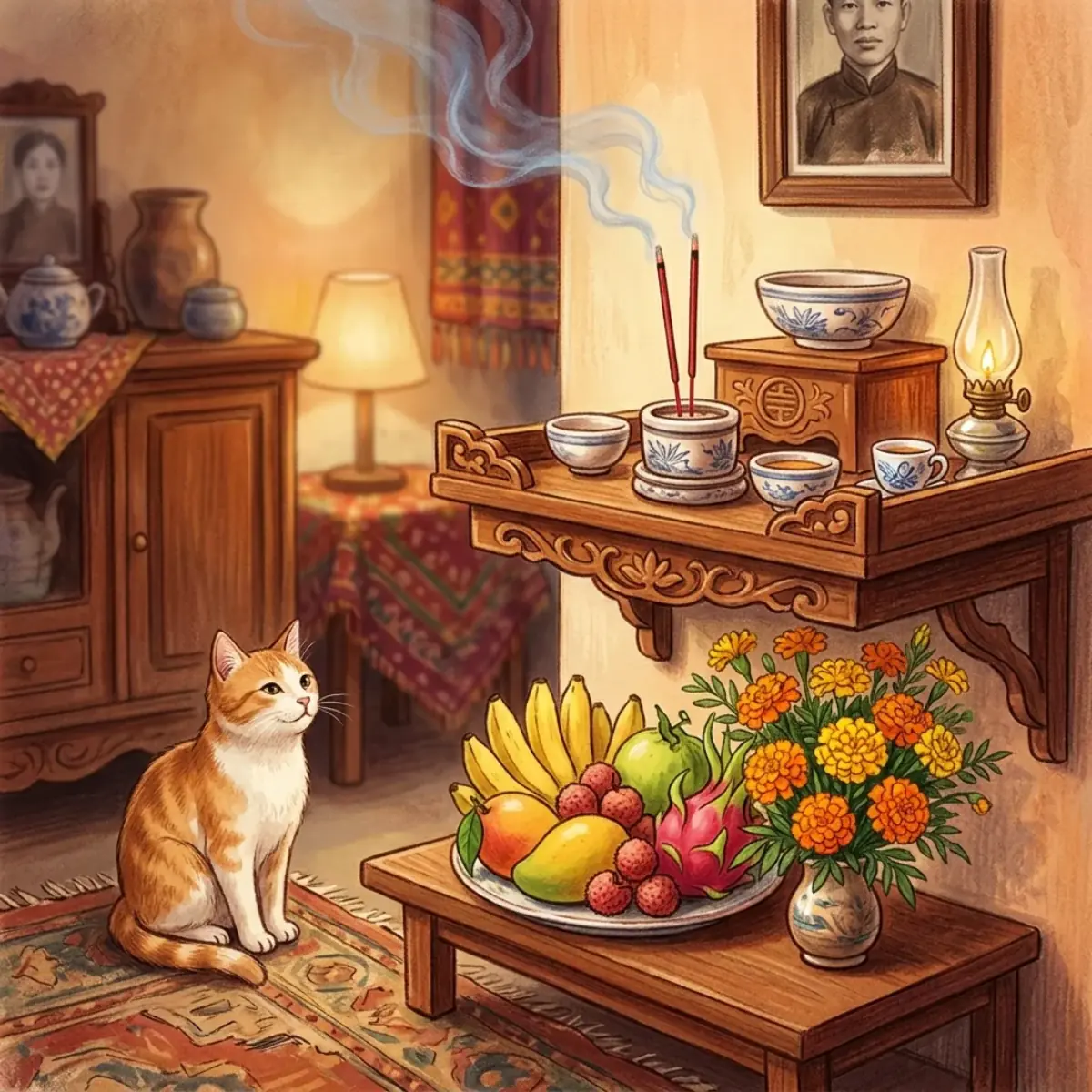
Bạn tui là kỹ sư, học đại học ở Úc, xài ba cái máy móc mắc tiền quá trời. Vậy mà tối đó nó giựt cái điện thoại khỏi tay tui: "Đừng có huýt sáo, khuya rồi!" Đó — người Sài Gòn là vậy. Hiện đại thiệt, mà mấy chuyện kiêng cữ thì vẫn giữ nguyên.
Quick answer: In Saigon almost everything runs on two little words — hên (lucky) and xui (unlucky) — and the golden rule is simple: don't say bad words out loud, especially at the start of something.
Hên and xui: the two words the whole system runs on
Before any superstition makes sense, you need these. Southerners say hên and xui constantly — at work, in traffic, over a card game, at the market.
That last one is gold. Nói gở means saying something that invites bad luck — like joking that a plane might crash while you're standing in the airport. And phủi phui is what an aunt will fire at you, half laughing, half serious.
Local tip
If you accidentally say something dark, just laugh and add "Nói chơi thôi nghen, phủi phui!" ("Just kidding — take it back!"). Everyone relaxes immediately.
The "first" rule: đầu năm, đầu tháng, đầu ngày
This is the single biggest idea in Vietnamese superstition. Whatever happens first sets the tone for the whole period. First customer of the day, first visitor of the year, first meal of the month.
Squid is out because mực also means ink — black, murky, unclear. Duck is out because ducks scatter everywhere. Bananas are out in the South because chuối sounds like sliding downward. Nobody can prove any of it and nobody cares.
Good to know
Watch a Saigon shopkeeper burn a scrap of paper on the sidewalk after a customer walks out without buying. That's đốt phong long — burning off the "heavy aura" so the next customer actually buys. Totally normal, do not stare.
Things you just don't say out loud
Vietnamese has a soft belief that words are a bit magnetic. Say the bad thing, attract the bad thing. So people dodge.
Common mistake
Foreigners meet a friend's baby and go straight to "Trời ơi, em bé dễ thương quá!" — sweet, but the grandma will flinch. Praising a child too openly is thought to draw the attention of spirits. Put trộm vía in front and you'll get a huge smile instead: "Trộm vía em bé dễ thương quá!"
The house rules everybody actually enforces
Ask any Saigon family and you'll get the same list. Learners who learn Southern Vietnamese online with a real teacher usually hear these long before they hit a textbook, because they come up constantly in normal chit-chat.
Numbers: 13 is imported, 4 is the real enemy
Everyone knows 13 is "unlucky in the West", and hotels here will play along. But locally? Số 4 is the one people actually dodge, because it echoes the word for dying. Meanwhile 6 and 8 carry fortune and prosperity, so a licence plate ending in 68 costs real money.
The nút thing comes from card games: nine is the best hand, ten is a bust. So people add up licence-plate digits the way other countries read horoscopes.
North vs South: where the beliefs actually differ
| Thing | Southern (Saigon) | Northern (Hanoi) |
|---|---|---|
| Everyday luck words | hên / xui, hên xui | may / đen, đen đủi |
| Tết fruit tray | mãng cầu, dừa, đu đủ, xoài — a wordplay wish for "enough to spend"; bananas avoided | a bunch of chuối is the essential base of the tray |
| Clearing bad luck at a shop | đốt phong long — burn paper on the sidewalk | đốt vía — same idea, different name |
| Ghost month (7th lunar) | big street offerings, kids scramble for the money: giật cô hồn | the emphasis sits more on the Vu Lan filial-piety side |
| Food to avoid at month's start | squid, duck, banana | squid and duck too, plus a separate "eat it at month's end to break the bad luck" habit |
Chúc gì ngày Tết — what to say, and what to absolutely not
At Tết, words are believed to be extra sticky. So you wish, you don't diagnose.
Now the danger zone. At Tết, don't tell someone they look thinner, don't ask seriously why they're still single, don't bring up anyone who passed away, don't talk about losing money, and please don't announce "hết tiền rồi" on day one. Also skip clocks and knives as gifts — a clock counts you down, a blade cuts the relationship.
Local tip
If someone invites you to xông đất — be the first person to enter their home in the new year — that's a real compliment. It means they think you carry good energy. Show up cheerful, say something nice, don't complain about traffic.
Try it yourself
- Your friend jokes that his motorbike might get stolen. Tell him to stop jinxing it.
- Compliment a friend's baby the safe way.
- It's late and your roommate is whistling. Stop him, Saigon-style.
- Wish an older shop owner a prosperous new year.
- Comfort someone who just broke a glass.
Answers: 1. Nói gở hoài, phủi phui cái miệng! · 2. Trộm vía em bé dễ thương quá trời! · 3. Khuya rồi, đừng huýt sáo nghen! · 4. Chúc cô năm mới làm ăn phát tài, buôn may bán đắt! · 5. Hông sao đâu, của đi thay người mà!
Frequently asked questions
Do young people in Saigon really believe this stuff?
"Believe" is a strong word. Most will tell you "có kiêng có lành" — avoid it and you'll be fine. They'll laugh at the belief and still refuse squid on the first of the month.
Is it rude if I break one of these rules by accident?
Not at all. Nobody expects a foreigner to know. Say "Dạ con hông biết, xin lỗi nha" and someone will happily explain the rule for the next ten minutes.
Is 13 unlucky in Vietnam?
Mildly, and mostly borrowed from abroad. The number locals actually avoid is 4, and to a lesser extent the ages 49 and 53.
Can I say xui about myself?
Yes, constantly. "Bữa nay tui xui quá trời" is one of the most useful sentences in Saigon. Just don't aim it at someone else's business or health.
What's the safest all-purpose Tết wish?
"Chúc năm mới mạnh giỏi, gặp nhiều may mắn!" — health plus luck, works for any age, any relationship, zero risk.
Learn Southern Vietnamese online with people who actually speak it
SVFF is the school built entirely around the Southern (Saigon) dialect — native teachers from Ho Chi Minh City, since 2014.
- Listen to the SVFF podcast — real Southern Vietnamese, free.
- Book a free trial lesson — 30 minutes 1-on-1 with a native Saigon teacher.
- Browse our courses — structured A0–C1, all Southern dialect.
- Go Unlimited — every course and e-textbook, one payment.








0 Comments
Log in to leave a comment.