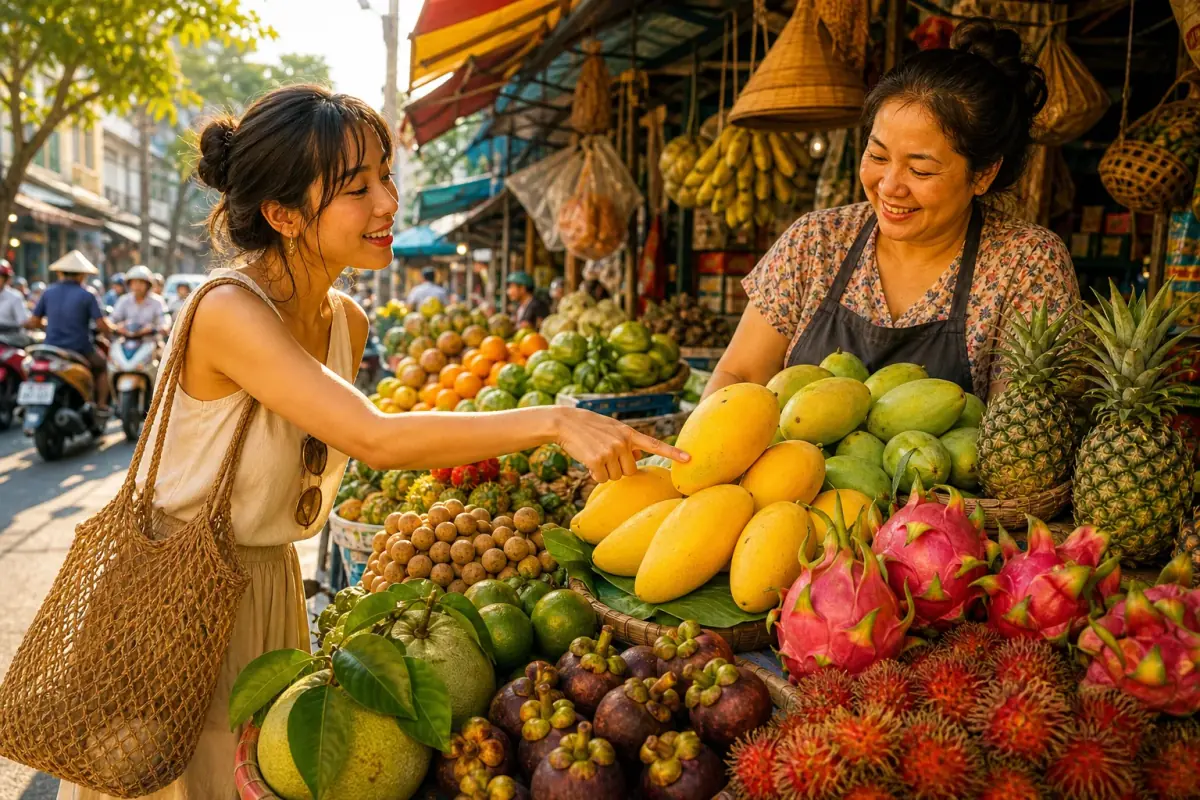
Picture this. You and a Saigon friend are squished onto plastic stools, iced coffee sweating in the heat, and they lean over and go: cái quán mà tụi mình ăn hôm bữa dẹp rồi — "that shop we ate at the other day closed down." You catch every word except one little guy sitting in the middle: mà. And once you notice it, you start hearing it everywhere.
Quick answer: In everyday Saigon speech, mà is the glue that turns "a thing" into "the thing that…" — it links a noun to whatever you're saying about it, exactly like English "that / which / who."
English has a whole toolkit for this: that, which, who, whom, where. Southern Vietnamese mostly just reaches for one friendly little word and moves on with its day. Let me show you.
The basic move: noun + mà + the rest
You take a thing. You want to point at which one. You bolt on mà and then describe it. That's the whole recipe.
See the pattern? Người mà…, cái mà…, quán mà…, ly nước mà…. Thing first, then mà, then you spill the details.
Local tip
Notice cái is doing heavy lifting. On its own it just means "thing." Slap mà after it — cái mà… — and it becomes "the thing that…". Saigon folks use cái mà constantly when they can't be bothered to name the exact object: đưa tui cái mà hồi nãy đó — "hand me that whatchamacallit from earlier."
Here's the secret: half the time you can just… drop it
This is the part that trips people up. In relaxed Saigon speech, mà is often optional. Native speakers leave it out all the time and the sentence still lands.
Both are perfect. So when do people bother saying mà? Two situations:
1. When you want to pause and point. Mà gives your brain a half-second to load the rest. It's the spoken equivalent of "you know, the one that—". Great for when you're describing something fuzzy.
2. When leaving it out would be confusing. If the sentence gets long or tangled, mà tells the listener "hold on, more info about that noun is coming." It keeps things from smushing together.
Good to know
Rule of thumb: short and obvious? Drop mà. Long, fuzzy, or "let me think of the word"? Keep mà. Nobody will ever mark you wrong for including it, so when in doubt, say it.
Mà with the pointing words: đó, kia, này
Saigon loves to open with mà and close with a little pointer — đó (that one), kia (over there), này (this one). It's like putting quotation fingers around exactly the thing you mean.
Hear the rhythm? Cái mà… đó. Open with the glue, close with the point. If you can nail that little sandwich, you'll sound wildly natural.
Careful — mà has an evil twin
Here's the thing that confuses learners, so let me clear it up over this iced coffee. The mà in this post means "that/which." But there's another mà that means "but" or "yet." Same spelling, totally different job.
Common mistake
Don't panic when you see two mà meanings — the position tells you which is which. Right after a noun (người mà, cái mà, quán mà)? It's "that/which." Sitting between two ideas or two adjectives (rẻ mà đẹp)? It's "but." You'll feel the difference fast once you listen for it.
Does the South say it differently?
This is one spot where you'll actually hear a regional flavor. The word mà itself is used all over Vietnam for this — but the words around it change. Saigon reaches for its own everyday vocabulary, and that's what makes a sentence sound Southern.
| Idea | Southern (Saigon) | Northern (Hanoi) |
|---|---|---|
| the drink I ordered | ly nước mà tui kêu | cốc nước mà tớ gọi |
| the bowl you asked for | tô mà em kêu | bát mà em gọi |
| the thing I told you | cái mà tui nói đó | cái mà tớ nói ấy |
| the person I like | người mà tui thích | người mà tớ thích |
The grammar with mà is basically identical. What flips is tui vs tớ, kêu vs gọi, ly/tô vs cốc/bát, and that trailing đó instead of ấy. Learn Southern Vietnamese online with Saigon speakers and this vocabulary becomes second nature — the mà was never the hard part.
Real Saigon life, in mà form
Let me leave you with a handful of sentences that could fall out of anyone's mouth on any regular day here.
Try it yourself
- Say "the shirt I bought yesterday" using mà.
- Say "that guy who talks too loud" with an đó at the end.
- Say "the drink you ordered has no ice left" (Saigon words: ly, kêu).
- Now say sentence 1 without mà — still correct?
Answers: 1. Cái áo mà tui mua hôm qua. 2. Thằng mà nói lớn tiếng đó. 3. Ly nước mà em kêu hết đá rồi. 4. Cái áo tui mua hôm qua. — yep, perfectly natural.
Frequently asked questions
Is mà always required for "that/which"?
Nope. In casual Saigon speech it's often dropped, especially in short obvious sentences. Include it when you want a natural pause or when the sentence is long enough that it'd get confusing without it.
How do I tell the "that/which" mà from the "but" mà?
Position. Right after a noun (người mà, cái mà) it means "that/which." Between two ideas or adjectives (rẻ mà đẹp) it means "but." Once you listen for a bit, the two feel completely different.
Can I start a sentence with mà?
Not for the "that/which" meaning — that mà always sits after the noun it describes. (The "but" mà can kick off a sentence to mean "but wait…", but that's the evil twin, a different lesson.)
Do I use mà for people and things equally?
Yes. Same word for everyone and everything — người mà (person that), cái mà (thing that), quán mà (shop that), chỗ mà (place that). No he/she/which/where sorting like English. One word covers the lot.
Learn Southern Vietnamese online with people who actually speak it
SVFF is the school built entirely around the Southern (Saigon) dialect — native teachers from Ho Chi Minh City, since 2014.
- Listen to the SVFF podcast — real Southern Vietnamese, free.
- Book a free trial lesson — 30 minutes 1-on-1 with a native Saigon teacher.
- Browse our courses — structured A0–C1, all Southern dialect.
- Go Unlimited — every course and e-textbook, one payment.








0 Comments
Log in to leave a comment.