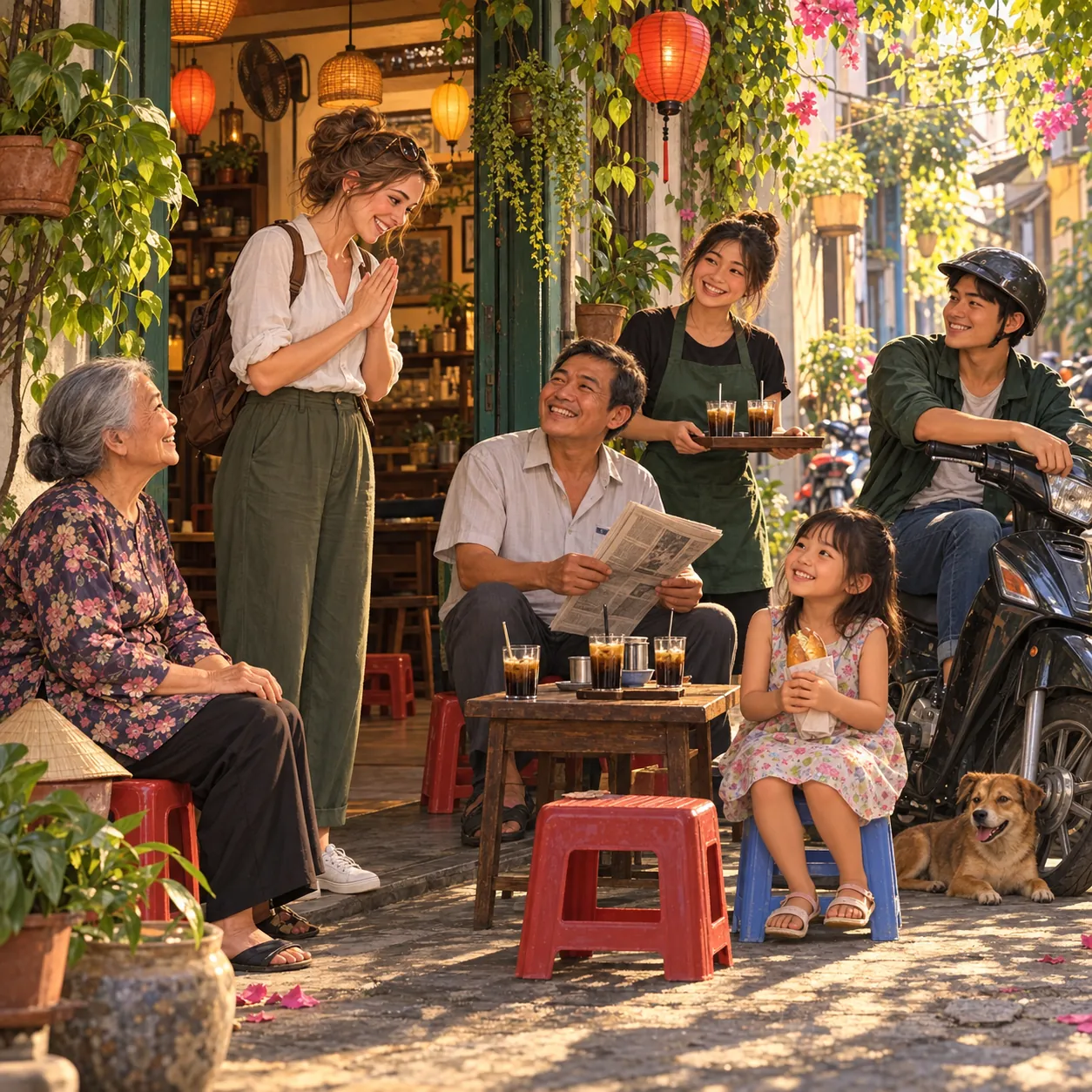
If you've been in Vietnam more than a week, you've already noticed the problem. You order a coffee. The barista smiles, says something with "anh" or "chị" or "em" in it, and now it's your turn — and you have no idea what to call yourself, much less her. The textbook said "tôi" means "I." The textbook lied to you, gently. Pronouns are the single biggest thing English speakers trip on when learning Vietnamese, and the good news is this: once the system clicks, it stays clicked. This guide is the version we wish someone had handed us on day one in Saigon.
The core mental model
Vietnamese pronouns are family terms used for everyone. There is no equivalent of English "you" or a neutral "I." You don't pick a pronoun based on who you are — you pick it based on the other person's age relative to yours and the relationship between you.
That means the same human being uses different words for "I" depending on who they're talking to. A 30-year-old woman is "chị" to a 22-year-old, "em" to a 45-year-old, and "cháu" to her grandfather — all in the same afternoon. She isn't being inconsistent. She's being polite. The system treats every conversation as a tiny family in which someone is the older sibling, someone is the younger sibling, and the words follow.
Once you accept that, two things become obvious. First, you can't memorize a single "I" word and use it everywhere. Second, the rules aren't arbitrary — they're a built-in respect system that English has to do clumsily with "sir" and "ma'am."
The everyday 7 (okay, 10) pronouns you actually need
Vietnamese has 30+ pronouns if you count regional, archaic, and intimate forms. In daily Saigon life, you'll get by beautifully with these:
| Pronoun | Northern IPA | Southern IPA | Rough English | When to use | Common mistake |
|---|---|---|---|---|---|
| tôi | /toj˧˧/ | /tojː˧˧/ | "I" (formal/neutral) | Writing, business, strangers you want distance from | Using it with friends — sounds cold |
| mình | /mïŋ˨˩/ | /mɨn˨˩/ | "I/me" (casual, friends) | Among peers, online, social media | Using with elders — too informal |
| em | /ɛm˧˧/ | /ɛm˧˧/ | "younger sibling" | Younger person, child, partner (woman), yourself when talking to elders | Calling an older woman "em" |
| anh | /aɲ˧˧/ | /an˧˧/ | "older brother" | Man older than you (up to ~15 yrs), male partner, male colleague | Using with grandfather-age men |
| chị | /ci˨˩˨/ | /ci˨˩˦/ | "older sister" | Woman older than you (up to ~15 yrs), female colleague | Using for women clearly your mom's age |
| cô | /ko˧˧/ | /ko˧˧/ | "aunt / Ms." | Woman ~your parents' age, female teachers | Using for women your own age |
| chú | /cu˦ˀ˥/ | /cu˦˥/ | "uncle / Mr." | Man ~your parents' age (very common in Saigon for any middle-aged man) | Using for grandfather-age men |
| bác | /ɓaːk˦˥/ | /ɓaːk˦˥/ | "older uncle/aunt" | Slightly older than your parents, more respectful than chú/cô | Using on a 30-year-old (ages them) |
| ông | /oŋ˧˧/ | /oŋ˧˧/ | "grandfather / sir" | Grandfather-age men, very formal "Mr." | Using on anyone under 60 |
| bà | /ɓaː˨˩/ | /ɓaː˨˩/ | "grandmother / Mrs." | Grandmother-age women, very formal "Mrs." | Using on a woman in her 40s |
How to pick the right pronoun in 3 seconds
Standing in front of a stranger, do this scan:
- Person is clearly older than you (under ~50)? → anh (man) / chị (woman). Call yourself em.
- Person is clearly younger than you? → em. Call yourself anh (if you're male) or chị (if you're female).
- Person is your parents' generation (~40s–60s)? → cô (woman) / chú (man). For a slightly more respectful register, use bác for either gender. Call yourself con or cháu.
- Person is grandparent-age (~70+)? → ông (man) / bà (woman). Call yourself cháu.
- Talking to a small child? → em (or con for very young kids). Call yourself anh/chị.
- Formal/professional setting where you want distance? → tôi for "I"; address them by title or by the pronoun matched to their visible age.
If you're truly stuck — say, the person is right at your age — split the difference and use anh or chị. Calling someone slightly older than they are is a small, harmless flattery. Calling them younger is the mistake.
Self-reference: which pronoun do you use for "I"?
This is the part English speakers forget. "I" also flips depending on who you're talking to:
- Talking to someone older than you → say em ("I, the younger sibling").
- Talking to someone younger than you → say anh (if male) or chị (if female).
- Talking to someone your parents' age → say con ("child") or cháu ("niece/nephew") — Saigon leans on con.
- Talking to someone grandparent-age → say cháu ("grandchild").
- Formal/business writing or a stranger you want to keep at arm's length → say tôi.
Yes, this means you'll refer to yourself as a different "person" five times in one day. It feels weird for about a week, then stops feeling like anything at all.
Southern-dialect specifics
Most pronouns are pan-Vietnam, but a few things shift in Saigon. If you live in the South, learn these:
- ba / má instead of bố / mẹ for "dad" / "mom." If you call your Saigon father-in-law "bố," he'll understand you, but it'll sound Northern in his living room.
- chú is used very loosely in the South for any middle-aged man — your friend's dad, the security guard, the guy fixing your motorbike. In Northern usage, "chú" is more specifically "father's younger brother." Saigon has stretched it into a general "Mr."
- anh hai, chị hai — in Southern families, the eldest sibling is called "second" (hai), not "first." There's a historical reason: under the Nguyễn dynasty, "cả" (first/eldest) was a taboo title reserved for royalty, so southerners shifted everyone down a rank. The eldest is anh hai / chị hai, the next is anh ba / chị ba, and so on.
- cô in Saigon is used widely for women from teacher-age and up, married or not. In the North, "cô" leans more specifically toward unmarried women and female teachers, with "bác gái" or "dì" preferred for older married women.
None of this is wrong-vs-right — it's just regional flavor. Want it corrected in real time by a Saigon native? Book a free 30-min trial — let a native teacher correct you in real time.
Common expat mistakes (and how to fix them)
- Calling everyone "bạn." "Bạn" literally means "friend," and yes, it's used as a pronoun — but mostly among young people in casual or online contexts. Saying "bạn" to a 50-year-old shopkeeper sounds like a customer service bot. Fix: use anh/chị/cô/chú based on age.
- Using "tôi" with everyone. Textbooks teach "tôi" because it's "neutral," but in real conversation it sounds cold or distant. Vietnamese friends will interpret your "tôi" as "I'm keeping you at arm's length." Fix: use em / anh / chị / mình instead.
- Calling an older woman "em." This is the one that gets loud reactions. Calling a woman "em" implies she's younger than you, which can read as flirtatious at best and condescending at worst. Fix: when in doubt, "chị."
- Calling a child "anh" or "chị." Kids find this confusing because they are supposed to be the "em." Fix: call kids "em" or "con."
- Calling a 30-year-old shopkeeper "bác." "Bác" is for people clearly older than your parents. Using it on someone in their 30s makes them feel old. Fix: "chị" or "anh" until proven otherwise.
Romantic and intimate pronouns
In a romantic relationship, the convention in Vietnamese is straightforward: the man is anh, the woman is em, regardless of who is actually older. A 35-year-old woman dating a 40-year-old man calls him "anh" and herself "em," obviously. A 35-year-old woman dating a 28-year-old man also calls him "anh" and herself "em" — the convention overrides the age math. In same-sex couples, partners pick anh/em or chị/em by mutual agreement.
You'll also hear:
- chàng / nàng — literary, used in poetry and song lyrics, not in everyday speech. Don't say these out loud unless you're being theatrical.
- ông xã / bà xã — informal, affectionate "husband" / "wife." Used by married couples talking about each other to friends ("ông xã tôi" = "my husband").
Workplace and business pronouns
Vietnamese offices run on the same family-pronoun system. You don't say "Mr. Nguyễn" — you say anh Nguyễn (or just "anh" once you're talking to him). Defaults:
- anh / chị for colleagues older than you or roughly your age.
- em for colleagues younger than you.
- tôi only in formal speeches, written reports, or when you want to maintain professional distance from someone difficult.
- First name + Mr./Ms. is rare in Vietnamese-internal communication. Pronoun + first name is the standard ("anh Minh", "chị Lan").
When you meet a Vietnamese client, the safest opener is "Anh / chị tên gì ạ?" — "What's your name?" with the polite particle "ạ." Match their apparent age, add "ạ" for respect, and you're in the right register before you've even exchanged business cards.
A 1-week pronoun drill
You'll learn pronouns faster from one week of pressure than from six months of Duolingo. Try this:
- Day 1–2: Order coffee and street food using only anh / chị / em. Write down what you said and who you said it to. Don't worry about being wrong — just notice when reactions feel warm vs. weird.
- Day 3–4: Ask a Vietnamese friend to roleplay 5 different ages — a 12-year-old, a 25-year-old, a 40-year-old, a 60-year-old, an 80-year-old. You self-pick the pronoun for each. They grade you.
- Day 5–6: Have one full conversation (5+ minutes) using only anh / chị / em — no "tôi" allowed. Notice how much warmer it feels.
- Day 7: Ask a native to grade your last 5 conversations. What did you call yourself? What did you call them? Where did you wobble?
If you want this corrected as it happens, our native Saigon teachers do exactly this — pause you mid-sentence, name the pronoun you should have used, and move on. 1-on-1 lessons start at $13/session, and the full A0–C1 path covers pronouns formally in A1.
Frequently asked questions
What if I genuinely can't tell their age?
Default to "anh" or "chị" and adjust if they correct you. Going slightly older is a small flattery; going younger is the rude direction. Vietnamese people are used to foreigners guessing — most will just smile and tell you their actual relational position.
Is "bạn" rude?
Not rude — just narrow. "Bạn" works among young peers, online, in classrooms, and in advertising aimed at general audiences. It does not work for people clearly older or younger than you, and it sounds odd in service contexts. Keep it for friends your age.
Do Vietnamese people care if I get it wrong?
Honestly, they're delighted you're trying and very forgiving with foreigners. The bar isn't perfection — it's effort. Most Vietnamese will gently correct you the second time you mess up, and you'll laugh about it. The one consistent exception: avoid calling adult women "em" if they're clearly older than you. That one lands harder than the others.
How does this work in same-sex relationships?
Couples pick by mutual agreement. Many same-sex couples use anh/em or chị/em with the older partner taking the senior role; others use mình + tên (name) to sidestep the gendered defaults. There's no enforced rule — it's negotiated.
What about non-binary people?
Vietnamese has no built-in non-binary pronoun. In practice, non-binary speakers often default to mình (gender-neutral "I") and ask others to use their name + a chosen pronoun. The community is still developing conventions; the safest move is to ask.
Is there a "they" pronoun?
Yes — họ means "they" (third person plural). For singular they, Vietnamese uses the same family terms: "anh ấy" (he, that older brother), "chị ấy" (she, that older sister), "em ấy" (that younger person). There's no neutral singular "they" baked in; you choose by relationship just like with second person.
Should I just use "tôi" to be safe?
Tempting, but no. "Tôi" is grammatically correct everywhere and emotionally correct almost nowhere. Using it with friends, partners, or warm acquaintances will make you sound like a tax form. Learn anh / chị / em first, keep "tôi" for paperwork.
Last updated
Last updated: May 2026.


0 Comments
Log in to leave a comment.