Back to Blog
Post Office & Shipping in Saigon: How to Send a Parcel in Southern Vietnamese
Southern Vietnamese Grammar

Post Office & Shipping in Saigon: How to Send a Parcel in Southern Vietnamese

Nobody warns you that half of living in Saigon is dealing with parcels. Something is always arriving, always being sent, always being handed over the gate by a guy in a green jacket yelling into his phone. So let's get you fluent in that little world — the post office counter, the shipping fee, the "how many days?" question, and the phone call that starts with "Alo anh ơi, em giao hàng nè!"

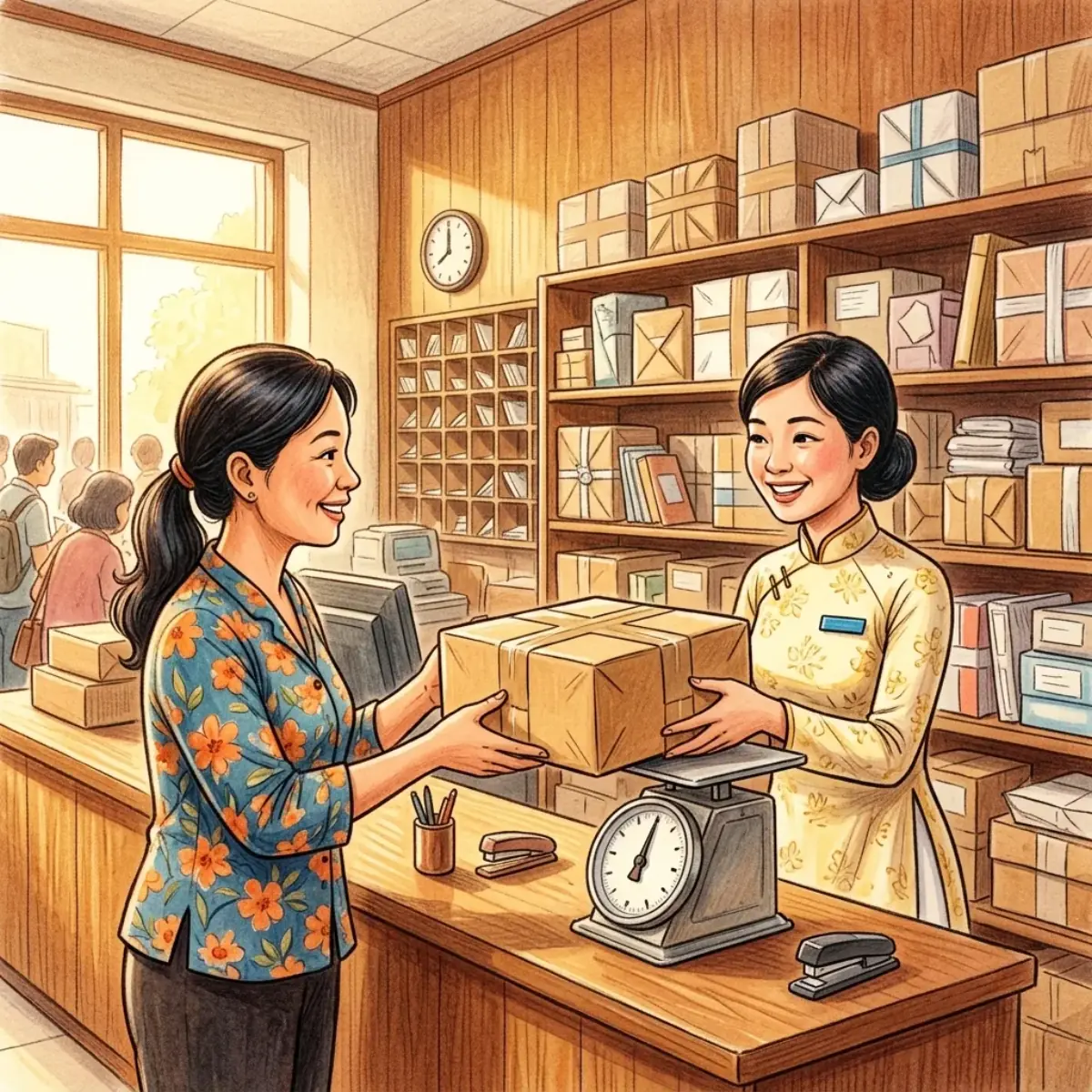
Dạ chị ơi, cho em gửi cái này đi Đà Nẵng nha chị.
Hi ma'am, I'd like to send this to Da Nang please.
Literally: yes / older-sister / hey / let / me / send / this thing / go / Da Nang / okay / older-sister.
Trong có gì hông em? Để chị cân coi.
What's inside? Let me weigh it.
Literally: inside / have / what / no / younger-sibling? / let / older-sister / weigh / see.

Quick answer: To send anything in Saigon you really only need four moves — cho em gửi cái này đi… (I want to send this to…), cân bao nhiêu? (how much does it weigh?), ship nhiêu tiền? (how much is the shipping?), and chừng nào tới? (when does it arrive?).

Three ways Saigon sends stuff

Before the words, the map. Nobody says "the postal service" here — people say which one, and each has its own vibe.

bưu điện
the post office — official, slow-ish, cheap, good for documents and going overseas
Literally: post + electric (an old word for telegraph office).
gửi ship / đặt ship
book a courier through an app — the everyday default
Literally: send ship / order ship (yes, "ship" is now a Vietnamese verb).
gửi nhà xe
send it on a long-distance bus — cheap, fast, very local
Literally: send / bus company.

Good to know

Ship got fully adopted into Southern speech. You'll hear ship giùm cái (ship it for me), tiền ship (the shipping money), shipper (the delivery guy), even đi ship as a job. Don't fight it — use it, it's what people say.

The counter dialogue, line by line

You've already opened the conversation up there. Here's how the rest of it goes, from the wrapping to the tracking number. Read it out loud once and you've basically done the errand already.

Dạ trong có đồ ăn khô với mấy bộ đồ thôi chị.
It's just some dried food and a few sets of clothes.
Literally: yes / inside / have / food / dry / with / a few / sets / clothes / only / older-sister.
Chị gói lại giùm em được hông chị?
Could you wrap it up for me?
Literally: older-sister / wrap / again / for-me / me / can / no / older-sister?
Cho em xin cái thùng nhỏ nhỏ với chút băng keo nha.
Can I get a smallish box and a bit of tape?
Literally: let / me / ask-for / classifier / box / small small / with / a bit / tape / okay.
Hàng dễ bể nha chị, chị dán giùm em cái tem hàng dễ bể.
It's fragile — could you stick the fragile sticker on it for me?
Literally: goods / easy / break / okay / older-sister, / older-sister / stick / for-me / me / classifier / sticker / goods / easy / break.
Em ghi tên với số điện thoại người nhận vô đây nha.
Write the receiver's name and phone number in here.
Literally: younger-sibling / write / name / with / number / telephone / person / receive / into / here / okay.

Two people, two words: người gửi is the sender (you), người nhận is the receiver. Every form asks for both, every shipper says both on the phone.

Cho em xin mã vận đơn để em theo dõi nha chị.
Can I have the tracking number so I can follow it?
Literally: let / me / ask-for / code / transport-order / in-order-to / me / follow / okay / older-sister.

Weight and money: the part everyone panics about

The scale comes out, a number happens, and suddenly you're being asked for money. Slow it down with these.

Cân được nhiêu vậy chị?
How much does it weigh?
Literally: weigh / get / how-much / huh / older-sister?
Một ký hai, hết bảy chục ngàn nghen em.
One point two kilos — that'll be seventy thousand.
Literally: one / kilo / two, / cost / seven / ten / thousand / okay / younger-sibling.
Hai ký rưỡi thì tiền ship nhiêu vậy chị?
If it's two and a half kilos, how much is the shipping?
Literally: two / kilo / half / then / money / ship / how-much / huh / older-sister?
Trời ơi mắc quá trời, có cách nào rẻ hơn hông chị?
Wow that's really expensive — is there a cheaper way?
Literally: heaven / oh / expensive / whole sky, / have / way / any / cheap / more / no / older-sister?
Ship nội thành có ba chục hà, rẻ chớ mắc gì.
Shipping inside the city is only thirty — that's cheap, not expensive at all.
Literally: ship / inside / city / only / three / ten / just, / cheap / rather / expensive / what.

Local tip

Southerners chop bao nhiêu down to just nhiêu in fast speech. Nhiêu tiền?, Ship nhiêu?, Cân nhiêu ký? — using the short form instantly makes you sound like you've been here a while.

"How many days?" — asking about time

Chừng nào tới vậy chị?
When will it arrive?
Literally: about / when / arrive / huh / older-sister?
Mấy ngày mới tới nơi hả chị?
How many days until it gets there?
Literally: how-many / day / only-then / arrive / place / huh / older-sister?
Ba bốn ngày là tới, đi tỉnh mà.
Three or four days and it's there — it's going to the provinces, you know.
Literally: three / four / day / then / arrive, / go / province / you-know.
Gửi nhanh thì hai ngày, mắc hơn ba chục ngàn.
Express is two days, thirty thousand more expensive.
Literally: send / fast / then / two / day, / expensive / more / three / ten / thousand.
Trong ngày là tới luôn hông chị?
Can it arrive within the day?
Literally: within / day / then / arrive / straightaway / no / older-sister?
Hoả tốc thì chừng hai tiếng là có liền.
Super-express is about two hours and you've got it.
Literally: fire / speed / then / about / two / hour / then / have / immediately.

When the shipper calls you

This is the conversation you'll have most often, and it's always the same six sentences. He is downstairs, he is in a hurry, there's a motorbike engine running. Be ready.

Alo anh ơi, em giao hàng nè, anh có ở nhà hông?
Hello sir, I've got your delivery — are you home?
Literally: hello / older-brother / hey, / me / deliver / goods / here, / older-brother / have / at / home / no?
Em để trước cửa giùm anh nha, anh đang bận chút xíu.
Just leave it at the door for me — I'm a bit busy.
Literally: you / put / in-front-of / door / for-me / me / okay, / I / am / busy / a-little-bit.
Nhà anh trong hẻm, quẹo vô hẻm hai mươi rồi hỏi tiệm tạp hoá là biết.
My place is in the alley — turn into alley 20, then ask at the grocery shop and they'll know.
Literally: house / my / inside / alley, / turn / into / alley / twenty / then / ask / shop / grocery / then / know.
Đơn này thu hộ hai trăm mốt ngàn nha anh.
This order is cash-on-delivery, two hundred and ten thousand.
Literally: order / this / collect / on-behalf / two / hundred / one / thousand / okay / older-brother.
Anh gửi em hai trăm mốt nè, khỏi thối.
Here's your two hundred and ten — keep the change.
Literally: I / give / you / two / hundred / one / here, / no-need / give-change.
Cho anh mở ra coi hàng được hông em?
Can I open it and check the goods?
Literally: let / me / open / out / look / goods / can / no / you?

Common mistake

Learners say tôi muốn gửi… at the counter. It's grammatically fine but sounds stiff and a little cold, like a customs officer. Real Saigon people say cho em gửi… or cho anh gửi… — "let me send" — with the kinship word that fits your age against theirs. Warmer, faster, and it gets you better service.

When it goes wrong

Sao mấy bữa rồi mà hàng chưa tới vậy em?
It's been several days — why hasn't the parcel arrived?
Literally: why / a-few / day / already / but / goods / not-yet / arrive / huh / you?
Em kiểm tra giùm anh coi hàng tới đâu rồi.
Please check for me where the parcel has got to.
Literally: you / check / for-me / me / see / goods / arrive / where / already.
Hàng bị bể hết rồi, giờ tính sao đây em?
The stuff arrived completely broken — what do we do now?
Literally: goods / suffer / break / all / already, / now / figure / how / here / you?
Cho anh gửi trả lại được hông em?
Can I send it back?
Literally: let / me / send / return / again / can / no / you?

Southern vs Northern words at the counter

Most of the shipping vocabulary is the same nationwide, but a handful of these words genuinely split. The Southern column is what you'll hear in Saigon; the Northern column is there so you recognise it, not so you use it.

MeaningSouthern (Saigon)Northern (Hanoi)
one kilogrammột kýmột cân
envelopebao thưphong bì
fragile / breaks easilydễ bểdễ vỡ
do it for me…giùm…hộ
when?chừng nàobao giờ
expensivemắcđắt
to arrivetớiđến
no / not (question tag)hôngkhông

Notice the sneaky one: cân. In the South it's the verb "to weigh" (chị cân giùm em), while in the North it can also be the unit itself. Say ký for the number and you're safely Southern.

Try it yourself

  1. Ask the counter lady to send this to Cần Thơ.
  2. Ask how much the shipping is.
  3. Say it's fragile and ask her to wrap it for you.
  4. Ask how many days until it arrives.
  5. Tell the shipper to leave it at the door because you're busy.

Answers: 1. Dạ chị ơi, cho em gửi cái này đi Cần Thơ nha. · 2. Tiền ship nhiêu vậy chị? · 3. Hàng dễ bể nha chị, chị gói lại giùm em nghen. · 4. Mấy ngày mới tới vậy chị? · 5. Em để trước cửa giùm anh nha, anh đang bận.

Frequently asked questions

Is ship really a Vietnamese word now?

Completely. Tiền ship, phí ship, freeship, đi ship, shipper — all normal, all everywhere, all pronounced with a Vietnamese accent. The older word cước (freight charge) still shows up on receipts, but nobody says it out loud in a shop.

What's the difference between gửi and giao?

Gửi is what you do — you hand it over and send it. Giao is what the courier does — deliver it to a door. So you gửi hàng at the counter, and later someone giao hàng to your friend.

How do I say cash on delivery?

People just say COD with English letters, or thu hộ ("collect on behalf"). On the phone it comes out as đơn này thu hộ ba trăm ngàn nha anh — this order collects three hundred thousand. And yes, that's the same hộ the table calls Northern — but thu hộ is a frozen shipping term printed on every label, so Saigon shippers say it too. Everywhere else, stick with giùm.

Do I need to be that polite at the post office?

A single dạ at the start and a nha or nghen at the end does all the work. It costs you two syllables and buys you a much friendlier counter experience.

Where can I practise these conversations for real?

Role-play beats memorising. If you learn Southern Vietnamese online with a Saigon teacher, you can run the whole parcel scene — counter, weight, price, shipper phone call — until it comes out without thinking, then use it the same afternoon.

Learn Southern Vietnamese online with people who actually speak it

SVFF is the school built entirely around the Southern (Saigon) dialect — native teachers from Ho Chi Minh City, since 2014.

SVFF Team
SVFF Team Southern Vietnamese For Foreigners
Thấy hay? Chia sẻ nha — Share this
Ready to speak Southern Vietnamese? Start with a free trial lesson, or learn at your own pace.

0 Comments







