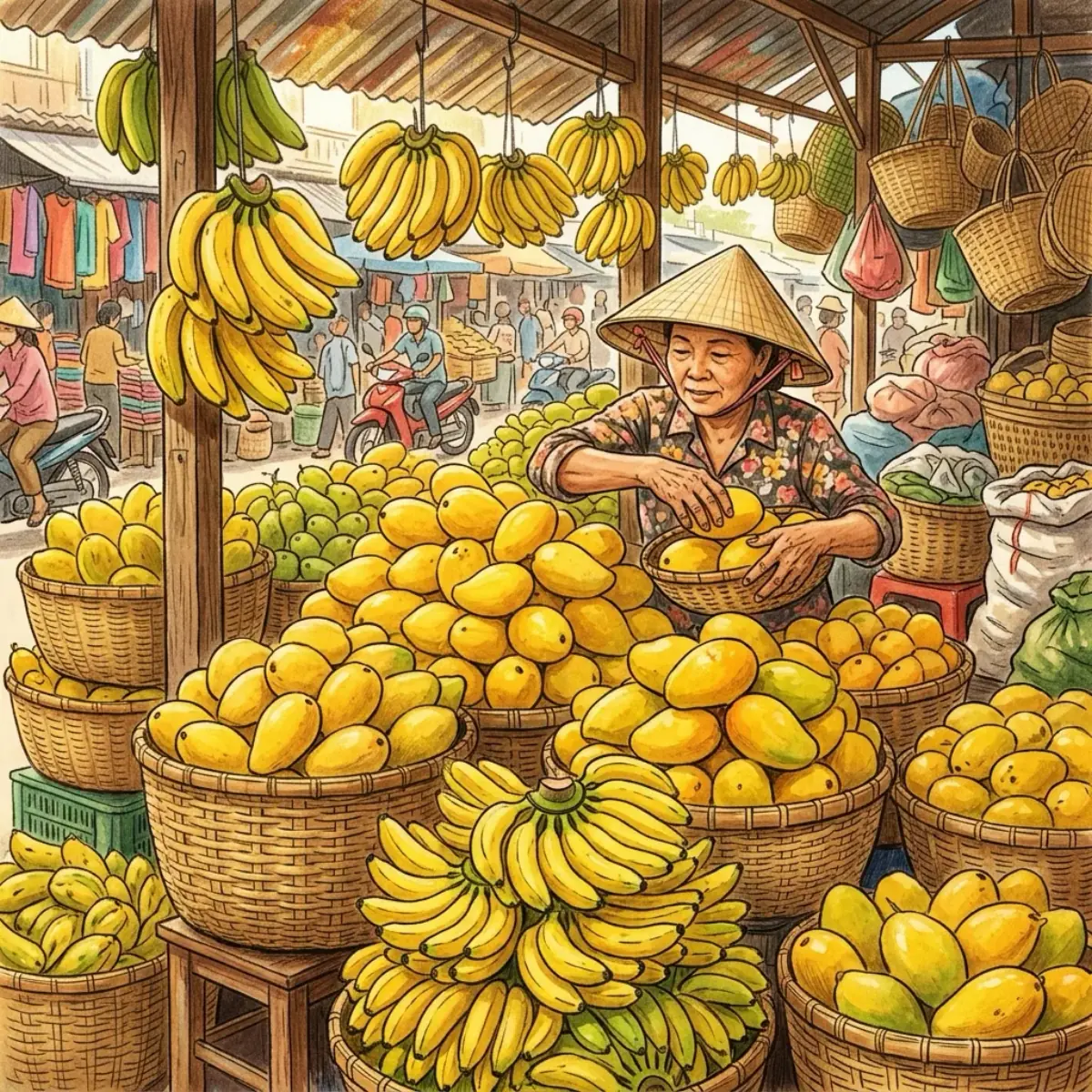
Two friends at a quán on a hot afternoon. Listen to what's missing:
Notice: ly (glass) didn't change for "two". đứa nhỏ (kid) didn't change either — a little word out front did the job. That's the whole plural system in Vietnamese, and honestly it's easier than English.
Quick answer: Vietnamese nouns never change shape — most of the time you add nothing at all, and when you do want to signal "more than one", Saigon reaches for mấy in daily talk, các for a whole group, and những for a particular set you're pointing at.
First, the good news: nouns don't move
One cat, five cats, a hundred cats — con mèo stays con mèo forever. No -s, no irregular forms, no "mouse/mice" nonsense. You just put a number in front and you're done.
The rule nobody tells you: usually you need nothing
This is the part learners overshoot. Beginners hear about những and các and start sprinkling them everywhere like fish sauce. Please don't. A bare noun in Vietnamese is already vague about number, and vague is often exactly right.
Local tip
Default to nothing. If the sentence still makes sense with a plain noun, leave it plain. You'll sound more natural than someone stuffing những into every slot.
Mấy — the most Saigon word on this page
If you only remember one thing today, remember mấy. It's the everyday, casual, no-thinking-required plural you'll hear all over the city. It means roughly "a few" or "those" — a small, known bunch. Warm, unfussy, slightly familiar.
Mấy loves to sit in front of people-words, which is very Southern: mấy đứa nhỏ (the kids), mấy bả (those ladies), mấy đứa bạn (my friends, the gang), mấy chị ở công ty (the women at the office). It's friendly, not rude — but keep it for peers and people younger than you, not for your má's guests.
It also stacks nicely with round numbers to mean "several": mấy chục ngàn (a few tens of thousands), mấy trăm (a few hundred), mấy tiếng (a few hours).
Good to know
Mấy also means "how many" in questions — Mấy giờ rồi? (What time is it?), Bao nhiêu người? Mấy người? Same word, question job. Context sorts it out instantly, so don't panic.
Những — "those particular ones"
Những picks out a specific set out of a bigger pool. It almost always wants something after it — a description, a clause, a "which ones" feeling. Standing alone with a bare noun it sounds unfinished, like saying "the ones" and then walking away.
Feel the difference? mấy ngày is "a few days, whatever". những ngày mưa is "the rainy ones, specifically". Những is a spotlight; mấy is a shrug.
Các — the whole group, a touch more polite
Các means all of them, the complete set we both know about. It's the word you use when you address a room, and it's the default in classrooms, announcements, and anywhere you want to sound respectful.
Same room, three vibes: các bạn = "everyone" (teacher voice), mấy bạn = "you lot" (friend voice), những bạn chưa đóng tiền = "the ones who haven't paid yet" (spotlight voice).
Where do they sit in the sentence?
Straight in front, before the classifier if there is one:
mấy / những / các + (classifier) + noun
So: mấy cái ghế (the chairs), những con đường nhỏ (the small streets), các em học sinh (the students). With people-words you usually skip the classifier entirely — các anh, mấy đứa, những người.
Common mistake
Don't use a plural word to do a number's job. "Three cats" is just ba con mèo — sticking những in front of it changes the meaning completely (see the next box). And skip các cà phê; you want mấy ly cà phê, because you're counting glasses, not the substance.
Good to know
That's the one flashy exception: những right before a number means "a whopping". Nó ăn những năm tô phở! — "He ate five whole bowls of phở!" It's an eyebrow-raise, not a plural.
North vs South: this is where mấy shines
| Idea | Southern (Saigon) | Northern (Hanoi) |
|---|---|---|
| the kids | mấy đứa nhỏ | bọn trẻ con |
| you lot (friends) | mấy bạn, mấy đứa | các cậu, bọn cậu |
| us / our group | tụi tui, tụi mình | bọn tớ, chúng tớ |
| those guys over there | mấy ổng, mấy bả | mấy ông ấy, các bà ấy |
| a few days now | mấy bữa nay | mấy hôm nay |
Những and các work the same nationwide — it's the casual layer that splits. In Saigon, mấy does a huge amount of daily work, and tụi beats bọn for grouping people. This is exactly the kind of thing that never shows up in a generic textbook, and one of the reasons people choose to learn Southern Vietnamese online with teachers who actually grew up talking like this.
The 3-second gut check
Ask yourself: Do I even need a plural word? Usually no — leave the noun bare. If yes: is it a casual bunch (mấy), the whole known group (các), or a specific set I'm about to describe (những)? Nine times out of ten in a coffee shop, the answer is mấy.
Try it yourself
- Ask someone to wash "the glasses" for you (casual, at home).
- Say "I bought a few bananas."
- Greet a group of older aunts and uncles politely.
- Say "I miss the afternoons in Saigon."
- Say "It's been hot these past few days."
Answers: 1. Rửa giùm tui mấy cái ly nha. 2. Tui mua mấy trái chuối. 3. Dạ, con chào các cô chú. 4. Tui nhớ những buổi chiều ở Sài Gòn. 5. Mấy bữa nay trời nóng quá trời.
Frequently asked questions
Is mấy rude?
No, just casual and familiar. Mấy bạn to your friends is perfectly warm. But when you're addressing elders, customers, or a formal room, switch to các — các cô chú, các anh chị.
Can I use những and các with things, not just people?
Yes. các món ăn (all the dishes), những con đường (those streets). Just remember các implies "all of a known set", so it's odd for a random handful — that's mấy's job.
How do I say "many"?
That's nhiều, a different word doing a different job: nhiều người (many people), nhiều xe quá (so many bikes on the road). Nhiều talks about amount; mấy and những just point at a group.
If I forget all of them, will people understand me?
Almost always yes. Bare nouns plus context carry the meaning, and leaving them out is far less noticeable than sticking những where it doesn't belong. Under-use beats over-use.
Why do I hear tụi and bọn too?
Those group people specifically, mostly with pronouns: tụi tui (us), tụi nó (them). In the South it's tụi; bọn sounds Northern to a Saigon ear.
Learn Southern Vietnamese online with people who actually speak it
SVFF is the school built entirely around the Southern (Saigon) dialect — native teachers from Ho Chi Minh City, since 2014.
- Listen to the SVFF podcast — real Southern Vietnamese, free.
- Book a free trial lesson — 30 minutes 1-on-1 with a native Saigon teacher.
- Browse our courses — structured A0–C1, all Southern dialect.
- Go Unlimited — every course and e-textbook, one payment.








0 Comments
Log in to leave a comment.