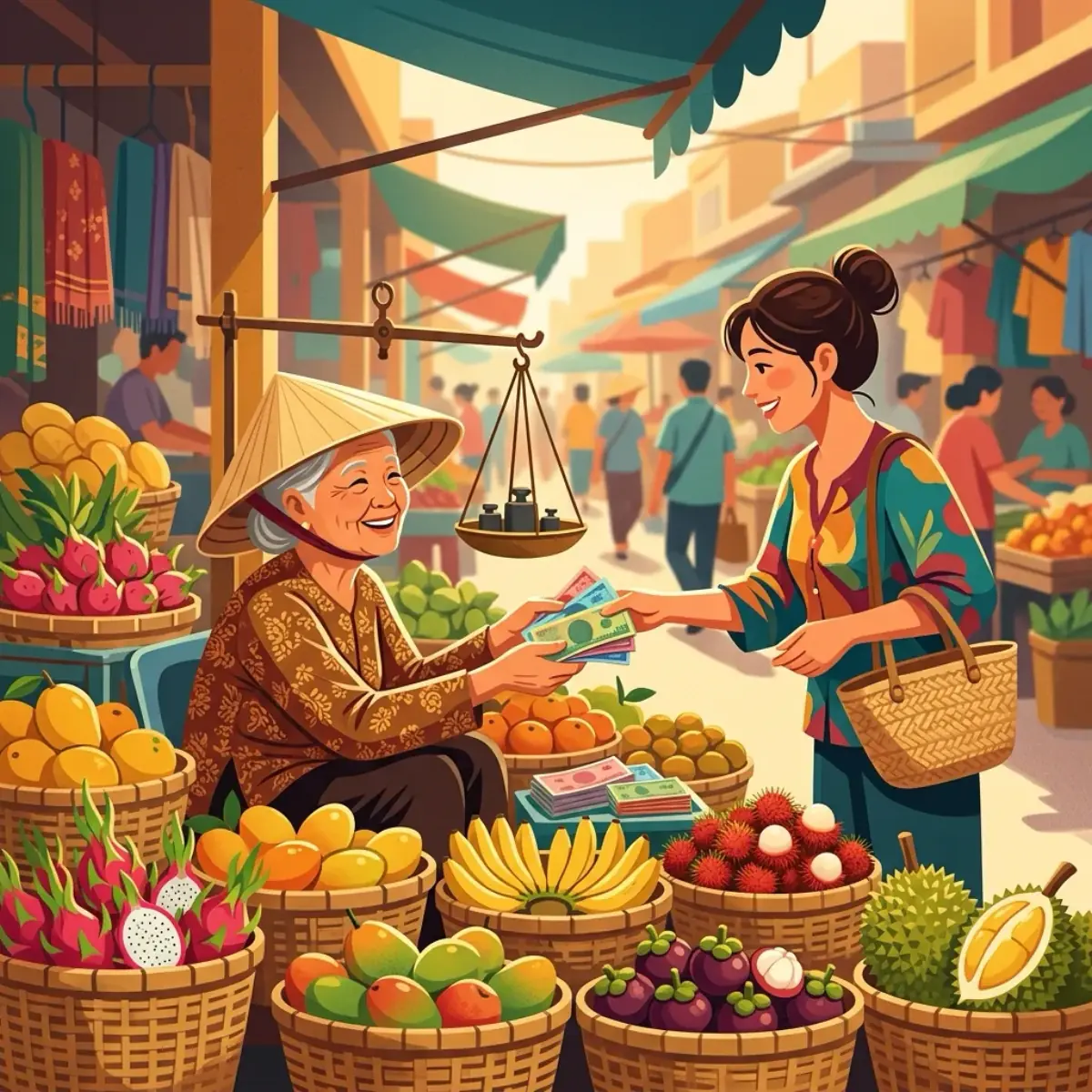
The first time I sent a friend to buy mangoes at a Saigon market, she came back defeated: the seller said a number, my friend nodded, and somehow paid double. The problem wasn't her ears — it was that Vietnamese counting has three little shape-shifters (mươi, lăm, mốt) and a money system where the same coin gets called two different names depending on which end of the country you're in. Once you learn the pattern, though, it clicks fast — and you'll be haggling in a week. This is the guide I wish she'd had before we started to learn Southern Vietnamese online together.
Quick answer: Vietnamese numbers build from ten simple digits — you say the tens with mươi and add the ones, but watch three quirks: 5 becomes lăm after a ten (25 = hai mươi lăm), 1 becomes mốt in the tens (21 = hai mươi mốt), and prices are counted in thousands of đồng, which Southerners call ngàn and Northerners call nghìn.
The building blocks: 0 to 10
Everything starts here. Memorize these ten and you're most of the way to a hundred, because Vietnamese numbers stack in a very regular way.
Notice một (1) and mười (10) look similar but the tone and vowel differ — that difference is exactly where the quirks come from.
Tens and the "mươi" pattern: 11 to 99
To build a two-digit number, say the tens digit, then mươi (the toneless "-ty"), then the ones digit. So 34 is literally "three-ty four."
Two things trip up every beginner. First, the number 10 itself uses mười (with a falling-rising tone), but when it means "-ty" inside a bigger number it flattens to mươi (no tone). Second, in fast Saigon speech people often swallow the mươi entirely, so 35 can sound like ba lăm instead of the full ba mươi lăm. Your ear will adjust.
Quirk 1 — five becomes "lăm"
After any tens word, the number 5 is never năm. It changes to lăm. This keeps it from clashing with năm, which also means "year."
Quirk 2 — one becomes "mốt"
From 21 upward, the ones-place 1 changes from một to mốt. (The lone number 11 stays mười một — the change only kicks in once you're past twenty.)
Quirk 3 — four often softens to "tư"
In the ones place, 4 can become tư instead of bốn, especially for 24, 34, and so on. Both are correct; tư just sounds smoother and is very common in the South.
Reaching 100 — and the "trăm" jump
One hundred is một trăm. When there's a zero in the tens place, Southerners slip in lẻ (or linh up North) to mark the gap.
Chục — a "batch of ten" you'll only understand at the market
Here's a word no textbook prepares you for. In Southern markets, sellers count in chục — a "unit of ten." Buy eggs, mangoes, or bananas and you'll be quoted per chục, not per piece.
The twist: in parts of the Mekong Delta, a chục can generously mean 12, 14, even 16, depending on the item and the town. If you're not sure, just ask.
Local tip
Use trái as the counter for round fruits in the South (Northerners say quả). "Two mangoes" is hai trái xoài. Pointing and saying trái này ("this one") plus a number will get you through almost any fruit stall.
Money: đồng, and the ngàn / nghìn split
Vietnam's currency is the đồng. Because prices run large, everyday amounts are counted in thousands. And this is the single most useful North–South difference for a traveler: Southerners say ngàn for "thousand," Northerners say nghìn. A bowl of hủ tiếu for 40,000 đồng is spoken as bốn chục ngàn or bốn mươi ngàn in Saigon.
Notice Southerners often drop ngàn entirely when the context is obvious — a seller may just say bốn chục ("forty") and everyone knows it means 40,000. For bigger sums, use triệu (million): rent might be năm triệu, five million.
| Meaning | Southern (Saigon) | Northern (Hanoi) |
|---|---|---|
| thousand (money) | ngàn | nghìn |
| 105 (the "zero" filler) | một trăm lẻ năm | một trăm linh năm |
| a round fruit (counter) | trái | quả |
| glass / cup | ly | cốc |
| bowl | tô | bát |
| a "yes / okay" softener | nha / nghen | nhé |
Haggling like a local
At markets (not restaurants or shops with price tags), a little back-and-forth is normal and friendly. Keep it light and smiling. Two phrases carry most of the work: mắc quá (too expensive) and bớt chút (lower it a bit).
Common mistake
Don't confuse mắc (Southern for "expensive") with đắt (the Northern word). In the South, mắc is what you'll hear and say — using it instantly signals you're tuned into Saigon speech. Also: haggle only where there are no price tags. Trying to bargain in a café or a supermarket just feels awkward.
Local tip
When you agree on a price, seal it warmly: Dạ, chốt nha! ("Okay, deal!"). Starting with dạ and ending with nha makes you sound polite and local, and sellers will often round the price down a touch just because you were friendly.
Try it yourself
- Say these three numbers out loud in Vietnamese: 25, 41, 84.
- You're at a fruit stall. Ask for one chục of mangoes, then ask how many pieces that is.
- A seller quotes 50,000 đồng. Say it's too expensive and ask them to lower it a bit.
Answers: 1) hai mươi lăm, bốn mươi mốt, tám mươi tư. 2) Cho tui một chục xoài nha. Một chục là mấy trái vậy chị? 3) Năm chục mắc quá, bớt chút được hông chị?
Frequently asked questions
Why do Southerners say "ngàn" but I learned "nghìn"?
Both mean "thousand" and both are correct standard Vietnamese. Nghìn is the Northern/Hanoi form taught in many textbooks; ngàn is the Southern form you'll hear everywhere in Ho Chi Minh City and the Mekong Delta. If you're learning for the South, use ngàn.
When exactly does 5 turn into "lăm" and 1 into "mốt"?
Lăm replaces năm whenever 5 sits in the ones place after a tens word — 15, 25, 35, all the way up. Mốt replaces một for the ones-place 1 starting at 21 (so 21, 31, 41…), but 11 stays mười một.
Is haggling expected everywhere in Vietnam?
No — only at traditional markets, street stalls, and some souvenir shops without fixed prices. Restaurants, cafés, convenience stores, and malls have set prices, and bargaining there isn't done. A polite bớt chút được hông? at a market is friendly; the same at a café would just be confusing.
Learn Southern Vietnamese online with people who actually speak it
SVFF is the school built entirely around the Southern (Saigon) dialect — native teachers from Ho Chi Minh City, since 2014.
- Listen to the SVFF podcast — real Southern Vietnamese, free.
- Book a free trial lesson — 30 minutes 1-on-1 with a native Saigon teacher.
- Browse our courses — structured A0–C1, all Southern dialect.
- Go Unlimited — every course and e-textbook, one payment.








0 Comments
Log in to leave a comment.