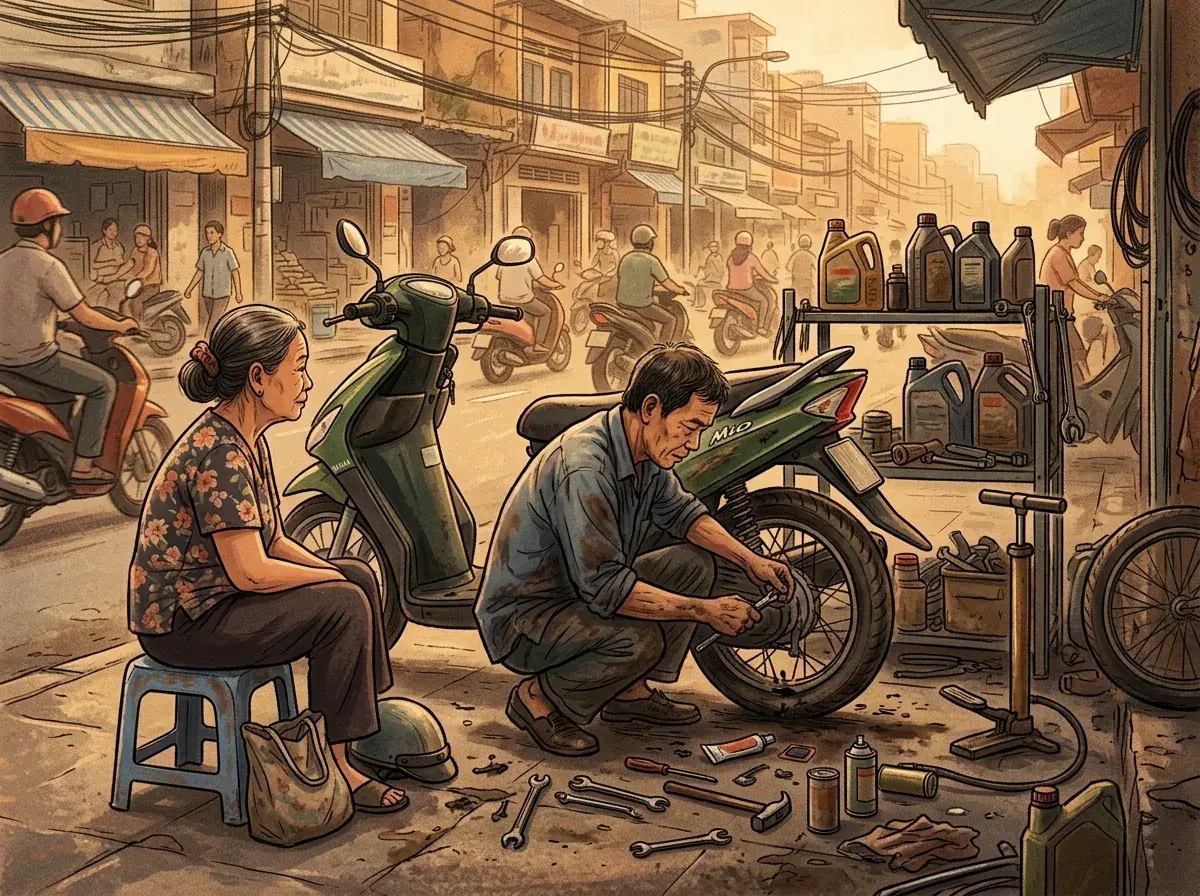
In Saigon, your motorbike is basically a family member. It carries you, your groceries, your kid, a 2-metre ladder, and sometimes a live chicken. And like any family member, it will betray you at the worst possible moment — usually in the rain, usually far from home. So let's learn the Vietnamese you actually need when that happens.
Quick answer: If you memorise only three Saigon bike phrases, make them đổ đầy bình nha (fill it up), xe con bị xẹp bánh (I've got a flat), and hết nhiêu vậy chú? (how much is it, sir?) — those three will get you home.
First, the parts of the bike you'll actually name
You don't need mechanic vocabulary. You need pointing vocabulary. Here's the cheat-sheet — the words you'll say while jabbing your finger at something greasy.
At the gas station: đổ xăng
The verb is đổ — literally "to pour". You đổ xăng, you don't "put gas". And the place is cây xăng, literally "gasoline cây" — cây being the classifier Vietnamese sticks in front of tall, upright things, the same one in cây cột (pole) and cây đèn (lamp post). The pump stands up, so it gets cây.
In Saigon you basically say one of two things: an amount in ngàn, or just đầy bình — full tank.
Local tip
Before the attendant starts pumping, everyone says anh bấm về 0 giùm em nha — "reset it to zero for me". It's not rude, it's routine. Locals say it, grandmas say it, everyone says it. Say it with a smile and you sound like you've lived here a while.
The flat tire: xẹp bánh and vá xe
Xẹp means deflated, gone soft. Vá means to patch — the same word you'd use for patching a pair of pants. And the roadside patch guy is a beautiful Saigon institution: a plastic stool, an air pump, a bucket of water, and a hand-written sign that says VÁ XE.
Good to know
Dắt xe is one of those verbs nobody teaches you and everybody uses. It means walking beside your bike, pushing it. You dắt xe out of a parking lot, and you dắt bộ sadly down the road when the tire dies. Dắt is also what you do with a small child or a dog — you lead it by the hand. Same energy.
Roadside dialogue: one nail, one afternoon
Here's how it actually goes. You've pulled over, the back wheel is flat, and there's a guy under a tarp with a pump. Read it out loud — this is the exact rhythm of the conversation.
When the bike just dies: hư and chết máy
Hư is the Southern word for broken. Your bike is hư, your fridge is hư, your phone charger is hư. And chết máy — "the engine died" — is exactly what it sounds like.
Common mistake
Learners love to say xe tôi không làm việc — a word-for-word "my bike doesn't work". Nobody says that. Objects in Vietnamese don't "work"; they're either hư (broken) or they chạy được / chạy hông được (can / can't run). So: Xe tui chạy hông được. Clean and correct.
Oil changes and the friendly nag: thay nhớt
Engine oil is nhớt in the South, and every mechanic in Saigon will tell you it's time to change it. Sometimes they're right.
Talking money without sweating
Roadside repair prices are usually honest and usually small. But you should still be able to ask before, not after.
Southern vs Northern bike words
This is one topic where the two dialects really do use different nouns — not just different accents. Say the Northern word in a Saigon alley and you'll be understood, but you'll sound like you learned from a textbook printed in Hanoi.
| Meaning | Southern (Saigon) | Northern (Hanoi) |
|---|---|---|
| tire | vỏ xe | lốp xe |
| inner tube | ruột xe | săm xe |
| brake | thắng | phanh |
| engine oil | nhớt | dầu máy |
| broken | hư | hỏng |
| flat tire | xẹp bánh | xịt lốp |
| mirror | kiếng chiếu hậu | gương chiếu hậu |
| chain | dây sên | xích |
Local tip
The mechanic is almost always older than you, so address him as chú (uncle) or anh (older brother) and call yourself con or em. Adding giùm con — "do it for me" — to any request turns a demand into a favour, and Saigon runs on favours.
Try it yourself
- Tell the gas attendant to fill the tank with 95: ________
- Say your back tire is flat: ________
- Ask if there's a repair shop nearby: ________
- Ask how much it costs: ________
- Ask him to change the oil for you too: ________
- Say your bike broke down in the middle of the road: ________
Answers: 1. Cho em đầy bình 95 nha anh. · 2. Xe con bị xẹp bánh sau rồi. · 3. Gần đây có tiệm sửa xe hông chú? · 4. Hết nhiêu vậy chú? · 5. Chú thay nhớt giùm con luôn nha. · 6. Xe tui hư, chết máy giữa đường luôn.
Frequently asked questions
Is xẹp lốp wrong in Saigon?
Not wrong, just not local. Saigon people say xẹp bánh or bể bánh, and they call the tire vỏ xe rather than lốp. Everyone will understand you either way — but if you want to sound like you live here, go with xẹp bánh.
What do I say if I don't know what's wrong with the bike?
Honestly, this is the most useful line of all: Con hông biết bị gì, chú coi giùm con với. — "I don't know what's wrong, please take a look for me." Mechanics prefer this to a wrong guess.
How do I ask them to just pump the tires, not repair anything?
Say Chú bơm hai bánh giùm con nha — "pump both tires for me". It's usually free or a few thousand đồng, and it's a nice low-stakes way to practise.
Why do people say con to a mechanic?
Because Vietnamese pronouns follow age, not job. If the man looks your parents' age you call him chú and call yourself con — the same words you'd use with a family friend. It's warm, it's normal, and it instantly makes the interaction friendlier.
Is this vocabulary worth learning if I use Grab everywhere?
Yes — because you'll still overhear it constantly, and because "my bike is broken" is one of the highest-value sentences in daily Saigon life. It's also a great confidence builder: short sentences, real stakes, instant feedback. That's why we teach it early when students learn Southern Vietnamese online with us.
Learn Southern Vietnamese online with people who actually speak it
SVFF is the school built entirely around the Southern (Saigon) dialect — native teachers from Ho Chi Minh City, since 2014.
- Listen to the SVFF podcast — real Southern Vietnamese, free.
- Book a free trial lesson — 30 minutes 1-on-1 with a native Saigon teacher.
- Browse our courses — structured A0–C1, all Southern dialect.
- Go Unlimited — every course and e-textbook, one payment.








0 Comments
Log in to leave a comment.