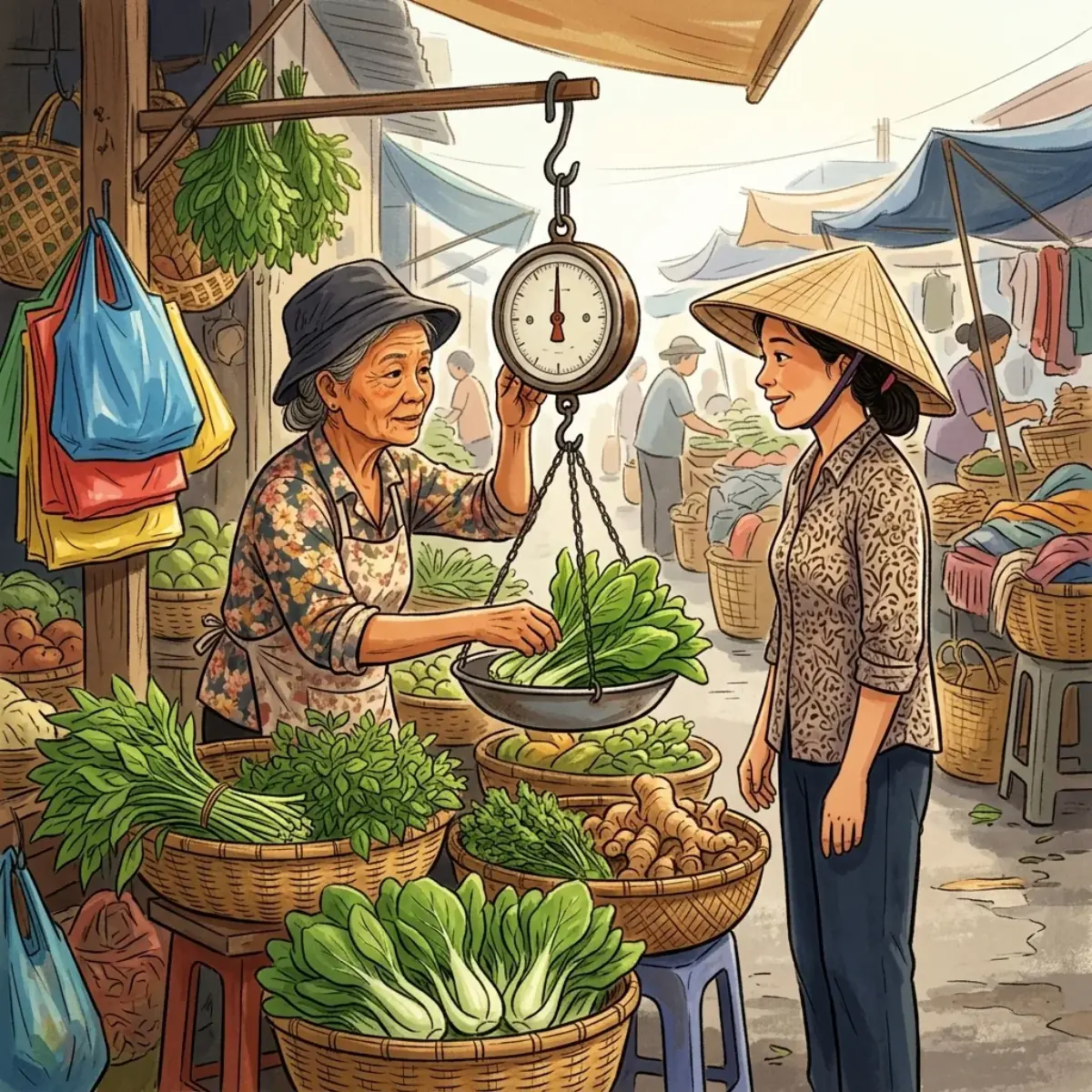
Here's a thing nobody warns you about. You go to a market in Saigon, you ask for một chục of something, you're feeling pretty smug because you know chục means ten. The lady hands you twelve. Sometimes fourteen. And she's not being generous — that's just what the word means down here.
That little exchange is basically the whole lesson. Southern measurement words are simple, but a few of them do not mean what the dictionary says. Let's go through them the way a friend would explain it while you two walk through chợ looking for mangoes.
Quick answer: In Saigon you buy weight in kí (kilo), lạng (100g) and nửa kí (half kilo); you buy bunches in bó; you buy length in mét or thước — and a chục is often 12 or 14, not 10.
Weight: kí is the king
Everything heavy gets sold by kí. Meat, fish, fruit, rice, sugar, shrimp — kí. You will hear it a hundred times a day and you'll basically never hear the formal word ki-lô-gam in a real market.
Half a kilo is nửa kí. That's the workhorse amount — the thing you buy when you're cooking for two people and don't want a fridge full of leftovers.
Then there's lạng — one hundred grams. This is your small-amount word. Chili, shallots, dried shrimp, expensive cuts of meat, medicinal herbs, cashews. Anything where a whole kilo would be ridiculous.
Local tip
Ten lạng = one kí. So ba lạng is 300g and bảy lạng is 700g. If you can count to ten you already know the whole system. And if you forget the word entirely, ba trăm gờ-ram works fine too — people say gờ-ram for small precise stuff, especially at the pharmacy or a fancy shop.
The chục problem (it's not always ten)
Okay, the fun one. In standard counting, chục means ten — ba chục ngàn is thirty thousand, no surprises. But when you're buying certain things at a Southern market, a chục is a traditional bundle, and that bundle is often 12, sometimes 14, occasionally 16 or 18 depending on the item and the region.
Down in the Mekong especially, this is completely normal. It's a leftover from old market generosity — you give a little extra so people come back. Nobody thinks it's strange. The seller will tell you which one she means if you ask.
Good to know
The extra-count chục mostly shows up with fruit, eggs, small fish and rice cakes at traditional markets. In a supermarket, on a receipt, or in any number bigger than about a hundred, chục is plain old ten. Nobody is going to charge you 14,000 when they say một chục ngàn.
Bundles, bunches and heads
Vegetables usually don't get weighed at all. They come tied up in a bó — a bunch — and you buy the bunch. Water spinach, herbs, green onions, morning glory, all bó.
A few cousins of bó that live in the same corner of the market:
Common mistake
Don't ask for một kí rau muống. Technically understandable, but nobody sells it that way and the lady will look at you funny while she tries to weigh a mountain of leaves. Ask for một bó. Same energy as walking into a bakery and asking for 400 grams of croissant.
Length: mét and thước
Mét is the metre and it's the everyday word — fabric, rope, electrical wire, the width of your hẻm, how far the coffee shop is.
Thước is the older word. Historically it was a different length, but in modern Saigon speech, when someone says thước in a shop or about a room, they usually just mean a metre. You'll hear it most from older folks, in fabric shops, and when people talk about house dimensions.
Note that second one — thước also just means ruler, the plastic thing in a schoolbag. Context sorts it out instantly.
For land and floor area you'll hear mét vuông, and older people sometimes say công or mẫu for farmland out in the countryside.
Liquid, spoons and "just a little"
Liquids go by lít, or by whatever container they came in. And a huge amount of real cooking talk uses vague measures, which honestly is more useful than the precise ones.
Local tip
That lon gạo is a real unit in Vietnamese kitchens — an old condensed-milk tin, roughly 200g of rice. Every household has one and it's more trusted than any scale. If someone tells you a recipe in lon, that's what they mean.
Where the North and South actually differ
| Meaning | Southern (Saigon) | Northern (Hanoi) |
|---|---|---|
| kilogram | kí | cân |
| 100 grams | lạng | lạng (same) |
| to weigh something | cân | cân |
| a "dozen" at market | chục = often 12–14 | chục = 10, or tá for 12 |
| bowl (for soup) | tô | bát |
| small bowl / cup | chén | bát con |
| spoon | muỗng | thìa |
| glass of drink | ly | cốc |
Watch that first row, it trips people up. In the South, kí is the noun (the kilo) and cân is the verb (to weigh). So cân giùm tui một kí nha — "weigh me out a kilo, would you" — is a perfectly normal sentence with both words in it.
Putting it together at the market
Try it yourself
- Ask how much a kilo of shrimp costs.
- Order 300 grams of pork using lạng.
- Ask a vendor whether her chục is ten or twelve.
- Ask for two bunches of green onion.
- Ask a fabric seller to cut you two and a half metres.
Answers: 1. Tôm bao nhiêu một kí vậy cô? · 2. Cho tui ba lạng thịt heo nha. · 3. Chục của cô là mười hay mười hai vậy cô? · 4. Bán tui hai bó hành lá nha chị. · 5. Cắt giùm tui hai mét rưỡi nha chị.
Frequently asked questions
So is a chục ten or twelve? I need one answer.
Both, depending on where you are. In numbers and money it's always ten. At a traditional market buying fruit or eggs, assume it might be twelve or fourteen and just ask: Chục này mấy trái vậy cô? Nobody will be offended — locals ask too.
Is lạng the same in the South and North?
Yes, 100 grams either way. The difference is the kilo word: down here it's kí, up north you'll hear cân used as the noun.
Can I just say gờ-ram for everything?
You can and you'll be understood, but you'll sound like a lab technician. Market Vietnamese runs on kí, nửa kí and lạng. Save gờ-ram for the pharmacy and the gold shop.
What's the difference between thước and mét?
In modern Saigon speech they're used interchangeably for a metre, with thước sounding older and more common in fabric shops and house measurements. Thước also means a ruler as an object.
What if the scale looks wrong?
Say it lightly, with a smile: Chị cân lại giùm em coi, thấy thiếu thiếu — "weigh it again for me, seems a bit short." Regular customers do this all the time and it's not rude at all.
Where can I practise this out loud?
Market talk is fast and full of shortcuts, so listening matters more than memorising. If you want to learn Southern Vietnamese online with someone who actually shops at these markets, a live lesson with a Saigon teacher will get you further in an hour than a week of flashcards.
Learn Southern Vietnamese online with people who actually speak it
SVFF is the school built entirely around the Southern (Saigon) dialect — native teachers from Ho Chi Minh City, since 2014.
- Listen to the SVFF podcast — real Southern Vietnamese, free.
- Book a free trial lesson — 30 minutes 1-on-1 with a native Saigon teacher.
- Browse our courses — structured A0–C1, all Southern dialect.
- Go Unlimited — every course and e-textbook, one payment.








0 Comments
Log in to leave a comment.