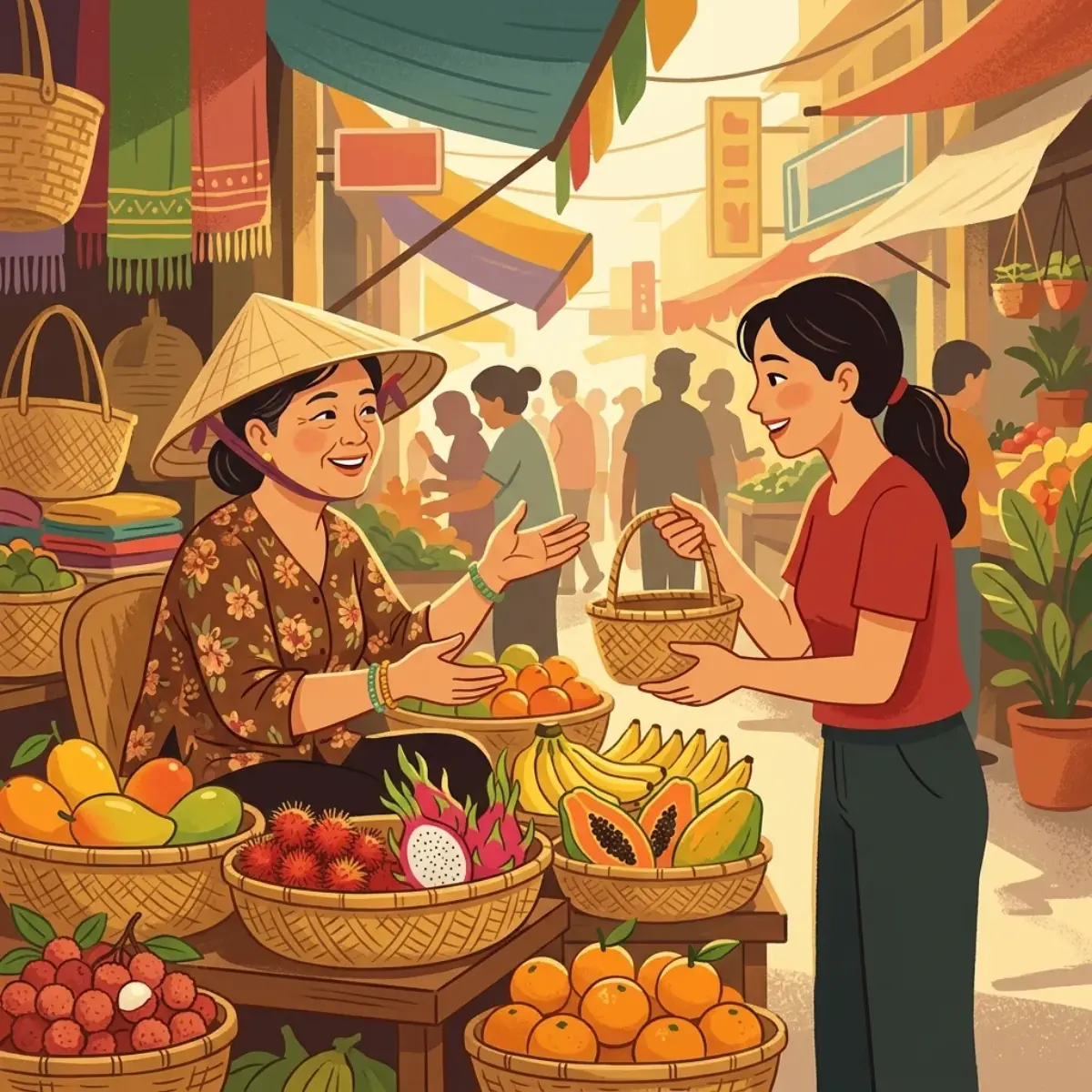
There's a moment every learner remembers: the first time you haggle at a Saigon market and the seller laughs, drops the price, and calls you cưng (sweetie). That's the day the language stops being homework and starts being yours. In this guide you'll learn Southern Vietnamese online the way it actually sounds at the chợ — warm, quick, and full of little softeners like nha and giùm that make a stranger want to give you a better deal.
Quick answer: Ask the price with "Bao nhiêu một ký vậy chị?", protest the price with "Mắc quá!", then sweetly ask "Bớt chút đi chị" until she gives you the giá chót (final price).
Let's walk into the market first
Picture a narrow lane in chợ Bà Chiểu. Baskets of mango, a lady fanning herself behind a mountain of rau (greens), the smell of sầu riêng somewhere close. You point at a pile of mangoes. Here's how it usually goes:
Four lines and you've got a deal. Now let's slow it down and pull out every useful piece.
Who do I even call them? (This part matters)
In the South, you address a seller by their apparent age relative to you. Get this right and the whole exchange warms up instantly.
Local tip
Open with "Dạ" — that little polite particle at the front of a sentence is pure Southern warmth. "Dạ chị ơi..." already tells the seller you're respectful, and respectful buyers get better prices. Sprinkle nha and nghen at the ends of your sentences to sound soft instead of demanding.
Asking the price: bao nhiêu
The workhorse phrase is bao nhiêu — "how much." You can use it bare or dress it up. The key add-on at a market is một ký (one kilo), because almost everything fresh is sold by weight.
Local tip
Southerners often shorten bao nhiêu to just nhiêu in fast speech: "Nhiêu một ký chị?" It's totally normal and sounds relaxed. Also, a Southern chục (dozen) at the market can sneakily mean 12, 14, or even 16 depending on the item — chục of certain fruits is a generous "baker's dozen" by old custom. Ask "Chục mấy trái vậy chị?" (how many pieces in a dozen?) if you want to be sure.
Understanding the numbers: ngàn and chục
Prices fly at you fast, and Southerners drop the word for thousand almost entirely. Money at the market is counted in ngàn (thousand) — never nghìn, that's the Northern word.
Common mistake
When a seller says "Một trăm hai" she means 120 thousand, not 100 point 2 and not 102. That trailing number is the next unit down. "Bốn chục rưỡi" = 45 thousand (rưỡi = "and a half" = another 5). If you're unsure, just repeat it back: "Dạ một trăm hai chục ngàn hả chị?" and she'll confirm.
The haggle itself
Haggling in Saigon is friendly theater, not a fight. You act mildly wounded by the price, they act mildly wounded by your offer, and you meet in the middle smiling. The magic words are mắc quá (too expensive) and bớt chút (knock a little off).
Local tip
The gentlest haggle isn't a demand — it's "Tính rẻ rẻ giùm em nha chị" (please figure me a cheap price). That word giùm (do it for me as a favor) is deeply Southern and instantly likeable. The doubled rẻ rẻ softens "cheap" into "a little cheaper," which feels playful rather than pushy.
Common mistake
Don't haggle hard over 5,000đ of vegetables — locals mostly haggle on fruit, souvenirs, clothes, and tourist-facing stalls, not on the rau muống. And if you name a price and she says "Ừ, lấy đi" (okay, take it), you've committed — walking away now is bad form. Only offer a number you'd actually pay.
Fruit and quantities: trái, ký, chục
Southern Vietnamese uses trái for a piece of fruit (the North says quả). You'll hear it constantly. Here's how to buy by the piece, by the kilo, or by the dozen.
North vs South at the market
Same market, very different words. If you learned the Northern terms first, here's what changes down South.
| Meaning | Southern (Saigon) | Northern (Hanoi) |
|---|---|---|
| a piece of fruit | trái | quả |
| thousand (money) | ngàn | nghìn |
| expensive | mắc | đắt |
| bowl / cup | tô / ly | bát / cốc |
| this / that (thing) | này / đó | này / kia |
| no / not (question tag) | hông / hôn | không |
| pineapple | thơm | dứa |
| peanut | đậu phộng | lạc |
That mắc vs đắt line is the giveaway. Say "Mắc quá!" and any Saigon seller instantly clocks you as someone who learned the local dialect — not a phrasebook tourist.
Wrapping up the sale
Once you've agreed on a price, you close it out and pay. A few phrases carry you through the last thirty seconds.
Local tip
Thối normally means "to smell rotten," but at the register thối lại means "give change back." Context does all the work. And gửi (literally "to send") is the polite verb for handing over money — softer than baldly saying "here's the cash."
Try it yourself
- Ask an older woman: "How much per kilo, auntie?"
- Protest that mangoes at 40,000đ/kilo are too expensive and ask her to come down a bit.
- Tell the seller you'll take half a kilo of rambutan and two guavas.
- Ask for the final price, then say you'll take it and to ring you up.
Answers: 1. Bao nhiêu một ký vậy cô? · 2. Mắc quá chị ơi! Bớt chút đi chị. · 3. Cho em nửa ký chôm chôm với hai trái ổi nha. · 4. Giá chót nhiêu chị? Ok, em lấy, tính tiền giùm em nha.
Frequently asked questions
Is haggling rude in Vietnam?
Not at all at markets and street stalls — it's expected and friendly. The tone is light and smiling, never aggressive. In supermarkets, convenience stores, and most restaurants, though, prices are fixed and you shouldn't bargain.
How much can I usually knock off the first price?
At tourist-heavy markets, first quotes can run high, and getting 20–40% off is common. At a neighborhood market where locals shop, prices are already close to fair, so you might only shave a little or get a small bonus piece thrown in. When in doubt, ask a couple of stalls first to learn the going rate.
What's the difference between ký and lạng?
A ký is one kilogram. A lạng is 100 grams, so nửa ký (half a kilo) equals five lạng. Most fruit is priced per ký; you'll hear lạng more for meat and dried goods.
Why do sellers call me cưng or em?
Both are affectionate, not condescending. Cưng means "sweetie" and em means "younger one." When a Saigon vendor uses them, she's being warm — a good sign you're getting the local, friendly treatment.
Do I really need to learn the Southern words if I already know some Vietnamese?
You'll be understood either way, but using mắc, ngàn, and trái makes you sound like you belong in Saigon rather than reciting a textbook — and that goodwill often translates into better prices and warmer service.
Learn Southern Vietnamese online with people who actually speak it
SVFF is the school built entirely around the Southern (Saigon) dialect — native teachers from Ho Chi Minh City, since 2014.
- Listen to the SVFF podcast — real Southern Vietnamese, free.
- Book a free trial lesson — 30 minutes 1-on-1 with a native Saigon teacher.
- Browse our courses — structured A0–C1, all Southern dialect.
- Go Unlimited — every course and e-textbook, one payment.








0 Comments
Log in to leave a comment.