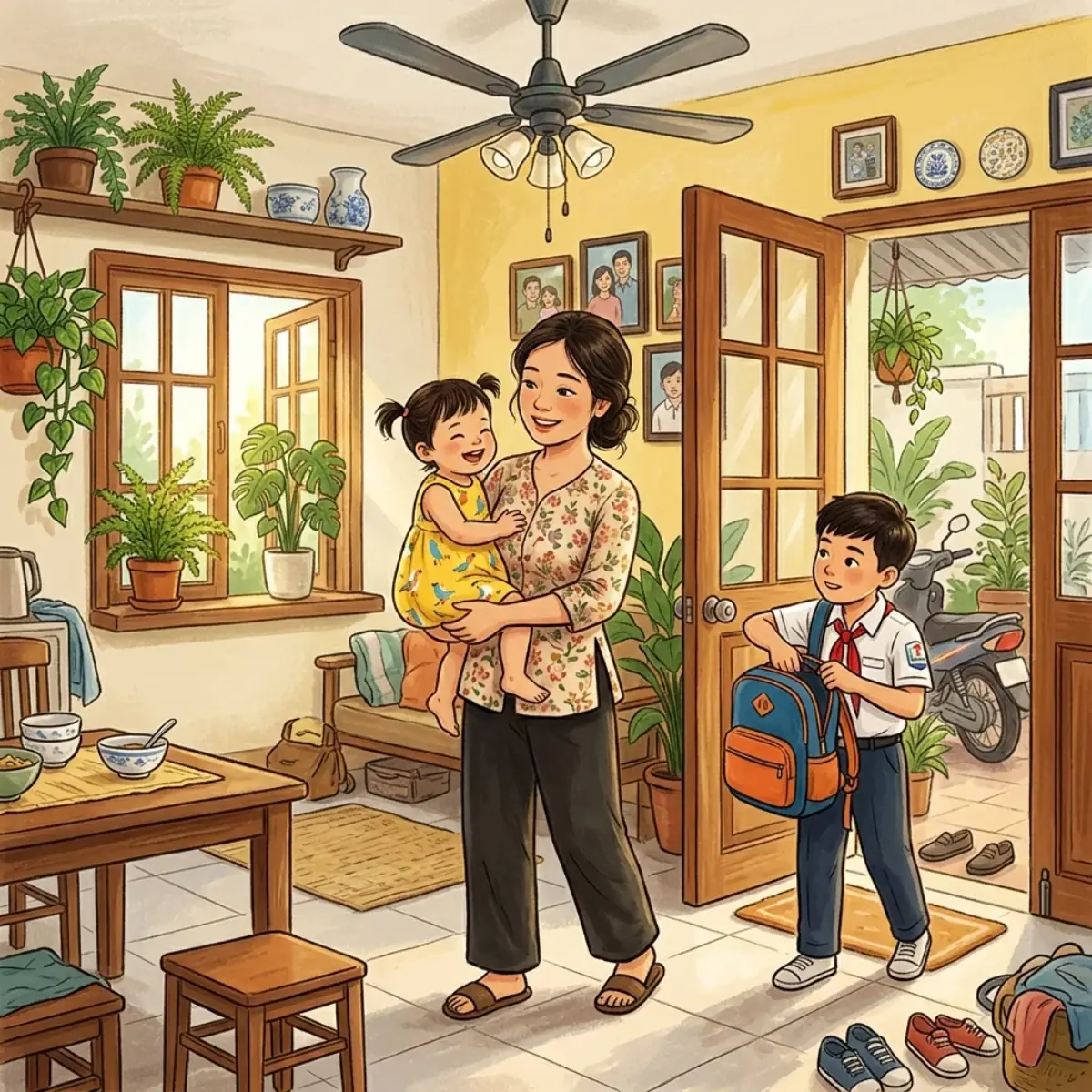
Live in a Saigon hẻm for one week and you'll hear it: somebody's baby crying at 6 a.m., an auntie yelling "Con nít gì mà hư quá trời!", and three neighbours immediately offering to hold the baby. Kid talk is the social glue here. So let's give you the words.
That two-line exchange happens about four hundred times a day in this city. And notice what already showed up: em bé, bồng, bao lớn. Those are the bones of Southern family talk.
Quick answer: In Saigon you say em bé for a baby and con nít for kids in general, you bồng or ẵm a child in your arms, and the two words every parent uses a hundred times a day are ngoan (well-behaved) and hư (badly behaved).
The kid words: em bé, con nít, and friends
Start with who you're talking about. Southern people are pretty loose here — the same child can be em bé at home and thằng nhỏ when the neighbour is complaining about him.
Con nít is the everyday Southern word for "kids" as a group. It's not rude — grandmothers say it constantly. And thằng nhỏ / con nhỏ (little boy / little girl) sound affectionate in the South, not harsh, as long as your tone is warm.
Local tip
Vietnamese people ask a baby's age in months for a long time. Bé mấy tháng rồi? ("how many months?") is the standard opener up to about two years old. Answering in years too early sounds a bit odd.
Holding the baby: bồng vs ẵm
English has one word — "hold" — and Vietnamese has a whole little family of them. In the South you'll mostly hear bồng and ẵm, and honestly people use them almost interchangeably. If you want a rule of thumb: bồng is scooping the child up into your arms, ẵm is carrying them around cradled.
Two extras worth memorising: cõng is on your back (piggyback), and dỗ is what you do when the kid is melting down — soothing, distracting, bribing, whatever works. Nín means to stop crying, and you'll hear parents say "Nín đi con" in the most exhausted voice imaginable.
Feeding, nappies, sleeping
This is the survival kit if you have a baby in Vietnam, or if you're visiting a family that does.
Good to know
Cho bú covers both breast and bottle in casual speech. If you need to be specific: bú mẹ (breastfeed) vs bú bình (bottle). Nobody gets shy about this word — an auntie will announce it across the room.
Ngoan vs hư: the two words parents live by
If you learn only two adjectives from this whole post, make it these. Ngoan means well-behaved, obedient, sweet — a huge compliment. Hư is the opposite: naughty, spoiled, acting up.
Related everyday scolding vocabulary: nghe lời (to obey, literally "listen to words"), lì (stubborn, won't budge), quậy (rowdy, causing chaos), and rầy — the Southern word for scolding a child.
Nhõng nhẽo: the untranslatable one
Here's a word English just doesn't have. Nhõng nhẽo is that whiny, clingy, wheedling behaviour a kid does when they want something — dragging out their voice, hanging on your leg, half-crying but not really crying. It's a mix of "whiny," "needy," and "putting on a show."
Local tip
Adults use nhõng nhẽo about each other too — teasingly, about a partner who's being cutely demanding. Say it with a smile and it's affectionate. Say it flatly to your boss and, well, don't.
School and growing up
Đi học covers everything from nursery to university. Parents in Saigon talk about the school run constantly, because the school run is the day.
Milestone verbs you'll hear from proud parents: biết lật (rolling over), biết bò (crawling), biết đi (walking), biết nói (talking). Notice biết — "knows how to" — does all the work.
Common mistake
Learners say "Tui có một em bé" to mean "I have a baby." Careful — có em bé in everyday speech usually means expecting one, so people will hear "I'm pregnant." Say "Tui có một đứa con" or "Nhà tui có con nhỏ". Also: never use bồng for objects — you bồng babies and small animals, not boxes.
North vs South: the words that really differ
Most kid vocabulary is shared nationwide, but a handful of these are genuinely regional. Everything in the examples above is Southern; here's how a few compare.
| Meaning | Southern (Saigon) | Northern (Hanoi) |
|---|---|---|
| kids, children (general) | con nít | trẻ con |
| to hold / carry in arms | bồng, ẵm | bế |
| to scold a child | rầy | mắng |
| to pick up (from school) | rước | đón |
| mom and dad | má, ba | mẹ, bố |
| naughty / rowdy | quậy | nghịch |
Use the Southern column and you'll sound like you actually live here. Bồng in particular is a giveaway — say it in Saigon and people relax immediately.
Try it yourself
- Tell a neighbour her baby is adorable and ask how many months old he is.
- Ask someone to hold the baby for a second while you get the bottle.
- Say your daughter starts first grade this year.
- Tell a kid to stop whining and eat.
- Say you'll pick the kid up at 4:30 this afternoon.
Answers: 1. Em bé dễ thương quá! Bé mấy tháng rồi chị? 2. Bồng bé giùm tui chút, tui đi lấy bình sữa. 3. Con gái tui năm nay vô lớp một rồi. 4. Đừng nhõng nhẽo nữa, ăn cơm đi con. 5. Chiều bốn giờ rưỡi tui rước bé nghen.
Frequently asked questions
What's the real difference between bồng and ẵm?
Honestly, very little in daily Saigon speech — most people treat them as synonyms. If you want the shade: bồng leans toward the act of scooping a child up, ẵm toward carrying them around cradled in your arms. Either one will sound completely natural.
Is con nít rude?
No. It's the ordinary Southern word for kids as a group, used warmly by everyone including grandparents. It's informal, so you wouldn't put it in a school newsletter, but in speech it's perfectly friendly.
Can I call an adult ngoan or hư?
Ngoan for an adult sounds like you're talking to a child, so avoid it unless you're joking with a close friend or a partner. Hư between couples is playful and flirty. Between strangers, don't.
Do I say tã for both cloth and disposable nappies?
Yes, tã covers both in everyday talk. If you need to be precise at the shop, tã giấy is disposable and tã vải is cloth. Most shops in Saigon will know exactly what you mean from tã alone.
Why do people ask about my kids so fast?
Because family is the default small-talk topic here, the way weather is elsewhere. Asking whether you have kids, how many, and how old isn't nosy — it's friendliness. If you want to learn Southern Vietnamese online and actually use it, this vocabulary set pays off faster than almost anything else, because it's what people ask you first.
Learn Southern Vietnamese online with people who actually speak it
SVFF is the school built entirely around the Southern (Saigon) dialect — native teachers from Ho Chi Minh City, since 2014.
- Listen to the SVFF podcast — real Southern Vietnamese, free.
- Book a free trial lesson — 30 minutes 1-on-1 with a native Saigon teacher.
- Browse our courses — structured A0–C1, all Southern dialect.
- Go Unlimited — every course and e-textbook, one payment.








0 Comments
Log in to leave a comment.