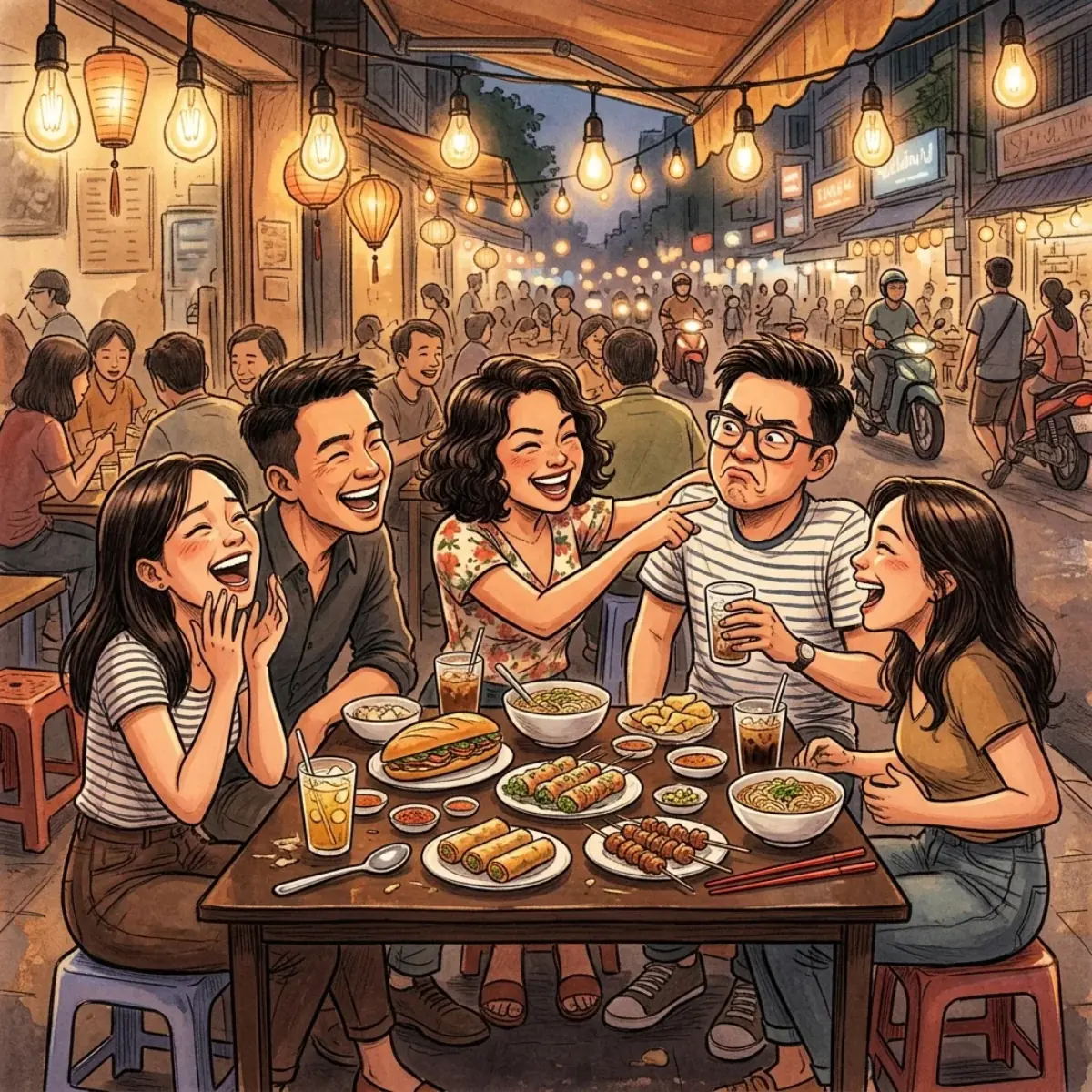
You've been in Saigon a few weeks. You dress up a little nicer than usual one morning, and the guy at the coffee cart looks you up and down and says something that makes everybody laugh. You have no idea what happened. Congratulations — you just got teased, and honestly, that's a good sign.
Quick answer: In Saigon, giỡn is the joking, chọc is what you do to a friend, and quê is how they feel afterwards — and if nobody ever teases you, you're not in the circle yet.
Giỡn: the word for the whole vibe
Down here, giỡn is the everyday word for messing around, joking, not being serious. It covers everything from a one-line joke to two kids wrestling on the floor. If you learn one word from this whole post, learn this one.
Notice tui tưởng thiệt — "I thought it was real." That's the standard face-saving line when you fall for a joke. Say it with a laugh and you've handled it perfectly.
Chọc: teasing a specific person
If giỡn is the general activity, chọc is the aimed version: you tease someone. Its cousin ghẹo is a bit more playful-flirty, often used with kids or with someone who's crushing on somebody.
Quê: the feeling that makes the joke land
This is the one nobody teaches you. Quê is that hot-face, wish-the-floor-would-open feeling when you get caught out — you said the wrong name, you tripped in front of everyone, you bragged about something and then it turned out to be false. It's not shame. It's the small, funny, survivable kind of embarrassment.
Good to know
Mắc cỡ and quê are not the same. Mắc cỡ is shy, bashful, blushing — a personality thing, and kind of cute. Quê is situational: you just got caught, and it stings for about ninety seconds. A shy person is mắc cỡ; a person whose lie just got exposed is quê.
The roast kit: what friends actually call each other
Here's the part that confuses learners the most. Saigon friends say things to each other that sound, on paper, like fighting words. Tone does all the work. These are the regulars:
And when you want to shut a tease down without any real heat, the classic move is a fake-scolding address term: Thôi đi cha nội or Thôi đi má. It means roughly "oh please, stop," and everyone laughs.
Local tip
The safest way for a foreigner to join in is to roast yourself first. Mess up a word, then say Tui nói tiếng Việt dở quá, quê quá trời! ("My Vietnamese is so bad, I'm so embarrassed!"). People will laugh with you, and one of them will immediately tell you it's actually fine. That's the fastest social shortcut in the country.
The "I was just kidding" repair kit
Every joker needs an undo button. In Saigon the undo button is short, casual, and usually paired with a soft particle.
That last one is the most useful pattern in the whole post: nói vậy thôi chớ…. Tease, then immediately land a real compliment. That's the Saigon rhythm.
Teasing vs. insult: how to actually tell
Here's the honest answer — it's almost never the words. It's four other things.
1. The relationship. Teasing runs sideways and downward, not upward. Friends your age, siblings, cousins, coworkers you eat lunch with: fair game. Someone clearly older, a customer, your girlfriend's father: never, until they start it and you've known them a long time.
2. The audience. A joke between two people is different from the same joke in front of eight. Making someone quê in front of their boss or their crush is where affectionate becomes cruel.
3. The topic. Money troubles, exam failures, a family member who's sick, someone's job being looked down on — those are out, no matter how close you are. Appearance and weight jokes exist here and are common, but only inside a tight friend group, and only if they roast you back.
4. The comeback. This is your real-time signal. A happy target fires back. A hurt one gives you a flat one-word answer and looks away.
Common mistake
Learners see giỡn and assume giỡn mặt must mean "joke around with." It does not. Mày giỡn mặt tao hả? means "Are you messing with me?" — it's a challenge, close to picking a fight. Same root word, completely different temperature. Stick with giỡn chơi and nói giỡn.
North vs South: the humour words really do differ
| Meaning | Southern (Saigon) | Northern (Hanoi) |
|---|---|---|
| to joke, mess around | giỡn | đùa |
| to tease someone | chọc, ghẹo | trêu |
| funny, makes me laugh | mắc cười | buồn cười |
| embarrassed, shy | mắc cỡ, quê | xấu hổ, ngượng |
| grumpy, in a huff | quạu | cáu |
| fibbing, talking nonsense | xạo, xạo ke | điêu, phét |
Use the Southern column in Saigon and you'll sound like you belong. Use buồn cười down here and people will understand you fine — they'll just clock you instantly as someone who learned from a Hanoi textbook.
Try it yourself
- Your friend claims he woke up at 5am to exercise. You don't believe him. What's the one-word roast?
- You told a joke and your friend's face went stiff. Walk it back in one sentence.
- You mispronounced the name of the coffee shop owner in front of five customers. Describe the feeling.
- Your friend hasn't answered your messages for two days and now shows up smiling. Tease her.
- Say "that's hilarious" the Saigon way.
Answers: 1. Xạo ke! — 2. Giỡn thôi mà, đừng có quạu nha. — 3. Quê chết đi được! or Quê một cục luôn. — 4. Nay chảnh dữ ha! — 5. Mắc cười quá trời!
Frequently asked questions
If someone teases me in Vietnamese, do I have to fire back?
No, but a smile plus Thôi đi cha nội or Giỡn hoài à nha is worth ten grammar drills socially. You're showing you took it the right way, which is all anyone wanted.
Is it rude when Vietnamese friends comment on my weight or my face?
It's not intended that way. Body comments circulate freely among close friends and family here, more like weather commentary than judgement. If you don't like it, the normal move is to joke back rather than get serious — or say Thôi, đủ rồi nha in a flat voice, which everyone reads correctly.
Can I call a friend mắc dịch or đồ quỷ?
Only with people who already say it to you, and only with a laughing tone. These are affectionate scoldings, most natural coming from women and from older family members. Wait until you've heard someone use it on you at least once.
Do I need mày and tao to join in on roasting?
Not at all. Plenty of adult friendships in Saigon roast each other happily using anh, chị, em and tui. Jumping to mày/tao too early is one of the fastest ways to make a joke land badly.
What's the fastest way to get comfortable with this?
Hearing it, constantly, from real Southern speakers — not reading it. That's exactly why people learn Southern Vietnamese online with SVFF teachers who are actually from Ho Chi Minh City: within a few lessons you stop translating jokes and start catching them live.
Learn Southern Vietnamese online with people who actually speak it
SVFF is the school built entirely around the Southern (Saigon) dialect — native teachers from Ho Chi Minh City, since 2014.
- Listen to the SVFF podcast — real Southern Vietnamese, free.
- Book a free trial lesson — 30 minutes 1-on-1 with a native Saigon teacher.
- Browse our courses — structured A0–C1, all Southern dialect.
- Go Unlimited — every course and e-textbook, one payment.








0 Comments
Log in to leave a comment.