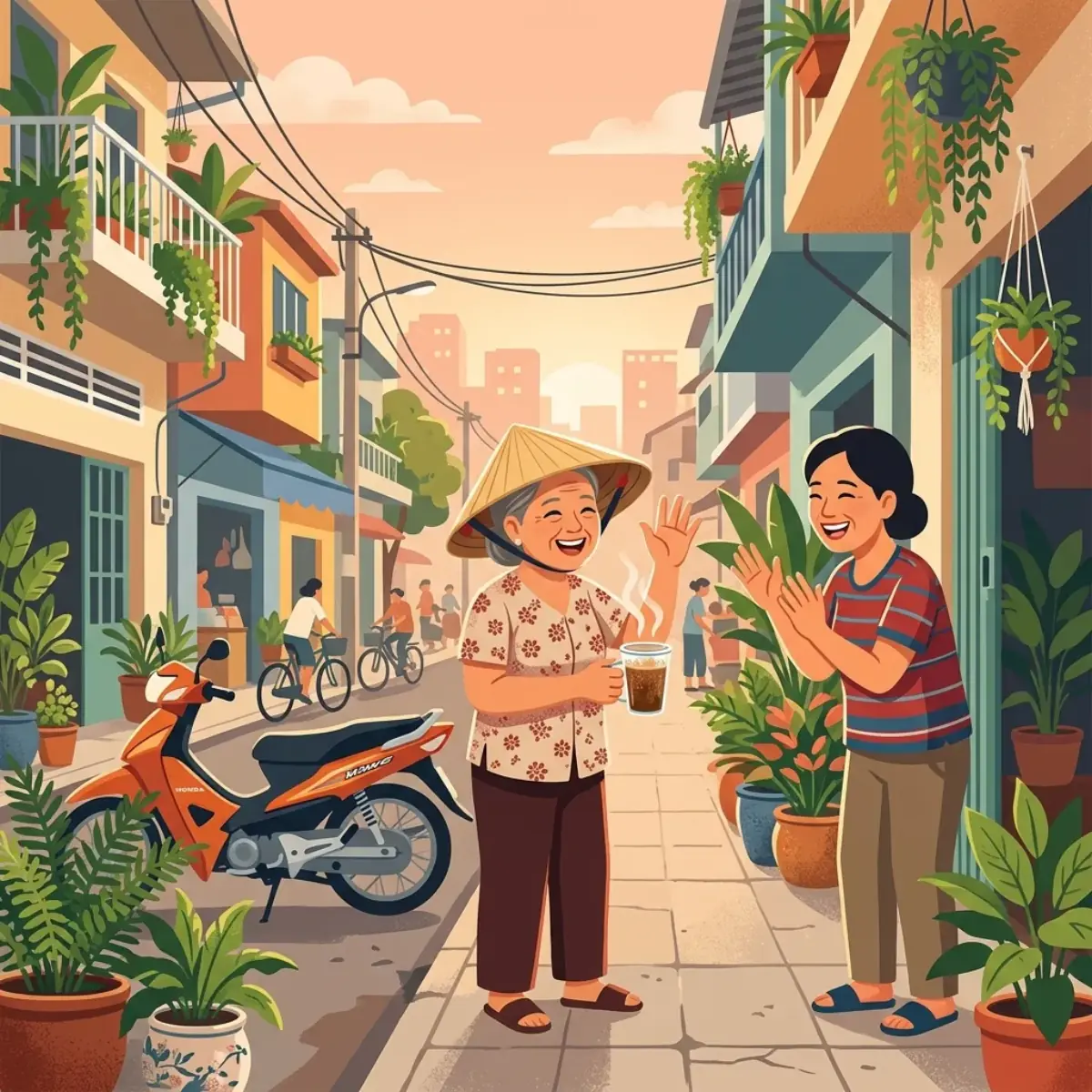
Walk down any hẻm (alley) in Sài Gòn around 7 a.m. and you'll hear it before you see it: neighbors calling across the street, not with a flat "hello," but with warm little questions — have you eaten? where are you off to? Southern Vietnamese greetings are less a fixed word and more a friendly nudge. If you want to learn Southern Vietnamese online and actually sound like a local from day one, this is the most useful place to start — because you'll use these exchanges every single day.
Here's a tiny scene to set the tone. Two neighbors bump into each other by the coffee cart:
Nobody actually needs to know where you're going. That's the secret: these are greetings dressed up as questions. You just answer breezily and keep walking.
Quick answer: In the South, a "hello" is usually a warm question — Ăn cơm chưa? (have you eaten?), Đi đâu đó? (where you headed?), or Khỏe không? (you good?) — and you soften almost everything with dạ and end with nha or nghen.
Chào — the polite base, and why it shifts with the person
The textbook word for "hello" is chào, and it's not wrong — but locals almost never say it bare. You attach the right pronoun for who's in front of you, and that choice does more social work than the word itself.
Notice con, em, cô, chú — the pronouns place you and the other person on the family map. Get the pronoun right and even a mumbled greeting lands warmly. Get it wrong and a perfect chào still feels off.
Local tip
Among friends your own age, most people drop chào entirely. You'd just say Ê! or Ủa mày! — like "hey!" or "oh it's you!" Saving chào for people you'd address formally is what makes it feel sincere rather than robotic.
Ăn cơm chưa? — the greeting that isn't really about food
This is the one that surprises newcomers most. Ăn cơm chưa? literally asks "have you eaten rice yet?" — but it's often just a warm hello, especially from older people and especially around mealtimes. It carries the same energy as an English "how's it going?"
You don't have to give a real report. "Eaten already" (ăn rồi) or "not yet" (chưa) is plenty, and bouncing the question back — cô ăn chưa? — is the polite move that keeps the warmth flowing.
Common mistake
Learners often hear Ăn cơm chưa? and launch into a detailed description of their lunch. You can, if you want to chat — but understand it's usually a greeting. A quick Dạ ăn rồi with a smile is a complete, natural answer.
Khỏe không? and Đi đâu đó? — checking in, Saigon-style
Two more everyday openers. Khỏe không? asks "you well?" and Đi đâu đó? asks "where you off to?" — the second is pure small talk, thrown out to anyone walking past with a bag or a helmet.
See that little word hông? In the South, không ("no / not") very often softens into hông in casual speech. It's not sloppy — it's the friendly, relaxed register you'll hear constantly. And ly for a glass, re stretched out for "totally fine" — those small choices are pure Saigon.
Where the South and North actually differ
Greetings themselves are shared across the country, but the little grammar words, particles, and pronunciations that ride along with them are where you hear the dialect. Here are the ones that matter most in everyday hellos:
| Meaning / word | Southern (Saigon) | Northern (Hanoi) |
|---|---|---|
| "no / not" (softened) | hông / không | không |
| friendly ending particle | nha / nghen | nhé |
| "hey you" (casual, close friends) | mậy / mày | mày |
| "going home" | dzìa / về | về |
| "a glass of" | một ly | một cốc |
| "yes / right" (agreement) | ừ / dạ | vâng / ừ |
The one you'll notice first is the ending particle. A Saigon goodbye ends in nha or nghen; a Hanoi one ends in nhé. Neither is more correct — but sprinkling nha at the end of your sentences instantly reads as Southern.
Dạ — the tiny word that makes you sound raised-right
If you take one habit from this whole article, make it dạ. It's a soft particle of respect that Southerners place in front of almost anything they say to someone older or in a service setting. It doesn't translate cleanly — it's somewhere between "yes," "yes ma'am," and a polite little bow made of sound.
Even when the answer is "no," you often start with dạ — as in Dạ hông ("no, [respectfully]"). It feels contradictory in English, but in Vietnamese the dạ is signalling respect, not agreement. Leading with it is the single fastest way to sound warm and well-mannered.
Local tip
With friends your age you drop dạ — using it with a buddy sounds oddly stiff, almost sarcastic. Save it for anyone you'd call cô, chú, anh, chị, or a shopkeeper. The instinct for when to switch it on and off comes fast with practice.
Saying goodbye: đi nha, gặp lại, dzìa trước nghen
Goodbyes in the South are just as soft and casual as the hellos. You rarely need the formal tạm biệt ("farewell") — that can sound weirdly final, like you're parting for years. Everyday goodbyes are light:
Two things to catch: tui is the relaxed Southern "I" (you'll also hear tụi mình for "us"), and dzìa is how về ("to go home") actually comes out of a Saigon mouth. And of course everything is capped with nha or nghen to keep it gentle.
Your Saigon greeting cheat-sheet
Everything above, in one glance. Mix and match — real conversations are just these blocks stacked together:
Try it yourself
- An older woman at the market smiles and says Ăn cơm chưa con? — give a polite, natural reply (you have eaten).
- Turn this into friendly Saigon speech: "Hi, are you well?" (to a slightly older man).
- You're leaving a friend's house. Say a light goodbye with "see you later," Southern-style.
- Soften this into polite Southern: "No, thank you" (to a shopkeeper).
Answers: 1) Dạ con ăn rồi, cô ăn chưa? — 2) Em chào anh, anh khỏe hông? — 3) Thôi tui dzìa nha, gặp lại sau! — 4) Dạ thôi, con cảm ơn cô nha.
Frequently asked questions
Is "Ăn cơm chưa?" a real question or just a greeting?
Both — but most of the time it's a greeting, like "how's it going?" A short Dạ ăn rồi ("yes, I've eaten") or Dạ chưa ("not yet") is a complete answer. Bouncing it back with cô ăn chưa? is the polite touch.
Do I always need to say "chào"?
No. Chào is for people you'd address formally — an elder, a stranger, a client. With friends your age, a simple Ê! or asking Đi đâu đó? works better and sounds more natural than a stiff chào.
Why do I keep hearing "dạ" even before someone says no?
Because dạ signals respect, not agreement. Dạ hông literally stacks "yes" and "no," but it just means a very polite "no." Leading with dạ is the fastest way to sound well-mannered in the South.
What's the difference between "nha" and "nhé"?
Meaning-wise, none — both are soft, friendly ending particles. But nha and nghen are Southern, while nhé is Northern. Ending sentences with nha instantly marks your speech as Saigon-style.
How do I say "how are you" to a friend versus an elder?
To a friend: Khỏe hông mậy? — relaxed and playful. To an elder: Dạ, cô khỏe hông cô? — wrapped in dạ and the right pronoun. Same question, two registers; switching between them is most of what sounding local really means.
Learn Southern Vietnamese online with people who actually speak it
SVFF is the school built entirely around the Southern (Saigon) dialect — native teachers from Ho Chi Minh City, since 2014.
- Listen to the SVFF podcast — real Southern Vietnamese, free.
- Book a free trial lesson — 30 minutes 1-on-1 with a native Saigon teacher.
- Browse our courses — structured A0–C1, all Southern dialect.
- Go Unlimited — every course and e-textbook, one payment.








0 Comments
Log in to leave a comment.