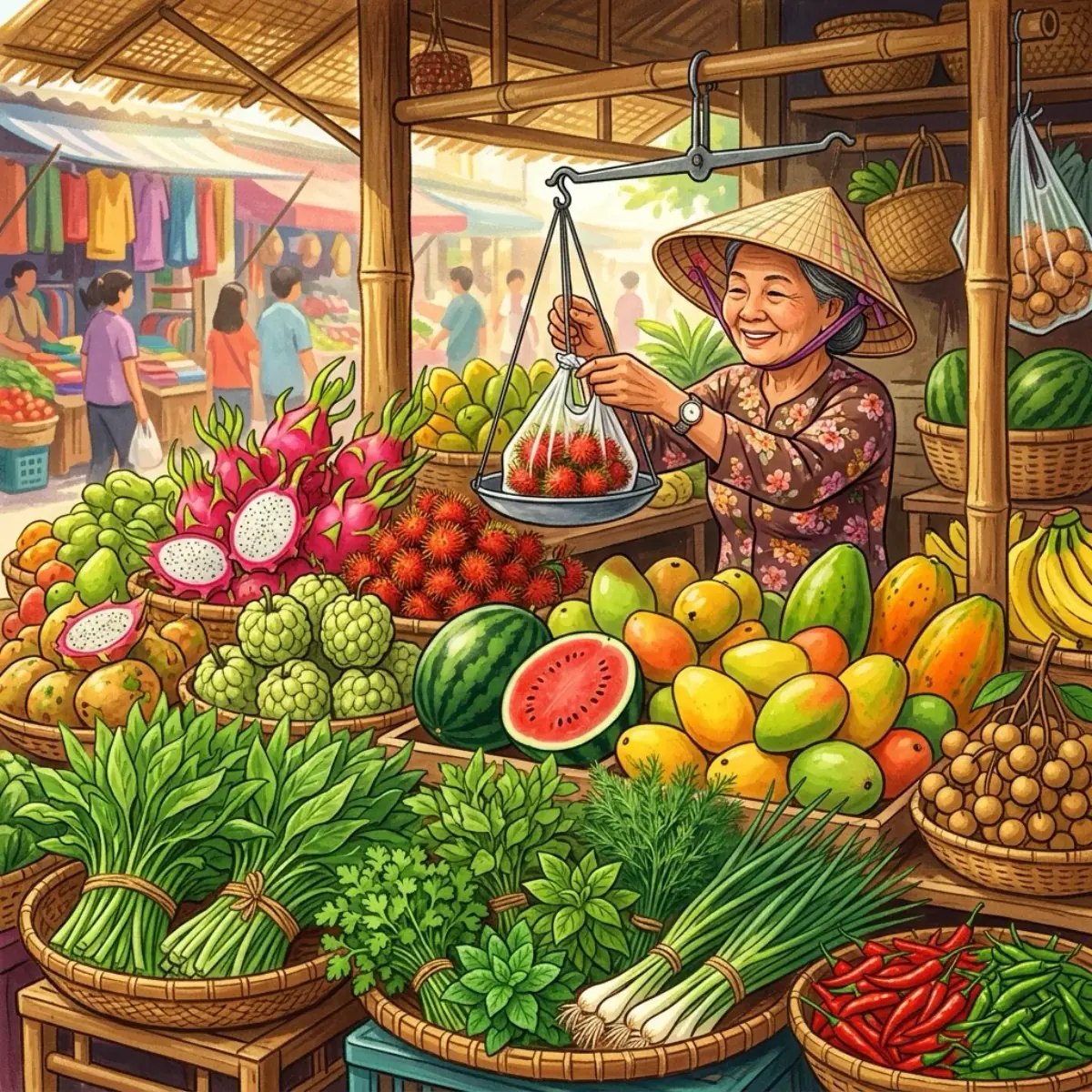
Go to a Saigon market at 6 in the morning and you'll notice something: nobody buys "a mango." They buy một trái xoài. Nobody buys "vegetables," they buy một bó rau muống. In Vietnamese the little word in front of the food is not optional decoration — it's the part that makes you sound like you've done this before.
Here's the good news. For the entire fruit-and-vegetable section of the market, you basically need three of those little words: trái, bó, and kí. Learn those three, bolt twelve produce names onto them, and you can shop.
Quick answer: In Saigon, fruit is counted with trái (hai trái xoài = two mangoes), leafy greens and herbs come in a bó (a bunch), and anything heavy is sold by the kí (kilo) — so cho con một kí chôm chôm means "give me a kilo of rambutan."
Two sentences you'll hear in the first thirty seconds
That's the whole shape of a market transaction. She names the thing, you name the amount. Now let's fill in the amounts.
The three counters that do all the work
Trái is the Southern word for a piece of fruit — and for most roundish things that grow. One mango, one guava, one watermelon: all trái. Yes, even a chili is một trái ớt.
Bó means a bundle tied together — anything leafy that the vendor grabs by the handful. Kí (you'll also see it written ký) is the kilo, and it's how the expensive or heavy stuff is priced. There's a fourth one worth knowing too: mớ, meaning a small loose pile that's not tied up — một mớ rau is "a little heap of greens."
Good to know
Prices are always said in ngàn in the South. Bốn chục ngàn một kí = 40,000 a kilo. If the vendor just says bốn chục, she means bốn chục ngàn — nobody says the whole thing.
Fruit: the seven you'll meet constantly
Every one of these takes trái, and every one of them is sold by the kí once you want more than a couple.
Now put them in real sentences. This is the part textbooks skip.
Local tip
In the South, một chục at a fruit stall is not always ten. In many Mekong-influenced markets a chục of small fruit is twelve, sometimes fourteen — it's called chục có đầu, "a dozen with a head on it." If you hear a suspiciously cheap price for một chục, that's usually why. Ask Chục là mấy trái vậy dì? ("How many pieces in a chục?") and she'll happily tell you.
Vegetables and herbs: the bó section
Walk five metres deeper into the market and the counter changes. Nothing here is trái anymore — it's all bó, mớ, or kí.
And here's how those actually come out of a Saigon mouth:
Local tip
Hành and ngò are usually free. Buy a decent amount of anything and it's completely normal to say Dì cho con xin miếng hành ngò nha — "can I get a bit of scallion and coriander?" She'll grab a handful and toss it in the bag. Regulars get it without asking.
North vs South: this is where the words really split
Produce vocabulary is one of the biggest dialect gaps in the whole language. If you learned from Hanoi materials, half your market words will get you a puzzled look in District 3.
| Meaning | Southern (Saigon) | Northern (Hanoi) |
|---|---|---|
| counter for fruit | trái (trái xoài) | quả (quả xoài) |
| kilo | kí / ký | cân |
| sugar apple | mãng cầu | na |
| pineapple | thơm | dứa |
| coriander | ngò | rau mùi |
| peanut | đậu phộng | lạc |
| corn | bắp | ngô |
Use the Southern column in Saigon and everything runs smoothly. The Northern words are understood — but they mark you instantly as someone who studied somewhere else.
Common mistake
Dropping the counter. Cho con hai xoài sounds like a child talking. It's cho con hai trái xoài. The exception: things already sold by weight or bundle — you say một kí chôm chôm and một bó ngò, never một trái chôm chôm unless you genuinely want one single rambutan (and then people will laugh at you a little).
Common mistake
Calling every green vegetable rau and stopping there. Rau is the category, not the order. Con mua rau makes the vendor ask Rau gì con? Name it: rau muống, cải ngọt, cải bẹ xanh. That one extra word saves the whole exchange.
Try it yourself
- Ask for two mangoes and one watermelon.
- Ask how much a kilo of rambutan is.
- Ask for three bunches of water spinach.
- Ask the vendor to pick you a ripe sugar apple.
- Ask for a bit of scallion and coriander thrown in.
Answers: 1. Dì cho con hai trái xoài với một trái dưa hấu nha. · 2. Chôm chôm nhiêu một kí vậy dì? · 3. Cho con ba bó rau muống. · 4. Dì lựa giùm con trái mãng cầu nào chín nha. · 5. Dì cho con xin miếng hành ngò nha.
Frequently asked questions
Do I really have to say trái every time?
Whenever there's a number, yes. Hai trái ổi, not hai ổi. When you're talking about the fruit in general — Tui thích xoài lắm ("I love mangoes") — you drop it, same as English drops "a piece of."
Is it kí or ký?
Same word, two spellings, identical pronunciation. Both are everywhere on handwritten market signs. Southerners rarely say ki-lô-gam out loud — that's for packaging and school books.
What's the difference between mãng cầu and mãng cầu xiêm?
Mãng cầu on its own is the sugar apple — small, bumpy, sweet, eaten in segments. Mãng cầu xiêm is soursop: much bigger, spiky, tart, mostly blended into sinh tố. Ordering one when you wanted the other is a classic first-year moment.
Why does everyone call me con at the market?
Because most vendors are around your parents' age, so they use family words: she's dì or cô, you're con. Younger vendor? She's chị and you're em. It's warmth, not condescension.
Can I ask to taste before buying?
With cut fruit, absolutely: Cho con ăn thử một miếng được hông dì? — "Can I try a piece?" With whole fruit like durian or watermelon, they'll usually offer to cut it open for you instead.
What's the fastest way to sound like a regular?
Two habits. First, always attach the counter — trái, bó, kí. Second, end your requests with nha or nghen. Cho con một kí xoài nghen dì is a hundred times friendlier than the same sentence bare, and it takes zero extra effort.
One last thing before you go
Markets are the single best classroom in Saigon. Nobody there expects perfect grammar — they expect you to name the thing, name the amount, and smile. The twelve words above cover most of what you'll point at for the first year, and the three counters cover the rest of the produce section by default.
If you'd rather practise this with someone who can correct your ngò and your nghen in real time, that's exactly what our lessons are for. You can learn Southern Vietnamese online with teachers who grew up shopping at these markets — then go test it out on Saturday morning and come back with a story.
Learn Southern Vietnamese online with people who actually speak it
SVFF is the school built entirely around the Southern (Saigon) dialect — native teachers from Ho Chi Minh City, since 2014.
- Listen to the SVFF podcast — real Southern Vietnamese, free.
- Book a free trial lesson — 30 minutes 1-on-1 with a native Saigon teacher.
- Browse our courses — structured A0–C1, all Southern dialect.
- Go Unlimited — every course and e-textbook, one payment.








0 Comments
Log in to leave a comment.