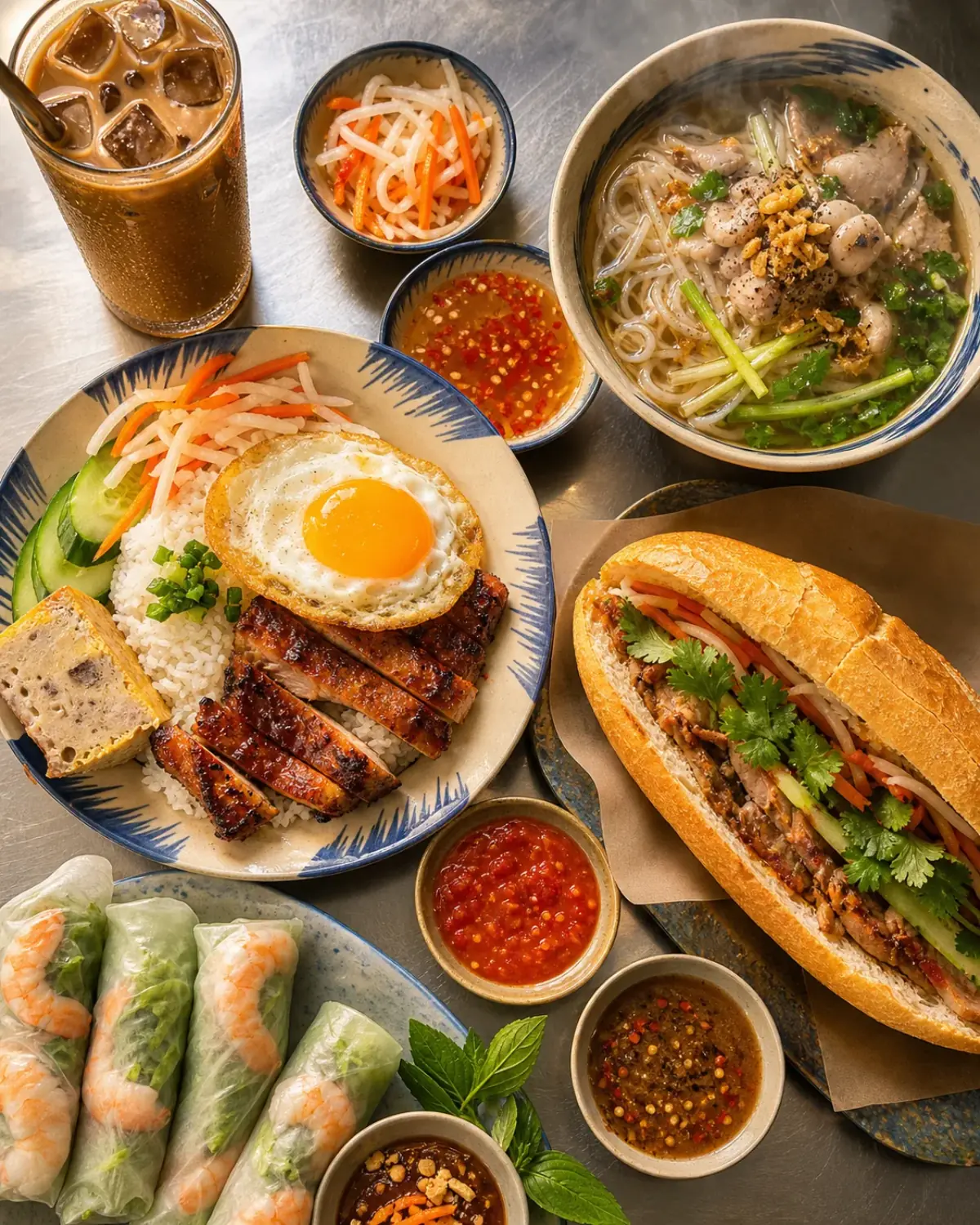
Okay, real talk: you can survive in Saigon knowing exactly zero grammar. What you actually need is the name of the food and one short sentence to point at it. That's it. Do that and the auntie behind the cart will love you, feed you, and probably give you extra sauce.
So grab an iced coffee, sit with me for ten minutes, and let's go dish by dish. By the end you'll be able to walk up to any cart and order like you've lived here for years.
See? Nobody asked you to conjugate anything. You said the food, you said nha, you sat down. That's the whole game.
Quick answer: To order almost any Saigon dish, just say "Cho con một [tô / dĩa / ổ / ly] [tên món] nha!" — "Give me one [bowl / plate / loaf / glass] of [dish], okay!" Learn the dish name, pick the right counter word, done.
First, the little words that carry everything
Before the food, two tiny things. In Saigon we count food with a "counter" word — the container basically. You don't say "one phở," you say "one bowl of phở." Here are the ones you'll use nonstop:
- tô — a big bowl (noodles, soup)
- dĩa — a plate
- ổ — a loaf (for bánh mì)
- ly — a glass (drinks)
- chén — a small bowl (chè, rice)
- phần — a "portion / serving" when you're not sure
And when in doubt, phần saves your life. "Cho con một phần nha" — "one serving please" — works for basically anything.
Cluster 1: Street food you eat standing up
This is the fun stuff. Plastic stools, sauce on your fingers, the smell hitting you from half a block away.
Ordering a bánh mì is a rite of passage. Here's the normal way:
And ốc is a team sport. You go with friends, you point at the tank, you over-order:
Local tip
At a bánh mì cart, "đầy đủ" means "the works" — all the meats, pâté, veggies. Just say "một ổ đầy đủ nha" and let the auntie cook. Trust her. She's done this longer than you've been alive.
Cluster 2: Rice and noodles — the real meals
This is what you eat when you're actually hungry, not just snacking. Most of these come in a tô (bowl), except cơm tấm which comes on a dĩa (plate) because it's rice.
Cơm tấm is where you'll eat your first Saigon breakfast, probably. The classic order:
With soup noodles, the one word that makes you sound local is "nước béo" — the rich fatty broth — or telling them how you want it:
Good to know
Khô ("dry") vs nước ("with broth") is the big fork in the road for hủ tiếu. Khô = noodles tossed in sauce with the soup served separately. Both are amazing. Order khô once and you'll feel like you cracked a secret.
North vs South: same food, different mouth
Most dish names are the same nationwide — but a few little ordering words flip completely between Saigon and Hanoi. Here in the South we say these, and honestly you'll hear the difference within your first hour:
| Meaning | Southern (Saigon) | Northern (Hanoi) |
|---|---|---|
| a glass (of drink) | ly | cốc |
| a bowl (of noodles) | tô | bát |
| a spoon | muỗng | thìa |
| a piece of fruit | trái | quả |
| iced milk coffee | cà phê sữa đá | nâu đá |
So the exact same coffee is cà phê sữa đá in Saigon and nâu đá up North. Order nâu đá here and you'll get a confused smile. Stick with the Southern words below and you're golden.
Cluster 3: Snacks, sweets and drinks
The reward round. This is the stuff you get after dinner, or at 3pm when the heat is melting your soul and you need sugar and ice immediately.
Chè is served in a ly or chén, and there are a hundred kinds, so just pick one you see:
Sinh tố is named by the fruit — just glue the fruit on the end:
And the coffee. You'll order this every single day. Learn it in your sleep:
Common mistake
Don't over-explain. Beginners try to build a whole sentence — "I would like to purchase one coffee." Nobody talks like that. Real Saigon is just "Cho con ly cà phê sữa đá nha" and a smile. Shorter is more natural, not less polite.
Local tip
Match the seller's age. If they're older, call yourself con (like "kid"). If they're around your age, use mình. Call a younger seller em. Getting this one thing right makes you sound instantly warmer.
The one formula that ties it all together
Everything on this page is really just this shape:
Swap the counter, swap the dish, add nha. You now have thirteen orders memorized. Nice.
Try it yourself
- Order one grilled-pork broken-rice plate.
- Order one bánh mì "with the works," no chili.
- Order one dry hủ tiếu, broth on the side.
- Order one iced milk coffee.
- Order one avocado smoothie, no sugar.
Answers: 1) Cho con một dĩa cơm sườn nha! 2) Cho con một ổ bánh mì đầy đủ, đừng ớt nha! 3) Cho con tô hủ tiếu khô, để nước riêng nha! 4) Cho con một ly cà phê sữa đá nha! 5) Cho con ly sinh tố bơ, đừng bỏ đường nha!
Frequently asked questions
Do I really need the counter word like tô or ly?
Ideally yes, but you won't be arrested for skipping it. Saying "cho con phở nha" still gets you phở. Adding tô just makes it sound complete and local — and it's easy, so why not.
What's the difference between chả giò and gỏi cuốn again?
Chả giò is fried and crunchy. Gỏi cuốn is fresh, soft, and cold — no frying. Easy memory trick: gỏi means "salad," so gỏi cuốn is the "salad roll." Up North people sometimes call fried rolls nem rán, but here in Saigon it's chả giò.
How do I ask the price without sounding rude?
Just say "Nhiêu tiền vậy anh?" — "how much is it?" Prices are usually counted in ngàn (thousands), so "hai lăm ngàn" means 25,000 đồng. Nothing about asking the price is rude here — it's normal.
Is it okay to just point at the food?
Totally. Point and say "cho con cái này nha" — "this one please." Between the dish name and a friendly point, you'll never go hungry in Saigon.
Where can I practice saying these out loud?
The fastest way is with a real Southern speaker who corrects your nha and your tones on the spot. You can learn Southern Vietnamese online with native Saigon teachers who'll run you through exactly these ordering scripts until they're automatic.
Learn Southern Vietnamese online with people who actually speak it
SVFF is the school built entirely around the Southern (Saigon) dialect — native teachers from Ho Chi Minh City, since 2014.
- Listen to the SVFF podcast — real Southern Vietnamese, free.
- Book a free trial lesson — 30 minutes 1-on-1 with a native Saigon teacher.
- Browse our courses — structured A0–C1, all Southern dialect.
- Go Unlimited — every course and e-textbook, one payment.








0 Comments
Log in to leave a comment.