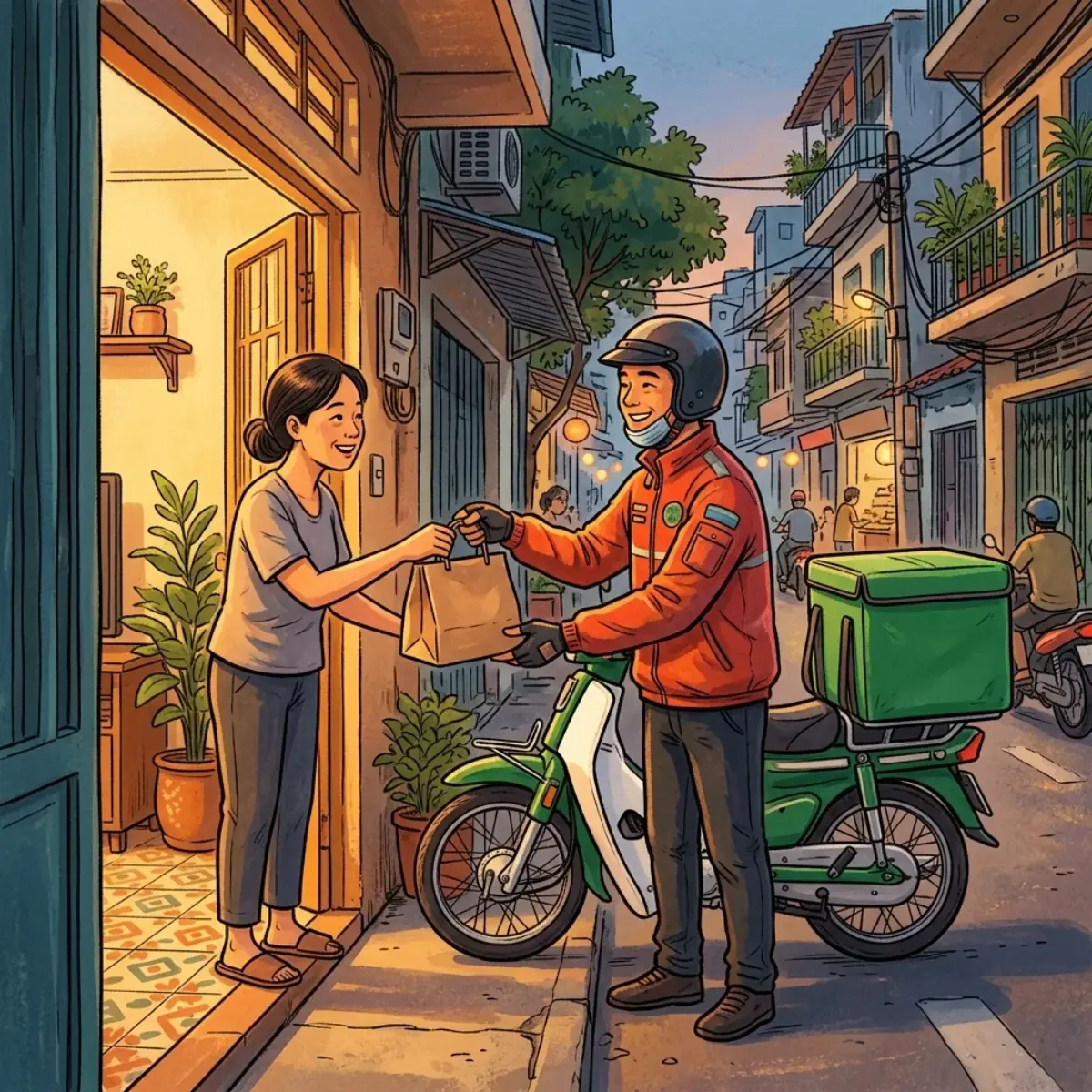
It's 8pm, it's raining, you're not moving. So you open the app, you tap, and forty minutes later your phone rings. A man is speaking very fast. He wants something. You panic and say "yes". This post is so that never happens again.
Quick answer: Ninety percent of every delivery call in Saigon is four things — tới chưa (are you here yet), ở đâu (where), để trước cửa (leave it at the door), and tiền mặt hay chuyển khoản (cash or transfer). Learn those four and you can order dinner forever.
First, the words on your screen
Switch the app to Vietnamese for one week. You'll pick these up by pure repetition, and suddenly the whole thing stops being scary. Here's the cheat-sheet, in little clusters.
Two more you'll want: ghi chú is the note box, and đánh giá is the star rating at the end. And when your friend says chốt đơn chưa? she means "did you hit confirm yet?"
Local tip
Shippers in Saigon are almost always anh to you, whatever your age — it's the friendly default, nobody is doing maths. He'll call you em if you sound young, chị or anh if you sound older. Just mirror whatever he uses and you're fine.
The note box: ghi chú
This is where you save yourself later. Short, plain, no full sentences needed. Saigon people write exactly like this:
"Are you here yet?" — the tới chưa family
The little dot on the map stopped moving. Your soup is getting cold. Time to text.
And what he answers, roughly always one of these three: Anh tới liền nha (I'm nearly there), Anh đang chờ quán làm đồ ăn (I'm waiting for the shop to cook it), Anh đang kẹt xe, em thông cảm nha (I'm stuck in traffic, sorry).
Good to know
If you say anh thông cảm nha back to him when you keep him waiting, you instantly sound like someone who's lived here a while. It's the all-purpose "sorry, be cool with me".
Telling him where you actually live
Saigon addresses are a genre of poetry. Alleys inside alleys, house numbers with slashes. The trick is not the address — it's the landmark.
Common mistake
In the South, the ground floor is tầng trệt and the one above it is lầu một. So lầu ba = three flights up. If you translate "third floor" straight from English you'll send the poor guy one floor wrong every single time. Say the room number too — phòng 305 settles the argument.
"Just leave it at the door"
The most useful line in the whole post. You're on a call, you're in the shower, you're in pyjamas you'd rather not debut publicly.
That little giùm is doing enormous work here. It turns a command into a favour, and Saigon runs on favours. Drop it in everywhere.
Cash or transfer? Tiền mặt hay chuyển khoản
If you already paid in the app, one sentence ends the conversation. If you didn't, here's the money dance.
Local tip
Tipping isn't required, but on a rainy night people do it and the word is bo. Em bo cho anh hai chục nha — "here's twenty for you". Say it with a smile, it always lands well.
When something's wrong
It happens. Missing drink, cold noodles, a soup bag that lost a fight with a speed bump. Stay light — the shipper usually didn't pack it.
Where the South really sounds different
Delivery talk is full of everyday objects, and that's exactly where the two dialects part ways. Everything in this post is Southern; this table is the only place Northern forms appear.
| Meaning | Southern (Saigon) | Northern (Hanoi) |
|---|---|---|
| alley | hẻm | ngõ |
| turn into | quẹo vô | rẽ vào |
| plastic bag | bịch | túi |
| glass / cup of drink | ly | cốc |
| bowl | tô, chén | bát |
| spoon | muỗng | thìa |
| give change | thối tiền | trả lại tiền |
| …for me (favour) | giùm | hộ |
| casual "no" | hông | không |
| one floor up | lầu một | tầng hai |
Try it yourself
- Text your shipper: "Where have you got to?"
- Tell him: "Leave it at the door for me, please."
- Ask: "Cash or transfer?"
- Say: "I've only got a 500 — do you have change?"
- Report the problem: "My order's missing the peach tea."
Answers: 1. Anh ơi, anh tới đâu rồi anh? · 2. Anh để trước cửa giùm em nha. · 3. Anh lấy tiền mặt hay chuyển khoản vậy anh? · 4. Em đưa năm trăm, anh có tiền thối hông anh? · 5. Anh ơi, đơn em thiếu ly trà đào rồi nè.
Frequently asked questions
The shipper called and I understood nothing. What do I say?
Buy yourself time with Dạ anh nói chậm chậm giùm em — "please say it slowly for me". If it's still a blur, Anh nhắn tin giùm em nha ("please text me instead") is completely normal and shippers do it constantly.
Do I really have to say dạ?
You don't have to, but that one syllable at the front of a sentence is the difference between sounding blunt and sounding like a nice person. It costs nothing and it works every time.
What if I want to cancel?
Do it in the app before the shop starts cooking. If you have to tell the shipper, say Dạ em xin lỗi, em huỷ đơn được hông anh? — "Sorry, can I cancel the order?" Once he's already picked the food up, honestly, just pay for it.
Is it rude to ask him to come inside the alley?
Not at all, that's the job. Just make it easy: Anh chạy vô hẻm chút xíu giùm em nha. If the alley is genuinely tiny, meeting him at the mouth of it earns you an instant five-star soulmate.
Is delivery Vietnamese a good place to start?
It's one of the best. Short sentences, high repetition, and you get immediate feedback in the form of dinner. It's also very Southern — the vocabulary above is exactly what students practise when they learn Southern Vietnamese online with us, because it's the language of an ordinary Saigon Tuesday.
Learn Southern Vietnamese online with people who actually speak it
SVFF is the school built entirely around the Southern (Saigon) dialect — native teachers from Ho Chi Minh City, since 2014.
- Listen to the SVFF podcast — real Southern Vietnamese, free.
- Book a free trial lesson — 30 minutes 1-on-1 with a native Saigon teacher.
- Browse our courses — structured A0–C1, all Southern dialect.
- Go Unlimited — every course and e-textbook, one payment.








0 Comments
Log in to leave a comment.