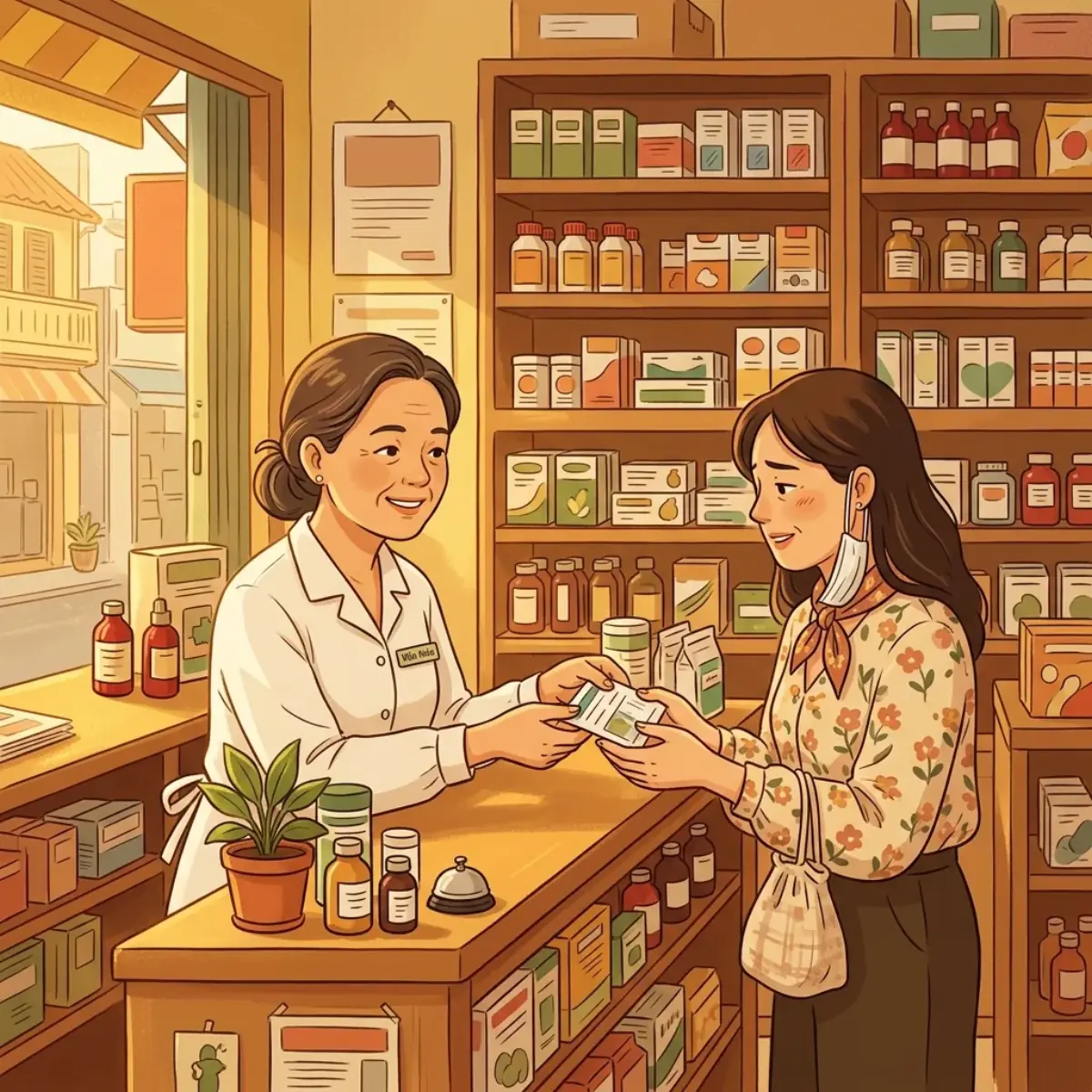
It is nine at night, you are two weeks into your Saigon trip, and something you ate is fighting back. Your head is pounding, your stomach is not happy, and the little green cross of a nhà thuốc glows across the street like a lighthouse. You walk in. The pharmacist looks up and says "Em cần gì?" — and your mind goes blank. This post makes sure that never happens. We are going to walk through one realistic pharmacy conversation, line by line, in authentic Southern (Saigon) Vietnamese.
Quick answer: To describe feeling sick, start with "Tui bị…" ("I've got…") plus the symptom — bị đau đầu (headache), bị đau bụng (stomachache), bị sốt (fever), bị cảm (a cold) — then ask "có thuốc gì hông?" ("got any medicine?").
The scene: a late-night pharmacy on a Saigon side street
Let's set it up as a real conversation first, then break down every useful phrase. Here's how it actually sounds — the customer is a learner named Minh, the pharmacist is a friendly woman in her forties.
Six lines, and you have survived. Now let's slow down and steal every phrase in there so it becomes yours.
Saying what's wrong: the "tui bị…" formula
The single most useful pattern is bị + symptom. That little word bị marks something bad happening to you — it's the "I've got / I'm suffering" of Vietnamese. In the South you'll often say tui for "I" in casual talk instead of the textbook tôi.
Local tip
Notice mệt. It's not only "tired" — Southerners use mệt trong người ("tired inside the body") to mean generally unwell, run-down, off-color. If someone says "Nay tui mệt lắm" they might mean sick, not just sleepy. Context (and how sorry they look) tells you which.
The pharmacist's questions — and how to answer
A good pharmacist will interview you a bit. Here are the questions you'll actually hear, all with that soft Southern hông ("no?") tacked on the end instead of the Northern không.
And your survival answers:
Good to know
Vietnamese "takes" medicine with the verb uống — literally "to drink" — even for a solid tablet. So uống thuốc is "take medicine," and một viên is "one tablet/pill." You will never say "eat medicine."
Asking for what you want at the counter
You don't have to wait to be asked. Walk in and lead with your request. These are the workhorse phrases:
Local tip
That word giùm ("do it for me / please") is pure Southern gold. The North says giúp. Tack giùm onto any request — "Lấy giùm tui" (get it for me), "Gói giùm nha" (wrap it up for me) — and you instantly sound like a local, not a phrasebook. Prices are quoted in ngàn (thousand), never the full number.
North vs South: same symptoms, different flavor
Most sickness vocabulary is shared across the country, but a handful of everyday words have a distinctly Southern feel. If you're learning Southern Vietnamese online, these are the ones to lock in.
| Meaning | Southern (Saigon) | Northern (Hanoi) |
|---|---|---|
| I (casual) | tui | tớ / mình |
| no? (tag question) | hông | không |
| please do for me | giùm | giúp / hộ |
| a bowl (of porridge/soup) | tô / chén | bát |
| spoon (for medicine) | muỗng | thìa |
| okay? / right? (soft ending) | nha / nghen | nhé |
| sick, unwell (feeling) | bịnh / mệt trong người | bệnh / mệt trong người |
The pharmacist will almost certainly send you home with advice to rest and eat light — and here the food words go Southern too:
Common mistake
Learners often say "Tui ốm" to mean "I'm sick," copying the Northern usage. But in the South, ốm mainly means thin / skinny! Tell a Saigon pharmacist "Tui ốm" and they may just think you're slim. Use bị bịnh, bị mệt, or the specific symptom instead.
Your pharmacy phrase cheat-sheet
Screenshot this. These are the lines that carry you from the door to the door.
Try it yourself
- Tell a pharmacist, casually and Southern-style, that you've had a headache since this morning.
- Ask "Do you have any stomach medicine?" using the soft Southern tag question.
- Ask how many times a day to take it, and whether it's before or after eating.
- Say "I'm not allergic to anything" in casual Southern speech.
Answers: 1) Chị ơi, tui bị đau đầu từ sáng tới giờ. 2) Có thuốc đau bụng hông chị? 3) Uống ngày mấy lần vậy chị? Trước hay sau khi ăn? 4) Tui hổng có bị dị ứng gì hết.
Frequently asked questions
Do I need a prescription to buy medicine in Saigon?
For everyday things — thuốc hạ sốt (fever reducer), thuốc đau bụng (stomach medicine), cold remedies, painkillers — no. A neighborhood nhà thuốc will hand them over after a quick chat about your symptoms. For antibiotics and stronger drugs, the rules officially require a toa (prescription), so bring one if you have it.
What's the difference between "bịnh," "mệt," and "đau"?
Bịnh is "sick / ill" in general. Mệt is "tired / run-down," and Southerners stretch it to mean "unwell." Đau is specific "pain" and always pairs with a body part: đau đầu (head), đau bụng (belly), đau họng (throat), đau lưng (back).
Why does the pharmacist keep ending sentences with "nha" and "nghen"?
Those are the warm Southern softeners, roughly "okay?" or "alright?" They make instructions feel friendly and caring rather than bossy. Northerners use nhé for the same job. Copy nha and nghen and you'll blend right in.
Is it rude to call the pharmacist "chị"?
Not at all — it's the polite default for a woman around your age or a bit older. For an older man use chú, an older woman cô or dì, and a young clerk em. Starting with dạ (a respectful "yes") is the Southern way to sound sweet and well-mannered.
What's the fastest way to get comfortable with all this?
Roleplay it out loud with someone who actually speaks the dialect. Reading a cheat-sheet is step one; saying "tui bị đau bụng, có thuốc gì hông chị?" until it's automatic is step two. That's exactly the kind of situational practice we drill in lessons when you learn Southern Vietnamese online with a native Saigon teacher.
Learn Southern Vietnamese online with people who actually speak it
SVFF is the school built entirely around the Southern (Saigon) dialect — native teachers from Ho Chi Minh City, since 2014.
- Listen to the SVFF podcast — real Southern Vietnamese, free.
- Book a free trial lesson — 30 minutes 1-on-1 with a native Saigon teacher.
- Browse our courses — structured A0–C1, all Southern dialect.
- Go Unlimited — every course and e-textbook, one payment.








0 Comments
Log in to leave a comment.