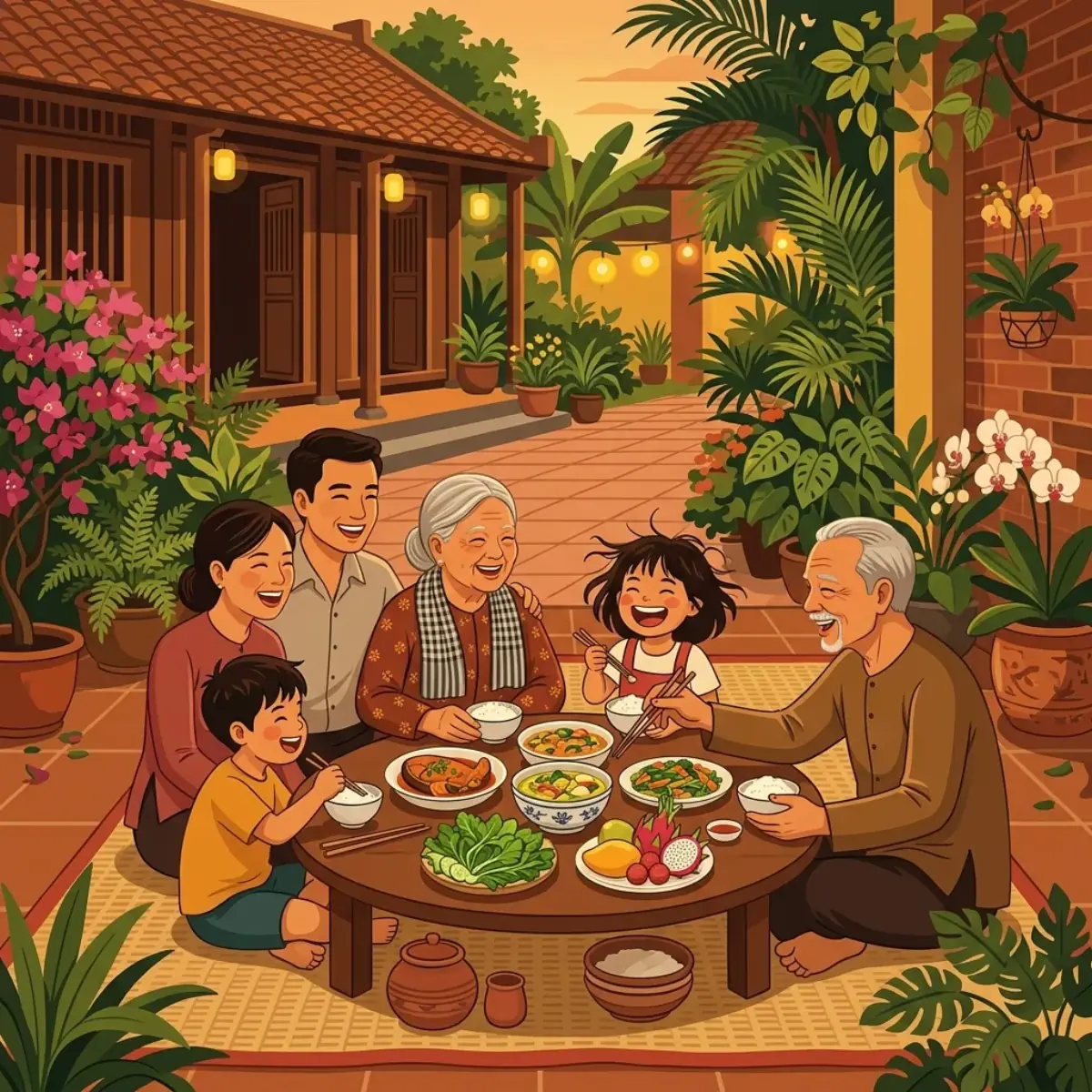
The first time a Vietnamese friend introduces you to her family, you'll notice something strange: nobody really says "you" or "I." Instead, everyone calls each other by their exact place in the family — ba, má, anh, chị, cô, chú. Get these words right and you don't just speak Vietnamese — you slot yourself into the family like you belong there.
Quick answer: In Southern Vietnamese, family members address each other by their relationship word instead of "you" and "I" — so a dad is ba, a mom is má, an older brother is anh, an older sister is chị, and a younger sibling is em.
Why family words replace "you" and "I"
Vietnamese doesn't lean on a single word for "you" the way English does. The word you choose depends on who the other person is to you — their age, their generation, their side of the family. Once you learn the family words, they double as pronouns. When your má speaks to you, she calls herself má and calls you con. When you answer, you call her má and call yourself con. The same two words carry the whole conversation.
Notice there's no "I" and no "you" anywhere — just con and má doing all the work. That's the heart of the system.
Parents: ba and má
In the South, dad is ba and mom is má. You'll also hear tía for dad in the countryside and among older families, and bố shows up too — but the warm, everyday Saigon default is ba and má.
Local tip
That little ơi after a name or title is how you call out to someone — like "hey" but affectionate. Má ơi!, Anh ơi!, Cô ơi! You'll use it a hundred times a day in Saigon.
Siblings: anh, chị, em
Vietnamese siblings aren't just "brother" and "sister" — they're marked by who's older. An older brother is anh, an older sister is chị, and anyone younger than you (brother or sister) is em. There's no single word for "younger brother" you'd use to their face — you just call them em, or by their name.
Good to know
Southern families number their kids, and the counting starts at Hai (Two), not Một (One). So the eldest is anh Hai or chị Hai, the next is anh Ba, and so on. There's an old belief you don't name the "first" child directly — so everyone starts from two.
Grandparents: ông and bà
Grandpa is ông, grandma is bà. To be specific about which side, the South often adds nội (dad's side) or ngoại (mom's side): ông nội, bà ngoại. Kids very commonly shorten it and just call their maternal grandma ngoại — one of the most tender words in the whole language.
Aunts and uncles: this is where it gets specific
English lumps every parent's sibling into "aunt" and "uncle." Vietnamese refuses to. The word changes depending on whether the relative is on your dad's or mom's side, older or younger than your parent, and whether they married in. Here's the Southern set that covers most of daily life:
Don't panic — you don't memorize a chart before speaking. In real life you usually just ask, or you copy what everyone else in the room calls that person. Here's how it sounds naturally:
Local tip
Út means "the youngest." Families use it like a name: dì Út, cậu Út, chú Út — the baby of that generation. Combine it with the numbers and you can place almost anyone: bác Ba is the third-eldest, cô Năm is the fifth, and so on.
Kids and grandkids: con and cháu
To your parents you are con (child). To your aunts, uncles, and grandparents you are cháu — which covers both "grandchild" and "niece/nephew." You'll also use con and cháu for yourself when speaking respectfully to older people, even strangers.
Married in: vợ, chồng, and the in-laws
A wife is vợ, a husband is chồng. But couples rarely call each other vợ and chồng to their faces — instead they use anh and em (older/younger), which is why so many Vietnamese sweethearts sound like affectionate siblings. Your spouse's parents you call ba and má, same as your own.
Southern vs Northern family words
This is one of the clearest places you can hear the dialect line. The words below are the same language, just different everyday choices — a Saigon family and a Hanoi family will pick different defaults for the very same relative.
| Meaning | Southern (Saigon) | Northern (Hanoi) |
|---|---|---|
| Dad | ba (also tía) | bố |
| Mom | má | mẹ |
| Parents (together) | ba má | bố mẹ |
| Maternal grandma (short) | ngoại | bà ngoại |
| Mom's brother | cậu | cậu |
| Dad's younger sister | cô | cô |
| Youngest child label | Út | Út |
| Sibling counting starts at | Hai (Two) | Cả / Hai |
Common mistake
Learners often mix up cô and dì because both translate to "aunt." Remember: cô is your dad's side, dì is your mom's side. Call your mom's sister cô and the whole room will gently correct you — it's dì.
How to address family you just met
Meeting your partner's relatives for the first time? The safe move is to guess age relative to your parents. Someone clearly older than your parents on either side → bác. A woman around your parents' age or a bit younger → cô or dì. A man a bit younger → chú or cậu. When in doubt, just ask warmly:
Leading with dạ (the soft Southern "yes/respectfully") and calling yourself con instantly signals warmth and good manners — even if you fumble the exact aunt-word, everyone will love you for trying.
Try it yourself
- Your mom's older sister is visiting. What do you call her — cô, dì, or bác?
- Fill in: "____ ơi, chở con đi học nha!" (calling your dad, Saigon-style).
- You want to say "Grandma (mom's side), I miss you." Start it with the short Southern word for her.
- Your partner is older than you. What word do you use for them, and what do you call yourself?
Answers: 1) bác — she's older than your parent, either side. 2) Ba. 3) Ngoại ơi, con nhớ ngoại. 4) You call them anh (or chị) and call yourself em.
Frequently asked questions
Do Southern Vietnamese people really never say "you" and "I"?
Within family and everyday polite speech, essentially yes — you use the relationship word instead. Neutral pronouns like tôi exist but sound formal or distant, so among family you'll almost always hear con, má, anh, em and so on.
Is it rude to call an older stranger by a family word?
Not at all — it's the opposite of rude. Calling a shopkeeper cô or chú and yourself con is exactly how polite Saigon works. The family words extend to the whole society.
What's the difference between chú, cậu, and bác for "uncle"?
Chú is your dad's younger brother, cậu is your mom's brother, and bác is any uncle (either side) who's older than your parent. Age relative to your parent, plus which side, decides the word.
Why do siblings get numbered starting from Hai (Two)?
It's a Southern tradition — the eldest is Hai, not Một. So you'll meet anh Hai, chị Ba, cô Tư, all the way down to Út, the youngest.
Can I just learn these from a chart, or do I need to hear them?
Charts help, but this system lives in conversation — the same word flips between "you" and "I" depending on who's speaking. The fastest way is to hear it in real Saigon families, which is exactly why so many students choose to learn Southern Vietnamese online with native teachers rather than from a table alone.
Learn Southern Vietnamese online with people who actually speak it
SVFF is the school built entirely around the Southern (Saigon) dialect — native teachers from Ho Chi Minh City, since 2014.
- Listen to the SVFF podcast — real Southern Vietnamese, free.
- Book a free trial lesson — 30 minutes 1-on-1 with a native Saigon teacher.
- Browse our courses — structured A0–C1, all Southern dialect.
- Go Unlimited — every course and e-textbook, one payment.








0 Comments
Log in to leave a comment.