Emergencies in Vietnamese: How to Ask for Help in Saigon
<p class="lead">Here's the thing about emergencies: they don't wait for you to finish Unit 12. They happen at 8pm at a red light on Nguyễn Trãi, with a helmet on your head and a stranger's motorbike disappearing into traffic. So today we're doing the vocabulary nobody wants but everybody should have — the short, calm Southern Vietnamese lines that get people to actually turn around and help you.</p>
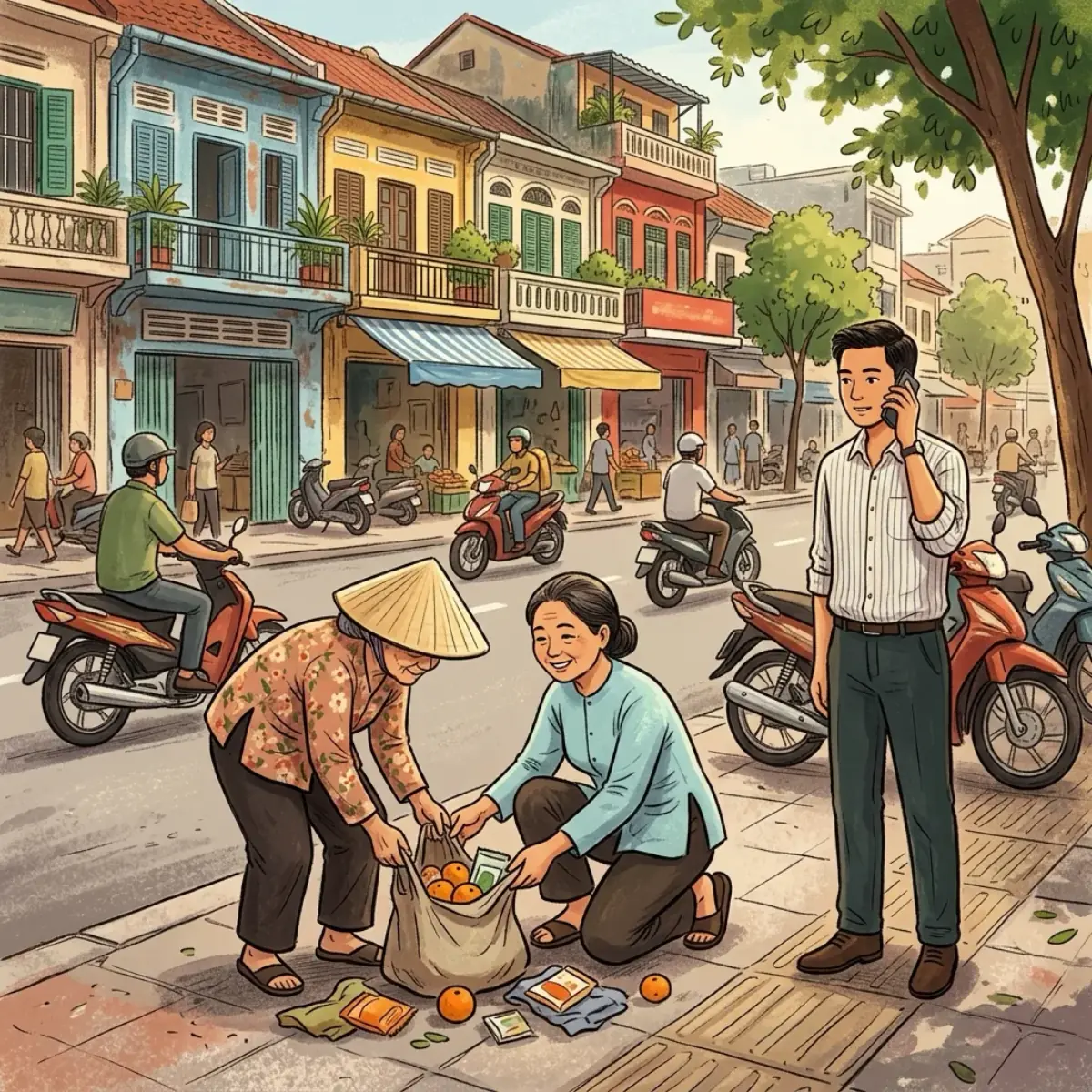
<p>Picture it. You're standing on the sidewalk, phone gone, heart pounding. The bánh mì lady is two meters away. What comes out of your mouth?</p>
<div class="bc-ex-grid">
<div class="bc-ex"><div class="bc-ex__vn"><span lang="vi">Cô ơi, cứu tui với!</span></div><div class="bc-ex__en">Ma'am, help me!</div><div class="bc-ex__lit"><b>Literally:</b> aunt hey, rescue me with.</div></div>
<div class="bc-ex"><div class="bc-ex__vn"><span lang="vi">Tui bị giựt điện thoại rồi!</span></div><div class="bc-ex__en">My phone just got snatched!</div><div class="bc-ex__lit"><b>Literally:</b> I suffer snatch phone already.</div></div>
</div>
<p>That's it. Two sentences. No grammar gymnastics, no polite warm-up. In a real emergency, Vietnamese gets short and loud, same as English.</p>
<div class="bc-answer"><span class="bc-answer__icon"></span><p><b>Quick answer:</b> Learn three things by heart — <span lang="vi">Cứu tui với!</span> (help me), <span lang="vi">Gọi công an giùm tui!</span> (call the police for me), and <span lang="vi">Bệnh viện gần nhứt ở đâu?</span> (where's the nearest hospital) — plus the numbers 113, 114 and 115.</p></div>
<h2>The numbers: 113, 114, 115</h2>
<p>Vietnam doesn't have one single 911. It has three, and they're easy to remember because they go in a row.</p>
<div class="bc-ex-grid">
<div class="bc-ex"><div class="bc-ex__vn"><span lang="vi">Gọi một một ba đi — công an!</span></div><div class="bc-ex__en">Call 113 — the police!</div><div class="bc-ex__lit"><b>Literally:</b> call one one three go — police.</div></div>
<div class="bc-ex"><div class="bc-ex__vn"><span lang="vi">Cháy nhà! Gọi một một bốn lẹ lên!</span></div><div class="bc-ex__en">House fire! Call 114, quick!</div><div class="bc-ex__lit"><b>Literally:</b> burn house! call one one four quick up.</div></div>
<div class="bc-ex"><div class="bc-ex__vn"><span lang="vi">Anh gọi giùm tui số một một năm được hông?</span></div><div class="bc-ex__en">Could you call 115 for me? (ambulance)</div><div class="bc-ex__lit"><b>Literally:</b> older-brother call help me number one one five can not.</div></div>
</div>
<div class="bc-box bc-note"><p class="bc-box__t">Good to know</p><p>The operators on 113/114/115 mostly speak Vietnamese only. That's exactly why the phrases below matter — and it's also why smart people in Saigon save a second number: their landlord, their office, or a Vietnamese friend who can be conferenced in. Honestly, in heavy traffic a <span lang="vi">xe cứu thương</span> (ambulance) can be slower than a Grab car. Locals often just flag a taxi and go.</p></div>
<h2>Move 1: Get people to look at you</h2>
<p>Vietnamese has one magic word for this, and it's <span lang="vi">cứu</span> — save/rescue. You don't need a full sentence.</p>
<div class="bc-ex-grid">
<div class="bc-ex"><div class="bc-ex__vn"><span lang="vi">Cứu! Cứu!</span></div><div class="bc-ex__en">Help! Help!</div><div class="bc-ex__lit"><b>Literally:</b> rescue! rescue!</div></div>
<div class="bc-ex"><div class="bc-ex__vn"><span lang="vi">Có ai giúp tui với!</span></div><div class="bc-ex__en">Somebody help me!</div><div class="bc-ex__lit"><b>Literally:</b> have who help me with.</div></div>
<div class="bc-ex"><div class="bc-ex__vn"><span lang="vi">Cướp! Cướp! Nó chạy đằng kia kìa!</span></div><div class="bc-ex__en">Thief! Thief! He went that way!</div><div class="bc-ex__lit"><b>Literally:</b> robber! robber! he run over there there.</div></div>
<div class="bc-ex"><div class="bc-ex__vn"><span lang="vi">Có người bị nạn! Lại đây phụ giùm cái!</span></div><div class="bc-ex__en">Someone's hurt! Come over here and give a hand!</div><div class="bc-ex__lit"><b>Literally:</b> have person suffer accident! come here assist favour one.</div></div>
</div>
<div class="bc-box bc-tip"><p class="bc-box__t"> Local tip</p><p>Adding <span lang="vi">với</span> at the end of a shout is what makes it sound like a real cry for help instead of a sentence from a book. <span lang="vi">Cứu tui với!</span> hits differently than a flat <span lang="vi">Giúp tôi</span>. And if you can grab one person and call them <span lang="vi">anh</span>, <span lang="vi">chị</span>, <span lang="vi">cô</span> or <span lang="vi">chú</span>, do it — a crowd helps nobody, one named person helps immediately.</p></div>
<h2>Move 2: Say what happened in one sentence</h2>
<p>The pattern is beautifully simple: <span lang="vi">Tui bị</span> + the bad thing. That's it. You don't need past tense, you don't need articles.</p>
<div class="bc-ex-grid">
<div class="bc-ex"><div class="bc-ex__vn"><span lang="vi">Tui bị móc túi rồi.</span></div><div class="bc-ex__en">I got pickpocketed.</div><div class="bc-ex__lit"><b>Literally:</b> I suffer pick pocket already.</div></div>
<div class="bc-ex"><div class="bc-ex__vn"><span lang="vi">Tui bị mất cái bóp, trong đó có hộ chiếu.</span></div><div class="bc-ex__en">I lost my wallet — my passport's in it.</div><div class="bc-ex__lit"><b>Literally:</b> I suffer lose classifier wallet, inside there have passport.</div></div>
<div class="bc-ex"><div class="bc-ex__vn"><span lang="vi">Có vụ đụng xe ở đằng kia, có người bị thương.</span></div><div class="bc-ex__en">There's been a crash over there, someone's injured.</div><div class="bc-ex__lit"><b>Literally:</b> have case bump vehicle at over there, have person suffer wound.</div></div>
<div class="bc-ex"><div class="bc-ex__vn"><span lang="vi">Tui kiếm hổng thấy con tui, nó năm tuổi.</span></div><div class="bc-ex__en">I can't find my child, she's five.</div><div class="bc-ex__lit"><b>Literally:</b> I search not see child my, she five year.</div></div>
<div class="bc-ex"><div class="bc-ex__vn"><span lang="vi">Có người theo tui từ nãy giờ, tui sợ quá trời.</span></div><div class="bc-ex__en">Someone's been following me — I'm really scared.</div><div class="bc-ex__lit"><b>Literally:</b> have person follow me from just-now until-now, I afraid whole sky.</div></div>
</div>
<div class="bc-box bc-mistake"><p class="bc-box__t"> Common mistake</p><p>Learners say <span lang="vi">Tui bị ăn cắp</span> thinking it means "I was robbed." It actually reads closer to "I was stolen" — like someone put <em>you</em> in a bag. You need the object: <span lang="vi">Tui bị ăn cắp đồ</span> or, easier and more natural, <span lang="vi">Tui bị mất đồ</span> (my stuff is gone) / <span lang="vi">Tui bị giựt đồ</span> (my stuff got snatched).</p></div>
<h2>Move 3: Ask a stranger to do the thing for you</h2>
<p>The single most useful word in this whole article is <span lang="vi">giùm</span> — "do it for me as a favour." Stick it after any verb and you've got a polite, urgent request.</p>
<div class="bc-ex-grid">
<div class="bc-ex"><div class="bc-ex__vn"><span lang="vi">Anh gọi công an giùm tui đi.</span></div><div class="bc-ex__en">Please call the police for me.</div><div class="bc-ex__lit"><b>Literally:</b> older-brother call police help me go.</div></div>
<div class="bc-ex"><div class="bc-ex__vn"><span lang="vi">Cho tui mượn điện thoại gọi một cuộc được hông?</span></div><div class="bc-ex__en">Can I borrow your phone for one call?</div><div class="bc-ex__lit"><b>Literally:</b> give me borrow phone call one call can not.</div></div>
<div class="bc-ex"><div class="bc-ex__vn"><span lang="vi">Chú kêu xe cứu thương giùm con với.</span></div><div class="bc-ex__en">Sir, please call an ambulance for me.</div><div class="bc-ex__lit"><b>Literally:</b> uncle call vehicle rescue injured help child with.</div></div>
<div class="bc-ex"><div class="bc-ex__vn"><span lang="vi">Tui hổng rành tiếng Việt lắm, nói chậm giùm tui nha.</span></div><div class="bc-ex__en">I don't know much Vietnamese — please speak slowly.</div><div class="bc-ex__lit"><b>Literally:</b> I not fluent language Viet very, speak slow help me okay.</div></div>
<div class="bc-ex"><div class="bc-ex__vn"><span lang="vi">Anh nói lại từ từ giùm tui được hông?</span></div><div class="bc-ex__en">Could you say that again slowly?</div><div class="bc-ex__lit"><b>Literally:</b> older-brother say again slowly help me can not.</div></div>
</div>
<h2>Move 4: Hospital, right now</h2>
<div class="bc-ex-grid">
<div class="bc-ex"><div class="bc-ex__vn"><span lang="vi">Bệnh viện gần nhứt ở đâu vậy anh?</span></div><div class="bc-ex__en">Where's the nearest hospital?</div><div class="bc-ex__lit"><b>Literally:</b> hospital near most at where huh older-brother.</div></div>
<div class="bc-ex"><div class="bc-ex__vn"><span lang="vi">Chở tui tới bệnh viện gần nhứt giùm cái, tui trả thêm tiền.</span></div><div class="bc-ex__en">Take me to the nearest hospital please — I'll pay extra.</div><div class="bc-ex__lit"><b>Literally:</b> carry me arrive hospital near most help one, I pay add money.</div></div>
<div class="bc-ex"><div class="bc-ex__vn"><span lang="vi">Ảnh chảy máu nhiều quá, đi lẹ đi anh!</span></div><div class="bc-ex__en">He's bleeding a lot — go fast!</div><div class="bc-ex__lit"><b>Literally:</b> he flow blood much too, go quick go older-brother.</div></div>
<div class="bc-ex"><div class="bc-ex__vn"><span lang="vi">Cổ xỉu rồi, ai biết sơ cứu hông?</span></div><div class="bc-ex__en">She fainted — does anyone know first aid?</div><div class="bc-ex__lit"><b>Literally:</b> she faint already, who know first rescue not.</div></div>
<div class="bc-ex"><div class="bc-ex__vn"><span lang="vi">Đừng có đụng vô ảnh, chờ xe cứu thương tới cái đã.</span></div><div class="bc-ex__en">Don't move him, wait for the ambulance first.</div><div class="bc-ex__lit"><b>Literally:</b> don't have touch into him, wait vehicle rescue injured arrive one first.</div></div>
<div class="bc-ex"><div class="bc-ex__vn"><span lang="vi">Tui đau ngực, khó thở quá.</span></div><div class="bc-ex__en">My chest hurts, I can't breathe properly.</div><div class="bc-ex__lit"><b>Literally:</b> I hurt chest, hard breathe too.</div></div>
</div>
<div class="bc-box bc-tip"><p class="bc-box__t"> Local tip</p><p>Learn to say your address out loud <em>before</em> you need it: <span lang="vi">Tui đang ở số hai mươi ba, đường Nguyễn Trãi, quận Một.</span> Everything in Saigon runs on <span lang="vi">quận</span> and <span lang="vi">phường</span>, and the first thing anyone asks is <span lang="vi">Ở đâu?</span> Knowing your ward number by heart is worth more than fifty vocabulary words.</p></div>
<h2>At the ward police: a short dialogue</h2>
<p>Phone snatched, you walk into <span lang="vi">công an phường</span>. Here's roughly how it goes.</p>
<div class="bc-ex-grid">
<div class="bc-ex"><div class="bc-ex__vn"><span lang="vi">Dạ chào anh. Tui bị giựt điện thoại hồi nãy, tui muốn trình báo.</span></div><div class="bc-ex__en">You: Hello. My phone got snatched earlier — I'd like to report it.</div><div class="bc-ex__lit"><b>Literally:</b> yes greet older-brother. I suffer snatch phone earlier, I want present report.</div></div>
<div class="bc-ex"><div class="bc-ex__vn"><span lang="vi">Bị ở đâu, mấy giờ vậy em?</span></div><div class="bc-ex__en">Officer: Where did it happen, what time?</div><div class="bc-ex__lit"><b>Literally:</b> suffer at where, how-many hour huh younger-sibling.</div></div>
<div class="bc-ex"><div class="bc-ex__vn"><span lang="vi">Dạ khoảng tám giờ tối, ngay góc đường gần chợ đó anh.</span></div><div class="bc-ex__en">You: Around 8pm, right at the corner near the market.</div><div class="bc-ex__lit"><b>Literally:</b> yes about eight hour evening, right corner road near market that older-brother.</div></div>
<div class="bc-ex"><div class="bc-ex__vn"><span lang="vi">Em có nhớ mặt tụi nó hông? Đi xe gì?</span></div><div class="bc-ex__en">Officer: Do you remember their faces? What vehicle?</div><div class="bc-ex__lit"><b>Literally:</b> younger-sibling have remember face group them not. ride vehicle what.</div></div>
<div class="bc-ex"><div class="bc-ex__vn"><span lang="vi">Dạ hai người đi xe máy, tụi nó chạy lẹ quá, tui hổng thấy rõ.</span></div><div class="bc-ex__en">You: Two guys on a motorbike, they went so fast I couldn't see clearly.</div><div class="bc-ex__lit"><b>Literally:</b> yes two person ride motorbike, group them run fast too, I not see clear.</div></div>
<div class="bc-ex"><div class="bc-ex__vn"><span lang="vi">Ừ, em điền cái đơn này, đưa hộ chiếu anh coi.</span></div><div class="bc-ex__en">Officer: Okay, fill in this form and let me see your passport.</div><div class="bc-ex__lit"><b>Literally:</b> yeah, younger-sibling fill classifier form this, give passport older-brother look.</div></div>
<div class="bc-ex"><div class="bc-ex__vn"><span lang="vi">Dạ. Anh cho tui xin cái giấy xác nhận để làm bảo hiểm nha.</span></div><div class="bc-ex__en">You: Sure. Please give me the confirmation paper for my insurance.</div><div class="bc-ex__lit"><b>Literally:</b> yes. older-brother give me ask classifier paper confirm in-order-to do insurance okay.</div></div>
</div>
<p>That last line is the one people forget. No paper, no insurance claim — and no easy replacement of a lost passport. Say it before you leave.</p>
<h2>Southern vs Northern words in this situation</h2>
<p>This is one topic where the vocabulary really does split. Everything above is Saigon speech; here's what changes up north, just so you're not confused if you hear it.</p>
<div class="bc-table-wrap"><table><thead><tr><th>Meaning</th><th>Southern (Saigon)</th><th>Northern (Hanoi)</th></tr></thead><tbody>
<tr><td>wallet</td><td><span lang="vi">bóp</span></td><td><span lang="vi">ví</span></td></tr>
<tr><td>to snatch (from a moving bike)</td><td><span lang="vi">giựt</span></td><td><span lang="vi">giật</span></td></tr>
<tr><td>to call / summon someone</td><td><span lang="vi">kêu</span></td><td><span lang="vi">gọi</span></td></tr>
<tr><td>…for me (favour)</td><td><span lang="vi">giùm</span></td><td><span lang="vi">hộ</span></td></tr>
<tr><td>nearest</td><td><span lang="vi">gần nhứt</span></td><td><span lang="vi">gần nhất</span></td></tr>
<tr><td>to faint</td><td><span lang="vi">xỉu</span></td><td><span lang="vi">ngất</span></td></tr>
<tr><td>traffic collision</td><td><span lang="vi">đụng xe</span></td><td><span lang="vi">đâm xe</span></td></tr>
<tr><td>not / no — casual spoken form</td><td><span lang="vi">hổng</span> / <span lang="vi">hông</span></td><td><span lang="vi">chả</span> / <span lang="vi">chẳng</span></td></tr>
</tbody></table></div>
<p>One note on that last row: <span lang="vi">không</span> itself is standard everywhere, South included — it's just that in fast Saigon speech it usually comes out as <span lang="vi">hổng</span> or <span lang="vi">hông</span>. Same with <span lang="vi">gọi</span>: for phoning someone, everybody says <span lang="vi">gọi</span>. <span lang="vi">Kêu</span> is the Southern word for calling a person over or summoning a taxi.</p>
<h2>Saying you're okay (and saying you're not)</h2>
<p>After a small scrape, half the conversation is people checking on you. Two answers cover almost everything.</p>
<div class="bc-ex-grid">
<div class="bc-ex"><div class="bc-ex__vn"><span lang="vi">Tui hổng sao, cảm ơn anh nghen.</span></div><div class="bc-ex__en">I'm fine, thanks.</div><div class="bc-ex__lit"><b>Literally:</b> I not matter, thank older-brother okay.</div></div>
<div class="bc-ex"><div class="bc-ex__vn"><span lang="vi">Tui bị trặc chân, đi hổng nổi.</span></div><div class="bc-ex__en">I twisted my ankle, I can't walk.</div><div class="bc-ex__lit"><b>Literally:</b> I suffer sprain leg, walk not able.</div></div>
<div class="bc-ex"><div class="bc-ex__vn"><span lang="vi">Bình tĩnh nha, xe cứu thương tới liền nè.</span></div><div class="bc-ex__en">Stay calm, the ambulance is coming right away.</div><div class="bc-ex__lit"><b>Literally:</b> calm steady okay, vehicle rescue injured arrive immediately here.</div></div>
<div class="bc-ex"><div class="bc-ex__vn"><span lang="vi">Ở đây với tui chút được hông, tui sợ quá.</span></div><div class="bc-ex__en">Can you stay with me a bit? I'm scared.</div><div class="bc-ex__lit"><b>Literally:</b> stay here with me a-bit can not, I afraid too.</div></div>
</div>
<div class="bc-practice"><h3> Try it yourself</h3><ol>
<li>Shout for help to a woman around your mother's age standing nearby.</li>
<li>Tell a stranger your phone was snatched.</li>
<li>Ask a Grab driver to take you to the nearest hospital.</li>
<li>Ask someone to call 115 for you.</li>
<li>At the police station, ask for the confirmation paper for insurance.</li>
</ol><p style="margin-top:10px;"><em>Answers: 1. <span lang="vi">Cô ơi, cứu tui với!</span> · 2. <span lang="vi">Tui bị giựt điện thoại rồi!</span> · 3. <span lang="vi">Anh chở tui tới bệnh viện gần nhứt giùm cái.</span> · 4. <span lang="vi">Anh gọi giùm tui số một một năm được hông?</span> · 5. <span lang="vi">Anh cho tui xin cái giấy xác nhận để làm bảo hiểm nha.</span></em></p></div>
<h2>Frequently asked questions</h2>
<div class="bc-faq">
<h3>What's the difference between <span lang="vi">cứu</span> and <span lang="vi">giúp</span>?</h3>
<p><span lang="vi">Cứu</span> is rescue — danger, injury, someone in the water, someone bleeding. <span lang="vi">Giúp</span> is ordinary help, like carrying a box. In a real emergency shout <span lang="vi">cứu</span>; people react to it instantly.</p>
<h3>Do police in Saigon speak English?</h3>
<p>Sometimes at district level, rarely at the ward station. Bring a Vietnamese-speaking friend if you can, or open a translation app — but leading with <span lang="vi">Dạ chào anh, tui muốn trình báo</span> instantly changes the temperature of the conversation. People are noticeably warmer when you try.</p>
<h3>Is it <span lang="vi">công an</span> or <span lang="vi">cảnh sát</span>?</h3>
<p>In daily Saigon speech, <span lang="vi">công an</span> covers it — that's the word for the local police you'd actually go see. <span lang="vi">Cảnh sát</span> shows up in specific titles like traffic police, <span lang="vi">cảnh sát giao thông</span>. If you only remember one, remember <span lang="vi">công an</span>.</p>
<h3>What do I do if my passport is stolen?</h3>
<p>Report at the ward police where it happened, get that <span lang="vi">giấy xác nhận</span>, then contact your embassy. Say it plainly: <span lang="vi">Tui bị mất hộ chiếu, tui cần giấy xác nhận.</span> Take a photo of your passport page today — future you will be grateful.</p>
<h3>How do I practise this without an actual emergency?</h3>
<p>Say the lines out loud until they're muscle memory, not vocabulary. This is exactly the kind of thing worth drilling with a teacher — when you learn Southern Vietnamese online with a native Saigon speaker, you can role-play the police station, the crash, the hospital reception, and never freeze when it counts.</p>
</div>
<p>Hopefully you never need a single sentence from this article. But knowing them costs you twenty minutes, and not knowing them costs you a lot more. Practise them once this week, then go back to ordering coffee.</p>
<div class="post-cta">
<h2>Learn Southern Vietnamese online with people who actually speak it</h2>
<p>SVFF is the school built entirely around the Southern (Saigon) dialect — native teachers from Ho Chi Minh City, since 2014.</p>
<ul>
<li> <a href="https://svff.online/podcast">Listen to the SVFF podcast</a> — real Southern Vietnamese, free.</li>
<li> <a href="https://svff.online/trial">Book a free trial lesson</a> — 30 minutes 1-on-1 with a native Saigon teacher.</li>
<li> <a href="https://svff.online/courses">Browse our courses</a> — structured A0–C1, all Southern dialect.</li>
<li> <a href="https://svff.online/svff-unlimited">Go Unlimited</a> — every course and e-textbook, one payment.</li>
</ul>
</div>








0 Comments
Log in to leave a comment.