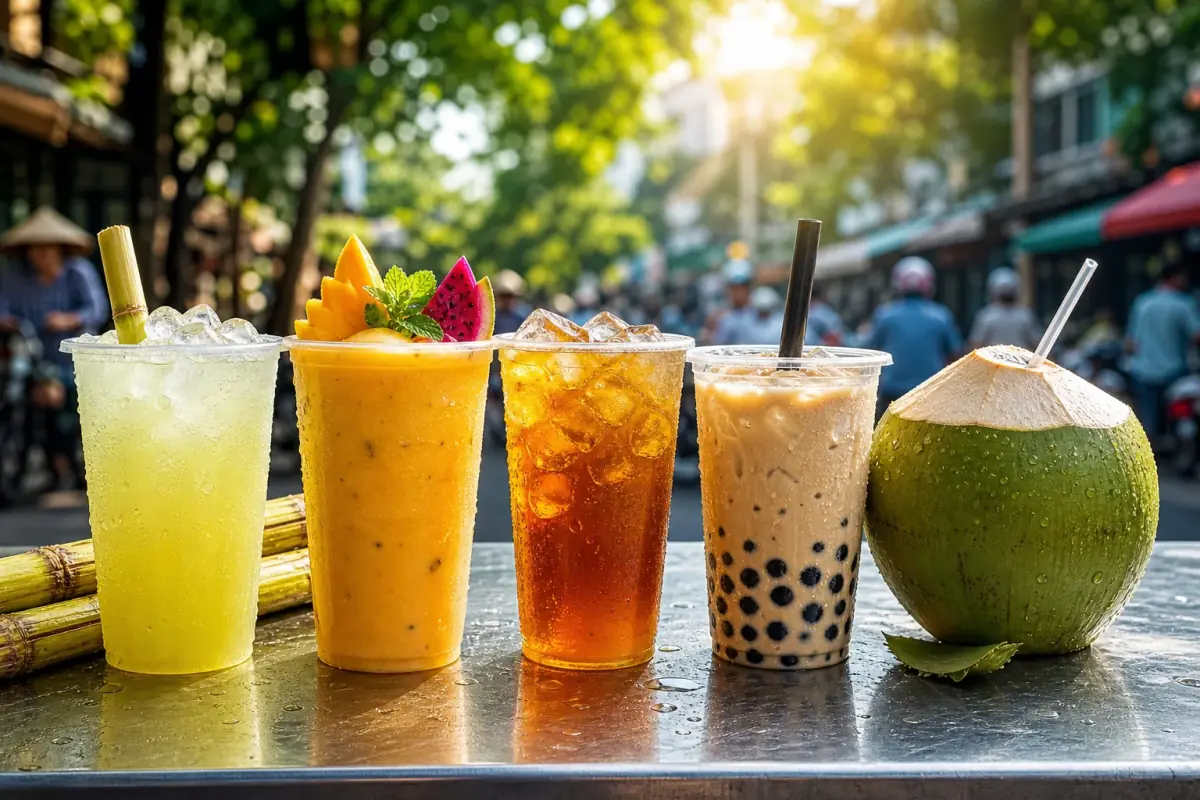
Everybody talks about Saigon coffee. Fine. But walk one block in this city and you'll pass a sugarcane cart, three trà sữa shops, a lady with a cooler of iced tea, a pile of coconuts, and a chè stand with eleven things in it. That's the real drink map. Let's learn how to order all of it — and how to stop the sugar before it stops you.
Quick answer: Say cho tui một ly… plus the drink name, then add ít đá (less ice) or ít đường (less sugar) — that one formula orders almost every drink in Saigon.
The two words that save your life: ít đá and ít đường
Saigon drinks are cold and sweet by default. Very cold. Very sweet. If you don't say anything, you get a glass that's 70% ice and tastes like candy. So learn these before anything else:
Stick them right after the drink. No grammar gymnastics needed:
Common mistake
Ít đá means less ice, not no ice. You'll still get ice — just less of it. If you truly want a warm-ish glass, say không đá. And if you want it warm on purpose, nóng works for tea and milk tea: Cho ly trà sữa nóng nha.
Nước mía — sugarcane juice, the true Saigon drink
A cart, a machine that screams, a stack of cane. Ten to fifteen ngàn a glass. On a 36-degree afternoon there is nothing better, and honestly nothing cheaper.
Local tip
Nobody adds sugar to nước mía — the cane is the sugar. So the only useful request here is ít đá. If you want it less sweet, ask for nước mía tắc: the kumquat cuts through it beautifully.
Sinh tố and nước ép — smoothies vs juice
Two different things, and people mix them up constantly. Sinh tố is blended thick, usually with condensed milk. Nước ép is pressed juice, thin, no milk.
Trà đá — the free one
Sit down at any quán cơm or quán hủ tiếu and a glass of pale iced tea lands on your table before you've said a word. That's trà đá. Usually free, usually refilled forever, and honestly it's half the reason eating out here feels so easy.
Good to know
At a small street eatery, trà đá is normally free. At a cafe or a nicer restaurant it's on the bill, maybe three to five ngàn. Nobody will be offended if you ask — Trà đá có tính tiền hông? is a completely normal question.
Trà sữa — milk tea, where the sugar negotiation happens
Milk tea shops changed how young Saigon orders drinks. Here they ask you for a sugar percentage, like you're programming your own diabetes level. Say a number and you'll sound like you've done this a hundred times.
Useful add-ons: trân châu (boba), thạch / rau câu (jelly), pudding, kem cheese (cheese foam). And the whole thing is mắc compared to a street drink — 40 to 60 ngàn is normal.
Nước dừa — coconut, straight from the trái
Note the classifier: coconuts come in trái, not ly. You're buying the whole fruit.
Bia — beer, quickly
Saigon beer culture is a whole universe (we've got a separate post on nhậu and toasting). Here, just the ordering part:
Chè — half drink, half dessert, all Saigon
In the South, chè is a sweet thing in a glass with beans, jelly, coconut milk and crushed ice. You drink it and spoon it at the same time. Ask for a muỗng if they forget.
Where Saigon and Hanoi really differ
The drinks themselves are mostly the same nationwide. The words around them are not.
| Meaning | Southern (Saigon) | Northern (Hanoi) |
|---|---|---|
| a glass (of drink) | ly | cốc |
| one coconut (classifier) | trái dừa | quả dừa |
| tea (the leaf/drink) | trà | trà or chè |
| sweet iced dessert soup | chè — always this meaning | chè, but it can also mean tea |
| typical street beer | bottles/cans: bia chai, bia lon | draft: bia hơi |
| "no / isn't it?" | hông | không |
| soft ending particle | nha / nghen / nhen | nhé |
Local tip
Ordering chè in Saigon will never get you a cup of tea. It gets you beans, jelly and coconut milk over ice. If you want actual tea, say trà.
Paying and leaving
Try it yourself
- Order two sugarcane juices with less ice, to go.
- Ask if the shop has soursop smoothie, and request less sugar.
- Ask the waitress for more iced tea.
- Order a brown-sugar boba milk tea, 30% sugar, less ice.
- Buy one fresh coconut and ask them to chop it open.
- Order a three-colour chè and ask for a spoon.
Answers: 1. Cho em hai ly nước mía ít đá, mang đi nha chị. 2. Có sinh tố mãng cầu hông chị? Cho ít đường nghen. 3. Chị ơi cho thêm trà đá giùm em. 4. Cho tui ly trà sữa trân châu đường đen, 30% đường, ít đá nha. 5. Cho con một trái dừa tươi, chặt giùm con nghen. 6. Cho con một ly chè ba màu, cho con xin cái muỗng nha.
Frequently asked questions
Is trà đá really free?
At street eateries, almost always yes, and they'll refill it all day. At cafes and sit-down restaurants it usually costs a few ngàn. Just ask: Trà đá có tính tiền hông chị?
What's the difference between ít đá and không đá?
Ít đá = less ice, you still get some. Không đá = zero ice. If you have a sensitive stomach, không đá is your friend.
How do I make milk tea less sweet?
Give a percentage — 30% đường, 50% đường, or 70% đường. Every trà sữa shop understands this. At a street cart, just say ít ngọt or ít đường.
Is chè a drink or a dessert?
In Saigon, both. It comes in a glass with a straw and a spoon. Nobody agrees on the category and nobody cares.
How do I say "to go"?
Mang đi or đem về. Full sentence: Cho em mang đi nha chị. If you're staying, Em uống ở đây.
Where can I practise these out loud?
Drink ordering is one of the fastest wins in the language — short sentences, instant feedback, and a cold glass at the end. If you want to drill it with someone who actually talks like the lady at the cart, you can learn Southern Vietnamese online with a native Saigon teacher and run through these lines in your first thirty minutes.
Learn Southern Vietnamese online with people who actually speak it
SVFF is the school built entirely around the Southern (Saigon) dialect — native teachers from Ho Chi Minh City, since 2014.
- Listen to the SVFF podcast — real Southern Vietnamese, free.
- Book a free trial lesson — 30 minutes 1-on-1 with a native Saigon teacher.
- Browse our courses — structured A0–C1, all Southern dialect.
- Go Unlimited — every course and e-textbook, one payment.








0 Comments
Log in to leave a comment.