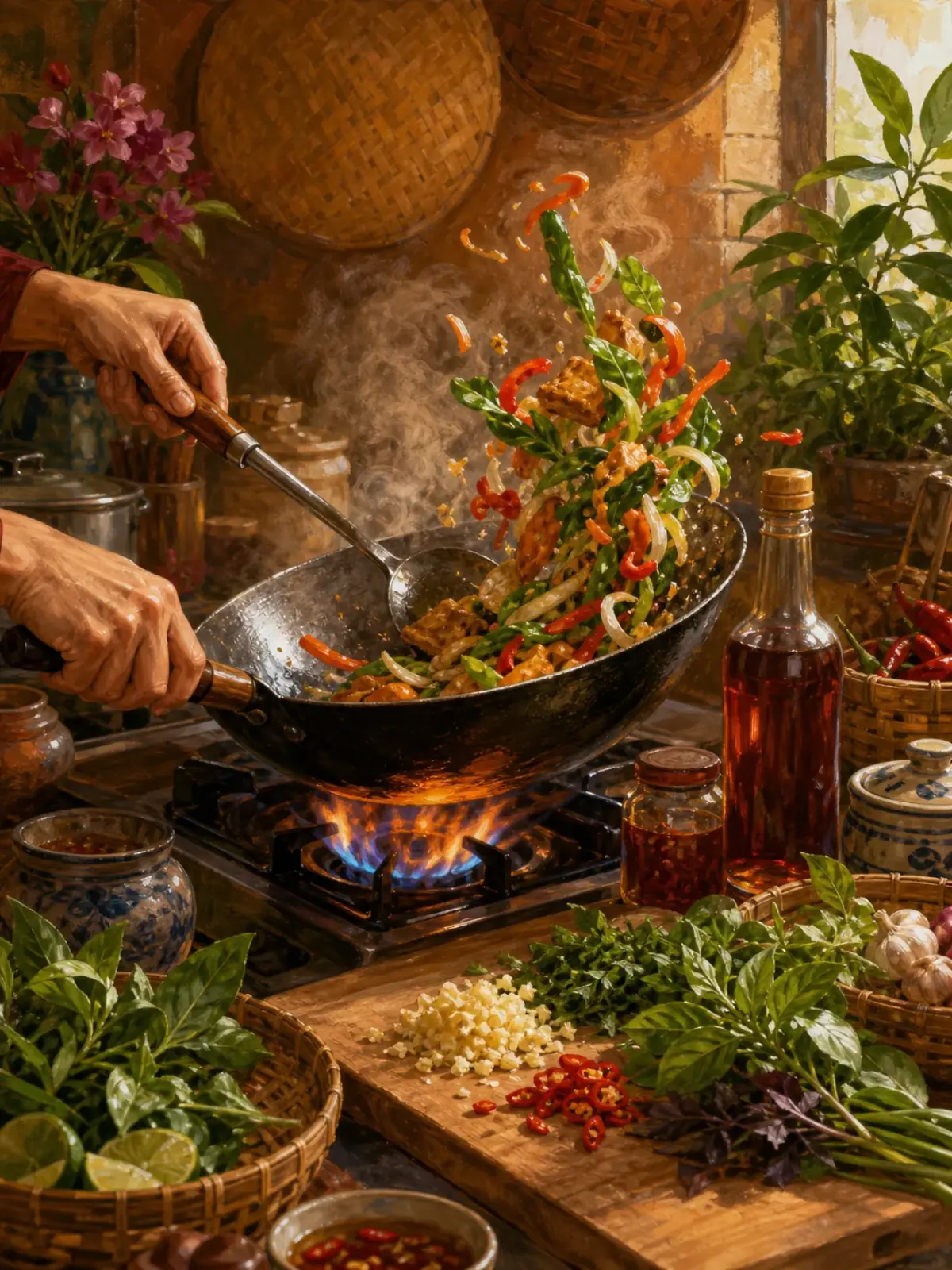
Nothing gets you adopted by a Vietnamese family faster than standing in the kitchen and being useful. But the kitchen has its own language — a whole set of verbs for "cook" depending on whether there's water, oil, fire or fish sauce involved. Let's sort it out, Saigon style.
Quick answer: Vietnamese doesn't have one word for "cook" — it has one verb per cooking method, so you pick luộc (boil), xào (stir-fry), chiên (fry), kho (braise in fish sauce), nướng (grill) or hấp (steam), and save nấu for the general "make a meal".
The big one: nấu
Nấu is your safe, general verb. Nấu cơm is making rice, nấu ăn is cooking in general, nấu canh is making soup. If you don't know which specific verb to use, nấu will not embarrass you.
The six cooking verbs you actually need
Here's the cheat-sheet. Learn these six and you can read 90% of a Vietnamese menu, which is a nice side effect.
Good to know
Kho is the one with no clean English translation, and it's the heart of Southern home cooking. It means simmering something low and slow in nước mắm, sugar and often nước dừa (coconut water) until the sauce goes dark and sticky. If a Saigon friend says nay má kho cá, drop your plans and go over.
The stove and the gear
Bếp is a lovely little word because it means both "stove" and "kitchen". Vô bếp = go into the kitchen. Bếp ga = gas stove, bếp từ = induction. And the thing you cook on the fire in is either nồi (pot) or chảo (pan).
Knife work: cắt, xắt, băm, gọt
English says "cut" for everything. Vietnamese splits it up, and Saigon has a favourite: xắt, for slicing things into pieces on a board.
Gia vị: the seasoning shelf
Gia vị means seasonings, and the Southern shelf is pretty predictable: nước mắm (fish sauce), muối (salt), đường (sugar), tiêu (pepper), bột ngọt (MSG), hạt nêm (seasoning granules), nước tương (soy sauce), dầu ăn (cooking oil), plus tỏi, hành and ớt.
Nêm — the verb that runs the kitchen
Nêm means "to season", and it lives right next to nếm ("to taste"). Same syllable, different tone, and Vietnamese cooks use them together constantly: nêm nếm, season-and-taste, season-and-taste, until it's right.
Local tip
The single most useful kitchen compliment is thơm quá! — "smells amazing!" Say it the moment you walk in, before you even see the food. The opposite is khét, that burnt smell: nghe mùi khét kìa, tắt bếp lẹ! ("I smell burning — turn off the stove, quick!")
North vs South in the kitchen
Cooking words are one of the places the dialects really split — same object, different word entirely. Everything on the left is what you'll hear in a Saigon kitchen.
| Meaning | Southern (Saigon) | Northern (Hanoi) |
|---|---|---|
| to pan-fry | chiên | rán |
| rice bowl | chén | bát |
| spoon | muỗng | thìa |
| plate | dĩa | đĩa |
| ladle | vá | muôi |
| MSG | bột ngọt | mì chính |
| peanut | đậu phộng | lạc |
| pineapple | trái thơm / khóm | quả dứa |
| coriander | ngò | rau mùi |
| bland / under-salted | lạt | nhạt |
Common mistake
Learners grab nấu for everything and end up saying nấu trứng when they mean a fried egg. If oil is involved, it's chiên. The other classic slip is using nóng for spicy food — nóng is temperature-hot. Chilli-hot is cay: món này cay quá trời!
Six kitchen phrases worth stealing
Try it yourself
- You want to say "Má is braising fish today."
- Ask a friend to fry two eggs for you.
- Say "The soup is too bland, add a little fish sauce."
- Say "This knife is blunt, it can't cut."
- Say "Turn the heat down, let it simmer gently."
Answers: 1. Nay má kho cá. · 2. Chiên giùm tui hai cái trứng nha. · 3. Canh lạt quá, nêm thêm chút nước mắm đi. · 4. Con dao này lụt quá, cắt hông được. · 5. Vặn lửa nhỏ lại, để riu riu.
Frequently asked questions
What's the difference between chiên and xào?
Chiên means frying something in a decent amount of oil until it's crisp and golden — eggs, spring rolls, fish. Xào is a fast toss in a hot pan with just a little oil, usually vegetables or noodles, and you keep stirring the whole time.
Is kho really that important?
Yes. In a Southern home, cơm + a kho dish + canh + some rau is basically the default dinner. Knowing the word means you can ask nay má kho gì vậy? and instantly sound like family.
Do Southerners really use bột ngọt that much?
Home cooks use it, street vendors use it, and nobody's shy about it. If you'd rather skip it, just say cho tui hông bỏ bột ngọt nha when you order — people hear that request all the time and won't be offended.
Why does bếp mean two different things?
Context does the work. Vô bếp = go into the kitchen; bếp ga, bếp từ, tắt bếp = the stove itself. Nobody ever gets confused, and neither will you after a week of hearing it.
What's the fastest way to actually practise this?
Cook with someone. Seriously — one afternoon in a Vietnamese kitchen beats a month of flashcards. If that's not available where you live, learn Southern Vietnamese online with a Saigon teacher and run a "cooking lesson" over video: you describe what's in your fridge, they walk you through making it. The vocabulary sticks because you're holding the knife.
Learn Southern Vietnamese online with people who actually speak it
SVFF is the school built entirely around the Southern (Saigon) dialect — native teachers from Ho Chi Minh City, since 2014.
- Listen to the SVFF podcast — real Southern Vietnamese, free.
- Book a free trial lesson — 30 minutes 1-on-1 with a native Saigon teacher.
- Browse our courses — structured A0–C1, all Southern dialect.
- Go Unlimited — every course and e-textbook, one payment.








0 Comments
Log in to leave a comment.