
Nobody wants to need this vocabulary. But sooner or later your coworker will lose their ba, or your landlady's mother will pass away, and everyone in the room will say a short sentence to the family — and you'll be the one standing there quietly, hoping a sad nod is enough. It isn't. In Vietnam, showing up and saying the right small sentence counts for more than saying anything beautiful. So let's get you ready, gently.
Here's how it usually starts. A message lands on Zalo at 6 in the morning:
Quick answer: The whole thing rests on one phrase — chia buồn, "to share the sadness." Say Chia buồn với anh/chị nghen, show up, light one incense stick, hand over an envelope, and leave quietly. That's 90% of it.
The one sentence you actually need
Chia buồn literally means "to divide the sorrow" — you're taking a piece of it off them. It is only for death. Not for a bad exam, not for a broken motorbike, not for a flu. Just death.
You'll also see the very formal written version on funeral flower wreaths and banners: Thành kính phân ưu — "respectfully sharing your grief." Nobody says that out loud to a person's face. It goes on the ribbon of the vòng hoa (flower wreath) and in the condolence book, sổ tang.
Don't say "died" — say "left"
The blunt word for die is chết, and you use it for mosquitoes, phone batteries and news headlines — not for somebody's grandmother while their family is standing right there. Saigon people soften it:
Mất ("lost") is your safe everyday word. Qua đời is a touch more formal, good for announcements. Đi rồi ("has gone") is the softest of all and very Saigon.
What you say in the first ten seconds
When you first hear the news, nobody expects a speech. React, then offer to come. That's the script.
Local tip
Ask Đám ở đâu? ("Where's the funeral?") rather than asking what happened. Asking about location shows you intend to come. Asking about the illness makes them relive it.
Phúng điếu: the envelope, the wreath, the incense
Phúng điếu is the custom of bringing money or offerings to a funeral. It's not a tip — it's how a neighbourhood collectively pays for a very expensive few days. Put cash in a plain white envelope (bao thư), write your name on it, and hand it to whoever is sitting at the table by the door, usually with the sổ tang.
Good to know
Some families print Miễn phúng điếu on the announcement — "no condolence money, please." Respect it. Bring flowers or fruit instead, or nothing at all. Coming is the gift.
How much? Don't overthink it. A coworker you know a bit: một trăm ngàn to hai trăm ngàn. A close friend or a neighbour you see daily: năm trăm ngàn and up. Nobody counts, and nobody judges a foreigner for guessing.
Inside the đám tang: what you do
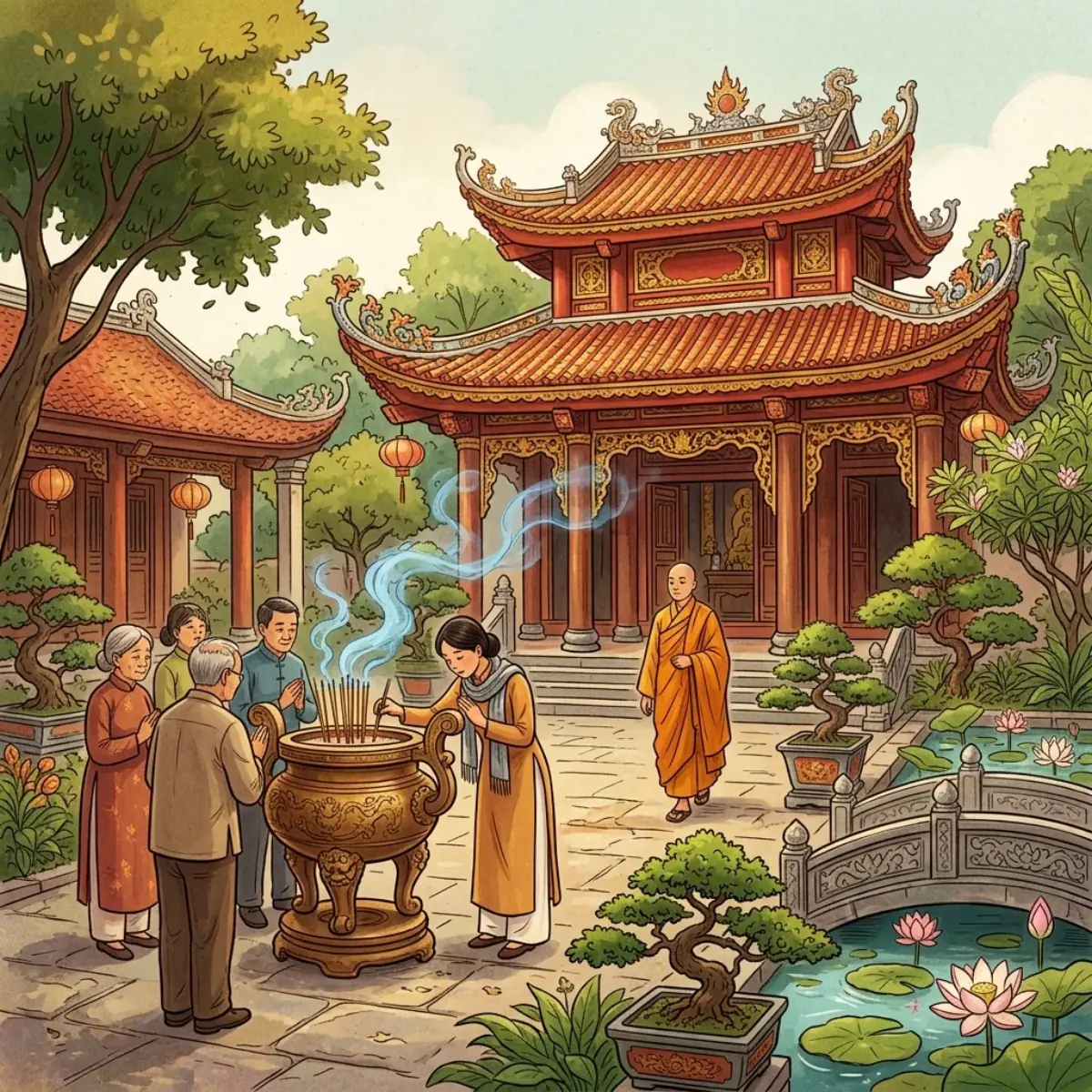
Southern funerals are usually held at the family home with a tent over the alley, or at a nhà tang lễ. You arrive, you're handed incense, you bow at the altar (bàn thờ) in front of the photo (di ảnh), you plant the incense in the pot, and you turn to bow slightly to the family standing beside it. They bow back. Nothing needs to be said at that moment — but if you want to:
Wear white, black, grey, navy. No red, no bright yellow, no big logos. And you can absolutely sit down, drink the tea they push at you, and say almost nothing — that's normal and it's appreciated.
When someone is sick, not gone
Totally different vocabulary. Do not use chia buồn here — it sounds like you've already buried them. For illness, you ask, you encourage, you feed them.
Offering help so it doesn't sound fake
"Let me know if you need anything" is polite in English and slightly empty in Vietnamese. Saigon people offer a specific thing, because a specific offer is easy to accept.
What NOT to say
Common mistake
1. Saying Xin lỗi for "I'm sorry for your loss." In Vietnamese that only means "I apologise" — you'll sound like you personally caused it. Always chia buồn.
2. Saying chia buồn to someone who's just ill. Deeply unlucky-sounding. Use mau hết bệnh nha.
3. Asking Chết sao vậy? Bệnh gì? ("How'd they die? What illness?") in the first minute. If they want to tell you, they will.
4. Saying Hẹn gặp lại nha ("See you again!") as you leave a funeral. Everyone will wince. Just say Thôi em về nghen.
Also skip the cheerful stuff — Vui lên đi! ("Cheer up!") is for a bad day at work, not for grief. And no photos, no laughing loudly in the tent, no "at least he lived a long life" unless the family says it first. If they do say it, echoing them is warm: Dạ, ông sống thọ, con cháu đầy đủ, cũng an lòng cô ha. — "He lived long and had all his children around him, that's a comfort."
Sending it on Zalo
Most condolences these days arrive as a message. Keep it short — three lines maximum. Long paragraphs are for eulogies.
Good to know
A year later there's đám giỗ — the death anniversary meal. If you get invited, go. Saying Mai giỗ bác hả chị? Em ghé thắp nhang nghen ("Is tomorrow his anniversary? I'll come light incense") is one of the kindest things a foreigner can say in Vietnamese.
North vs South: the words that differ
| Meaning | Southern (Saigon) | Northern (Hanoi) |
|---|---|---|
| incense stick | nhang | hương |
| to be sick | bệnh | ốm |
| get well soon | Mau hết bệnh nha! | Chóng khỏi nhé! |
| I'm sorry for your loss | Chia buồn với anh nghen. | Xin chia buồn cùng anh ạ. |
| the funeral | đám ma, đám tang | tang lễ, đám hiếu |
| coffin (everyday) | cái hòm | quan tài |
| envelope | bao thư | phong bì |
| to go pay respects | đi đám, đi viếng | đi viếng, đi phúng |
Try it yourself
- Your coworker's grandmother died. Text her one sentence.
- Your neighbour anh Tư has dengue fever. Say something kind and offer one specific thing.
- You're handing the envelope to the aunt at the door. What do you say?
- You're leaving the funeral tent. Say goodbye — without saying "see you again."
Answers: 1. Chị ơi, em mới hay tin, chia buồn với chị nghen. · 2. Anh mau hết bệnh nha, chiều em mua cháo qua cho anh. · 3. Dạ, chút lòng thành, cô nhận giùm con. · 4. Thôi em về nghen chị, có gì cứ kêu em.
Frequently asked questions
Do I have to go if I barely knew the person?
If you know the family — your boss, your neighbour, your teacher — then yes, go for fifteen minutes. Vietnamese funerals are about supporting the living, not honouring someone you never met.
Is chia buồn too formal for friends?
No, it's the standard phrase at every level. Just soften it with nghen or nha and your own name-for-them: Chia buồn với mày nghen works between close friends.
What if I cry or say the wrong thing?
Nobody will mind. Grieving families in Saigon are exhausted and kind; a foreigner who came, bowed, and mangled the tones is remembered warmly for years. Silence plus presence beats a perfect sentence sent from home.
Can I bring fruit or food instead of money?
Yes. A fruit basket, flowers, or a box of tea is completely normal, especially if the family said miễn phúng điếu. For a sick friend, fruit, cháo, or milk is the classic move.
How do I practise this without waiting for something terrible?
Role-play it with a teacher. It's one of the first things students ask for when they learn Southern Vietnamese online with us, because it's the moment where getting the register wrong is most painful — and getting it right is most remembered.
Learn Southern Vietnamese online with people who actually speak it
SVFF is the school built entirely around the Southern (Saigon) dialect — native teachers from Ho Chi Minh City, since 2014.
- Listen to the SVFF podcast — real Southern Vietnamese, free.
- Book a free trial lesson — 30 minutes 1-on-1 with a native Saigon teacher.
- Browse our courses — structured A0–C1, all Southern dialect.
- Go Unlimited — every course and e-textbook, one payment.







0 Comments
Log in to leave a comment.