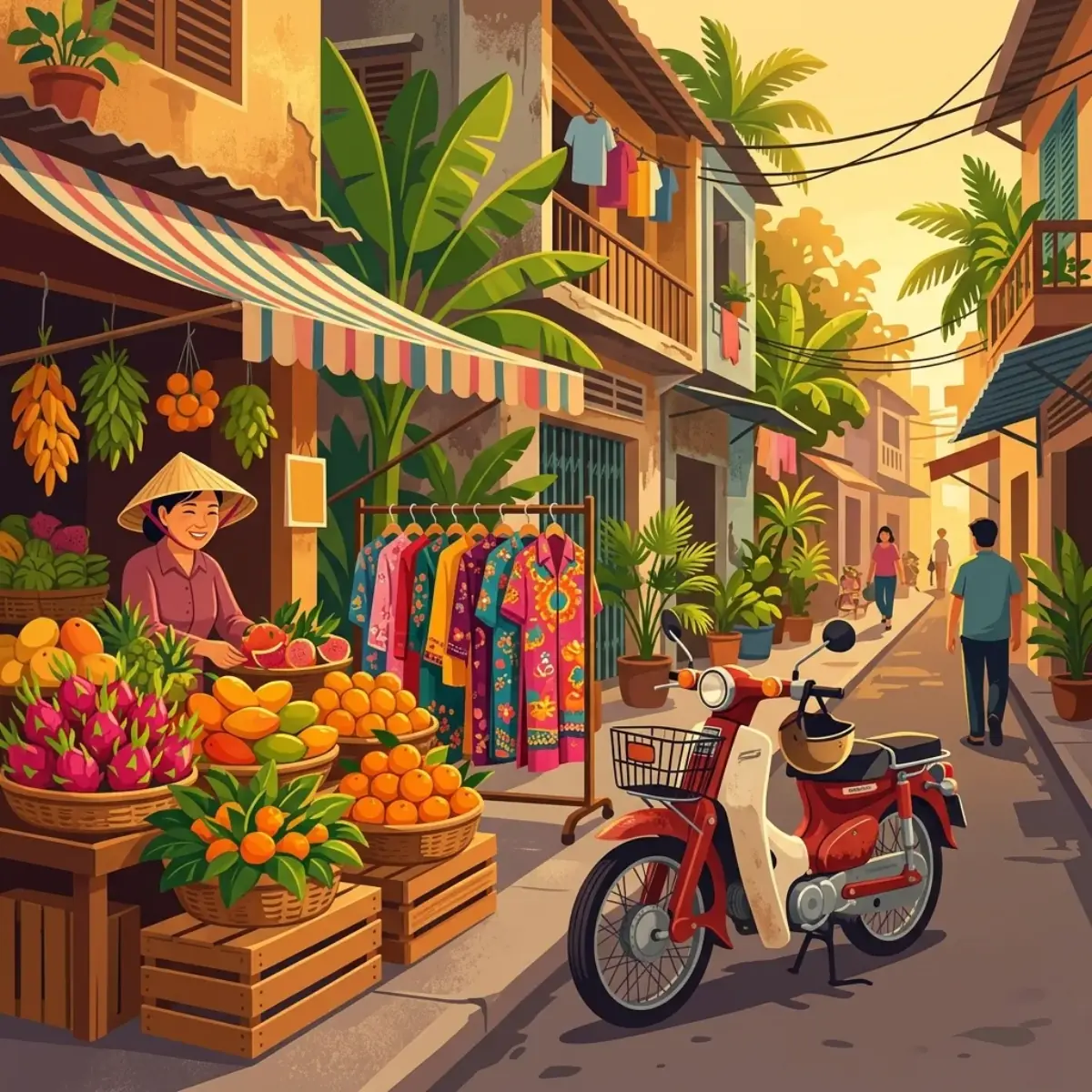
Colors are one of the first things you can actually use — pointing at the shirt you want, describing your motorbike to a Grab driver, picking the ripe mango at the market. The good news: Vietnamese colors are simple and the word order is easy. The fun news: there's one color word that means both blue and green, and locals are completely relaxed about it. Here's the whole palette, Saigon-style.
Quick answer: "Color" is màu, and the color word comes after the noun: áo đỏ = "red shirt" (literally "shirt red"). The core colors are đỏ (red), xanh (blue/green), vàng (yellow), đen (black) and trắng (white). The one twist: xanh covers both blue and green — add dương for blue or lá for green when you need to be exact.
The one rule: color goes after the noun
In English the color comes first ("a red shirt"). Vietnamese flips it: the thing first, the color second. Once you feel that, whole descriptions fall into place.
You'll notice màu ("color") is optional. Xe đen and xe màu đen both mean "black bike" — adding màu just sounds a touch more explicit, handy when you're describing something carefully.
Your Saigon color palette
A nice bonus: cam is also the word for "orange" the fruit, and hồng is "rose" — so a couple of these double as things you'll see at the market.
The famous xanh: blue or green?
Here's the quirk everyone loves. Vietnamese traditionally uses one word, xanh, for the whole blue-green range — the sky, the sea, the leaves, the grass. If it matters which one, you tack on a second word:
Good to know
In everyday speech, plain xanh is often enough — context tells people whether you mean the sky or the grass. Reach for xanh dương / xanh lá only when the difference actually matters, like choosing paint or a shirt.
Making colors stronger, softer, or "-ish"
Use the same intensity words you'd use for any adjective: đậm (dark/deep), nhạt (light/pale), and quá or lắm for "very / too."
Colors in real Saigon sentences
Local tip
At the fruit stall, color is ripeness. Vàng mango = ripe and sweet; xanh mango = green and sour (great with chili salt!). Knowing two color words genuinely gets you better fruit.
Common mistake
Putting the color first, English-style: đỏ áo. It should be áo đỏ — noun first, color second. Every time.
Try it yourself
- Say "a white shirt."
- Tell a Grab driver "my bike is blue" (use xanh dương) and end softly with nha.
- Say "I like the color green."
Answers: 1) áo trắng. 2) Xe của con màu xanh dương nha. 3) Tui thích màu xanh lá.
Frequently asked questions
Do I really not need to say blue vs green?
Correct — plain xanh is perfectly natural, and locals use it constantly. Only add dương (blue) or lá (green) when the exact shade matters.
Is màu ("color") ever required?
No, it's optional — xe đen and xe màu đen both work. Add màu when you want to be a bit more explicit or formal.
Are color words different in the South?
The color words themselves are the same nationwide — this is one topic with almost no North/South split, so you can learn these once and use them anywhere in Vietnam.
Learn Southern Vietnamese online with people who actually speak it
SVFF is the school built entirely around the Southern (Saigon) dialect — native teachers from Ho Chi Minh City, since 2014.
- Listen to the SVFF podcast — real Southern Vietnamese, free.
- Book a free trial lesson — 30 minutes 1-on-1 with a native Saigon teacher.
- Browse our courses — structured A0–C1, all Southern dialect.
- Go Unlimited — every course and e-textbook, one payment.








0 Comments
Log in to leave a comment.