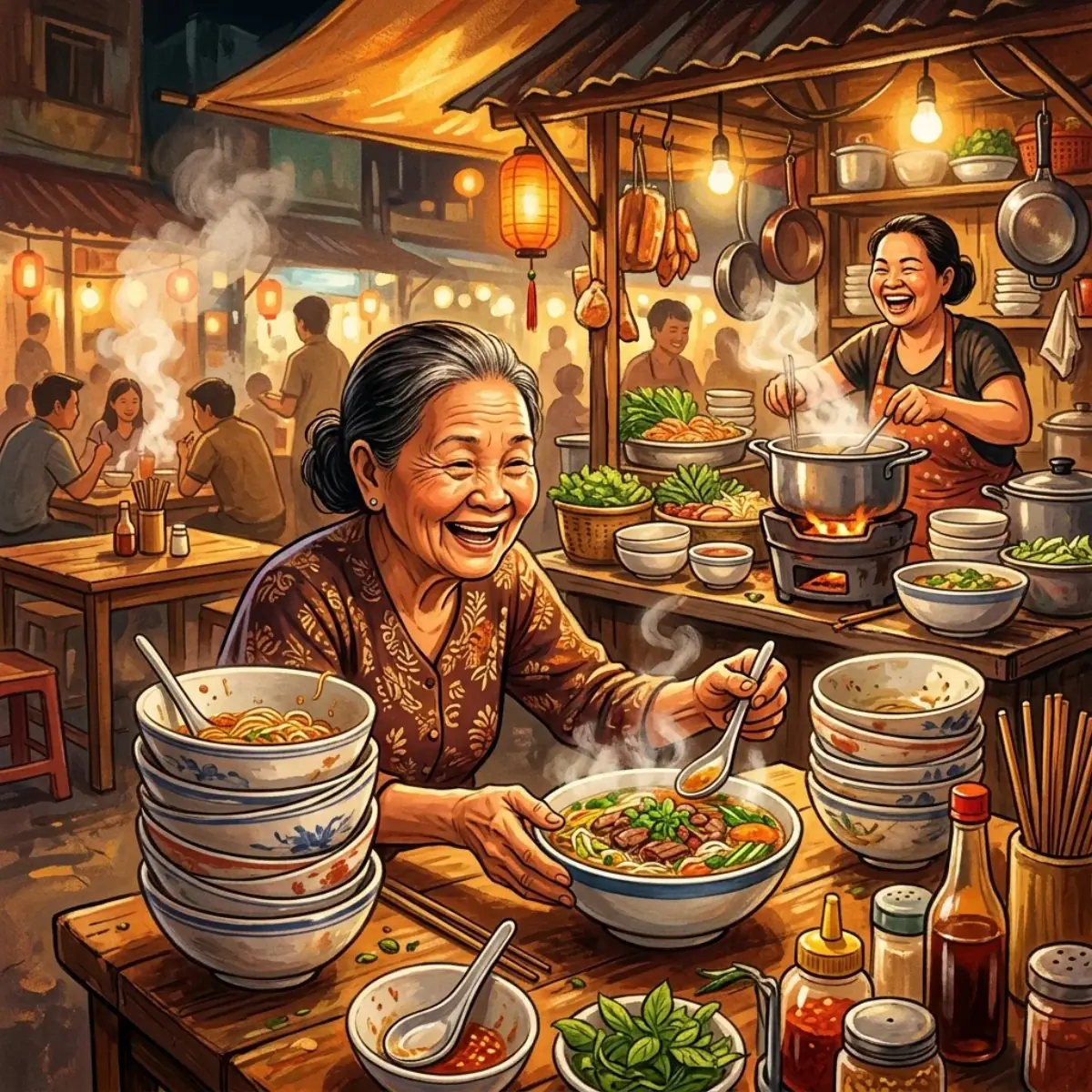
There's a moment every learner hits in Saigon. You're on a plastic stool, second bowl of something, and the auntie laughs and says a sentence with one word repeated twice. You catch nothing except that word. Twice. That word is càng, and once you own it, you can say about forty new things by tonight.
Quick answer: càng A càng B = "the more A, the more B" — and càng ngày càng = "more and more as time goes by."
Let me show you the scene first, then we'll take it apart.
The shape: càng ___ càng ___
That's it. Two slots. You put a verb or adjective in the first, a verb or adjective in the second, and Vietnamese does in four words what English needs a whole clause pair for.
English: "The more it rains, the worse the flooding gets." Saigon: càng mưa càng ngập. Four words. Done. This is one of those patterns that makes you sound way better than your actual level, which is exactly the kind of shortcut I like handing people.
When the two halves have different subjects
Sometimes it's not the same person doing both things. Then you just name the second subject after the second càng. Nothing fancy — no linking word needed.
Good to know
That little thì in the middle is optional. It's a soft "then," and Saigon speech drops it constantly. Tui càng nói nó càng lì is perfectly normal. Put it in when the sentence is long and you want a breath in the middle.
càng ngày càng — "more and more, day by day"
Now the version you'll hear the absolute most. Càng ngày càng literally has ngày (day) sitting in the first slot: "the more days pass, the more ___." It's how you describe a trend — something changing over time, usually with a bit of feeling attached.
Notice how casual all of those are. Càng ngày càng isn't formal writing language. It's what your neighbour says while hanging laundry.
Local tip
You'll also run into the shorter ngày càng — giá nhà ngày càng mắc. Same meaning, slightly tighter, and it's the version the news and written Vietnamese prefer. Both are fine. If you're just talking, càng ngày càng is the safest bet.
Other things you can shove in the first slot
Ngày isn't the only "measuring stick." Any word for a growing amount works, and each one gives you a different flavour.
Just one càng: "even more so"
You can also use a single càng on its own — hanging off a cause, or thrown in as a reaction to what someone just said. It means "even more," "all the more." This one's great for gossip and for complaining, which covers most of daily conversation.
Common mistake
Don't mix càng with hơn in the same clause. Saying càng ngày càng mắc hơn is doubling up — càng already carries the "-er." Just say càng ngày càng mắc. Same goes for stacking rất or quá in there: càng ngày càng rất nóng sounds broken. Keep the second slot bare.
Common mistake
Learners often forget the second càng. Càng ăn ghiền isn't a sentence, it's a shrug. The pattern needs both halves. Think of them as a pair of chopsticks — one alone doesn't do the job.
North vs South
Good news: the grammar itself is identical everywhere. The differences are in the words you'll naturally drop into the slots, and in what sits at the end of the sentence.
| Meaning | Southern (Saigon) | Northern (Hanoi) |
|---|---|---|
| Getting more and more expensive | càng ngày càng mắc | càng ngày càng đắt |
| The more I say, the more tired I get (with a soft ending) | càng nói càng mệt nghen | càng nói càng mệt nhé |
| Getting worse and worse (intensity) | càng ngày càng dữ | càng ngày càng ghê |
| The more you eat, the more you're hooked | càng ăn càng ghiền | càng ăn càng nghiện |
| Getting fatter and fatter | càng ngày càng mập | càng ngày càng béo |
So the structure travels fine. What marks you as a Saigon speaker is mắc not the northern word for expensive, ghiền for addicted, mập for chubby, and a friendly nghen hanging off the end.
Two mini-conversations to steal
That last line is a genuine crowd-pleaser. Say it to a Vietnamese person and watch their face.
Try it yourself
- Say: "The more I drink coffee, the more awake I am."
- Say: "Rent in Saigon is getting more and more expensive."
- Say: "The more it rains, the more the alley floods."
- Say: "My Vietnamese is getting better and better." (about yourself, casually)
- Say: "The closer it gets to Tết, the more crowded the market is."
- Fix this: càng ngày càng nóng hơn
Answers: 1. Càng uống cà phê càng tỉnh. · 2. Tiền nhà ở Sài Gòn càng ngày càng mắc. · 3. Càng mưa hẻm càng ngập. · 4. Tiếng Việt của tui càng ngày càng khá. · 5. Càng gần Tết chợ càng đông. · 6. Drop the hơn → càng ngày càng nóng.
Frequently asked questions
Is càng… càng… formal or casual?
Both, honestly. It shows up in newspaper headlines and in your landlord complaining about the electricity bill. It's neutral, so you can use it anywhere without worrying about register.
What's the difference between càng ngày càng and ngày càng?
Meaning is the same. Càng ngày càng is the fuller, more conversational version. Ngày càng is shorter and feels a touch more written or newsy. Speak the long one, read the short one.
Can I use it for negative changes only, or positive too?
Both. Càng ngày càng đẹp (prettier and prettier) is a compliment people genuinely give. It's just that Saigon life gives us more chances to complain about heat, traffic and prices, so you'll hear the negative ones more often.
Can the two halves be full sentences with different subjects?
Yes. Tui càng nói thì nó càng lì — two subjects, one sentence. Just keep each càng right in front of its own verb or adjective, and drop in thì if the sentence needs a pause.
Is there a negative version, like "the less… the less"?
There's no neat mirror word. Southern speakers put the verb first and drop ít into the slot instead: for "the less you sleep, the more tired you are," you'd say ngủ càng ít càng mệt — literally "sleep the-more little the-more tired." Same trick for eating, talking, spending — càng still does all the work.
Where can I practise this with a real person?
Patterns like this stick fastest when someone answers you back. If you want to learn Southern Vietnamese online with teachers who actually grew up saying càng ngày càng mắc about the market down the street, that's exactly what we do at SVFF.
Learn Southern Vietnamese online with people who actually speak it
SVFF is the school built entirely around the Southern (Saigon) dialect — native teachers from Ho Chi Minh City, since 2014.
- Listen to the SVFF podcast — real Southern Vietnamese, free.
- Book a free trial lesson — 30 minutes 1-on-1 with a native Saigon teacher.
- Browse our courses — structured A0–C1, all Southern dialect.
- Go Unlimited — every course and e-textbook, one payment.








0 Comments
Log in to leave a comment.