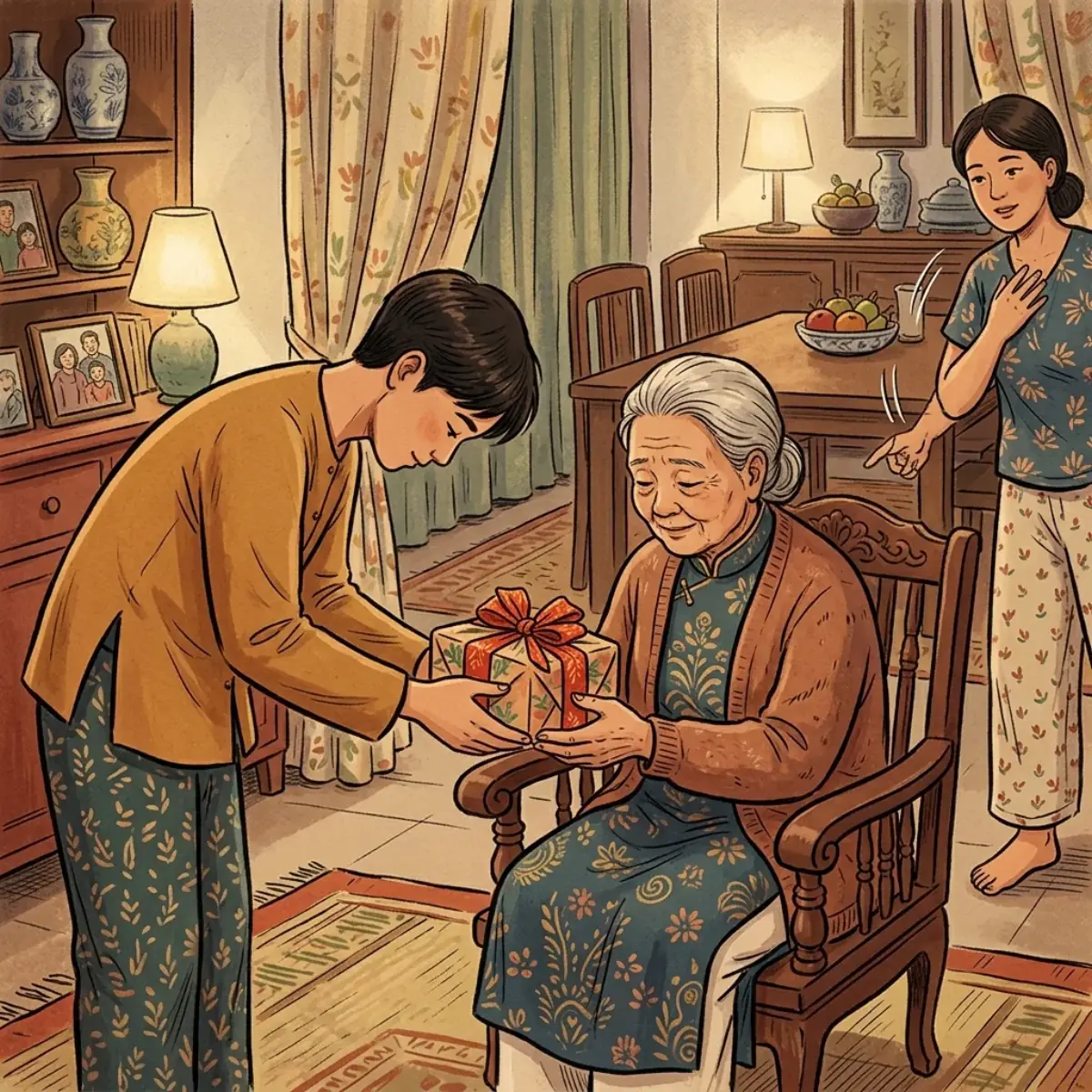
Here's a thing nobody tells you: in Saigon you can have great grammar and still come across as a little bit rude. And you can have almost no Vietnamese at all and come across as lovely. The difference is usually your hands, your head, and whether you know when to just… not talk.
Tui thấy vụ này quá trời lần rồi. A learner says a perfect sentence, hands over money with one hand, and the auntie's face goes flat for half a second. Nothing bad happens. But something small got lost.
So let's fix that over an iced coffee. Nothing scary — like five things, and four of them take zero effort.
Quick answer: Give and receive with two hands, nod your head a little instead of waving hello, beckon with your palm facing down, keep your feet and your hands off people's heads — and remember that in the South, silence is often a full sentence.
Two hands. That's it. That's the whole trick.
If you only remember one thing from this whole post: use two hands when you give something or receive something, especially with anyone older than you.
Money. A menu. A phone. A business card. A cup of coffee. Change from the cô at the bánh mì cart. Two hands. Or, if your other hand is genuinely busy, do the half-version: right hand gives, left hand lightly touches your right forearm. That counts. Everyone reads it.
Notice mời in that last one. In a Southern family you don't just plonk food down — you offer it. Kids get taught this at like three years old: Con mời ba má ăn cơm. When you do it as a foreigner, ba má will talk about you for a week. In a good way.
Local tip
Two hands is strongest going up the age ladder. If a kid hands you something with one hand, relax — that's normal. But when you hand something to a cô, chú, bác, or anyone with grey hair, two hands every single time. It costs you nothing and it buys you everything.
The little nod (your all-purpose Saigon hello)
Vietnamese people don't really do the big cheerful wave at a stranger. What you'll see instead is a small, quick head dip — chin down maybe two centimetres, eyes soft, sometimes with a dạ attached.
That nod does a ridiculous amount of work. It means hello, thanks, I heard you, go ahead, sorry, and yes-I'm-acknowledging-you-exist. When you walk into a shop and the owner looks up: nod. When someone lets your motorbike squeeze past: nod. When you leave a coffee shop: nod.
Handshakes exist, but mostly in offices and mostly between men. Two hands on the handshake — or one hand shaking and the other touching your own forearm — reads as extra respectful. With an older woman, don't reach for the hand first. Nod, smile, let her decide.
Good to know
Hugging is not a default greeting here. Close friends might, young people definitely do, but a hug at a first meeting can freeze the room a bit. Start with the nod. You can always upgrade later.
Beckoning: palm DOWN, always
This is the one that trips up almost every Westerner. Back home you call someone over with your palm up, fingers curling toward you. In Vietnam that gesture is what you'd use for a dog. Doing it to a person — especially an older person — lands somewhere between funny and offensive.
The Vietnamese version: hand out in front of you, palm facing down, fingers flapping toward your body like you're patting the air. Whole hand, not one finger. That's how you call a waiter, a friend across the street, a kid, anybody.
Honestly in Saigon the voice does most of the work. A loud friendly Em ơi! across a quán will get you served faster than any hand signal. The palm-down flap is the backup, and the thing you use when it's too loud to shout.
Common mistake
Snapping your fingers or clicking at staff. Please don't. It reads as kêu người ta như kêu chó — calling someone like a dog — and it will kill the vibe of the whole table. Same with pointing one finger at a person. Point with your whole hand, palm up-ish, like you're presenting them.
Feet down, heads off-limits
Two body parts carry a lot of weight in Vietnamese culture: the head is the highest, most respected part of a person, and the feet are the lowest and dirtiest. Everything follows from that.
Feet. Don't point the soles of your feet at anyone, and really don't point them at an altar. In a Vietnamese home there's usually a family altar with photos and incense — sit so your feet aren't aimed at it. Don't use your foot to nudge something toward someone, don't rest your feet on a chair someone's sitting on, and take your shoes off at the door unless the host waves you off.
Heads. Don't pat an adult on the head, ever. It's not a friendly gesture here — it's what you do to a small child, so doing it to a grown man is basically saying "cute little guy." Even with kids, be careful: many families believe touching a baby's head is unlucky, or that praising a baby too loudly invites bad spirits. If you meet somebody's newborn, admire it with your voice and keep your hands to yourself.
Also: when you walk past people who are sitting and talking — especially older people — dip your head and shoulders a little as you pass. It's a tiny "sorry, coming through" with your body. Southern kids do it automatically.
Local tip
Sitting height matters too. If everyone's on low plastic stools and you're towering on a chair, you'll feel it. Go low with them. And when you hand something to someone seated, bend a bit so your hand isn't coming down from above their head.
Silence is an answer (and usually it means no)
Okay, this is the subtle one, and it's where a lot of foreigners get genuinely confused.
In the South, people avoid flat refusals. Saying a hard no to someone's face feels harsh — it makes them lose face, it makes the moment awkward. So instead you get: a pause. A small laugh. A look off to the side. A để coi. And then a change of subject.
All of that means no. Or at minimum, "I'm not comfortable and please stop pushing."
The laugh confuses people the most. A Vietnamese person laughing while telling you something bad happened is not being callous — the laugh is a cushion. It softens the moment for you, so you don't have to react. Same with the laugh when someone doesn't understand your question. It's embarrassment, not mockery.
What to do about it: when you hit that silence, back off and offer an exit. Give the person a graceful way out and they'll love you for it.
Common mistake
Filling the silence by repeating your question louder. That turns a soft no into a corner, and now the person has to either lie to you or lose face. Let the quiet sit. Then move on, cheerfully. You'll get the real answer later, often through a third person.
Does any of this change North vs South?
Most gestures are national — two hands, palm-down beckoning and the head/feet rules are the same everywhere in Vietnam. But the temperature of body language does shift, and so do a couple of habits.
| Southern (Saigon) | Northern (Hanoi) | |
|---|---|---|
| Overall style | Looser, more touching between friends, bigger smiles, faster to joke | More reserved with strangers, more formality on first meeting |
| Polite marker with the nod | Dạ — constant, from all ages | Vâng is the standard equivalent |
| Calling someone over | Voice first — a loud friendly ơi, hand as backup | Often quieter; hand gesture does more of the work |
| Soft "no" | Trails off with chắc…, thôi…, plus a laugh | Northern speakers use chắc là…, e là… similarly, but with less laughing |
| Physical contact between same-sex friends | Very common — arm grabs, shoulder leans, hand-holding | Present but generally more restrained in public |
Don't overthink the table. If you learn the Saigon version you're fine everywhere; you'll just look a bit warmer than the local baseline up north, which is hardly a crime.
Try it yourself
- You're paying the cô at a bánh mì cart. What do your hands do, and what do you say?
- You want the waiter's attention in a busy quán. Which hand position — palm up or palm down?
- You ask a colleague if she can help you Saturday. She laughs and says Chắc hơi khó à nha. What does she mean, and what do you say back?
- You're visiting a friend's parents. Two things you check before you sit down?
- Your friend's toddler is unbelievably cute. What do you do with your hands?
Answers: 1) Both hands, and something like Dạ con gửi cô nghen. — then receive the change with two hands too. 2) Palm DOWN, fingers flapping toward you — plus a loud Em ơi! 3) It's a no. Give her the exit: Hông sao đâu, hôm khác cũng được nha. 4) Shoes off at the door, and check where the family altar is so your feet aren't pointed at it. 5) Nothing — admire out loud (Trời ơi, bé dễ thương quá trời!) and ask before touching.
Frequently asked questions
Is the two-hand thing really necessary, or will people forgive a foreigner?
People will absolutely forgive you. That's not the point. The point is that doing it marks you as someone who paid attention, and in Vietnam that lands harder than fluent grammar. It takes half a second. Just do it.
What if my hands are full and I physically can't use two?
Use the forearm touch — right hand extends, left hand lightly touches your right wrist or forearm. It's a recognised half-bow with your arms and it reads perfectly. A slight dip of the head does the same job.
Someone laughed when I said something serious. Were they laughing at me?
Almost certainly not. A laugh in Vietnamese conversation often means embarrassment, uncertainty, or "this moment is awkward and I'm smoothing it over." Read it as a social cushion, not mockery. Smile back and keep going.
How do I know if silence means "no" or just "thinking"?
Look at what comes after. Real thinking usually ends with an actual answer within a few seconds. A soft no drifts — a pause, then a vague phrase like để coi or rồi tính sau, then a topic change. If the topic changes, you have your answer.
Do I need to bow?
No deep bowing — that's not Vietnam. What you want is a small forward tilt of the head and shoulders when greeting someone much older, when handing something over, or when passing in front of seated elders. Think "slight dip," not "formal bow."
Is it rude to cross my legs?
Crossing legs is normal. What matters is where the sole of your foot ends up pointing. Aim it at the floor or at empty space, not at a person's face or at the family altar, and you're completely fine.
Where can I practise this stuff with a real person?
Honestly, the fastest way is talking to someone who'll correct you gently. When you learn Southern Vietnamese online with a Saigon teacher, you get the gestures and the register together, which is the whole point — the words and the body language are one system, not two.
That's it. Two hands, small nod, palm down, feet and heads off-limits, and respect the quiet. You'll be reading Saigon rooms better than half the people who've lived here five years.
Learn Southern Vietnamese online with people who actually speak it
SVFF is the school built entirely around the Southern (Saigon) dialect — native teachers from Ho Chi Minh City, since 2014.
- Listen to the SVFF podcast — real Southern Vietnamese, free.
- Book a free trial lesson — 30 minutes 1-on-1 with a native Saigon teacher.
- Browse our courses — structured A0–C1, all Southern dialect.
- Go Unlimited — every course and e-textbook, one payment.








0 Comments
Log in to leave a comment.