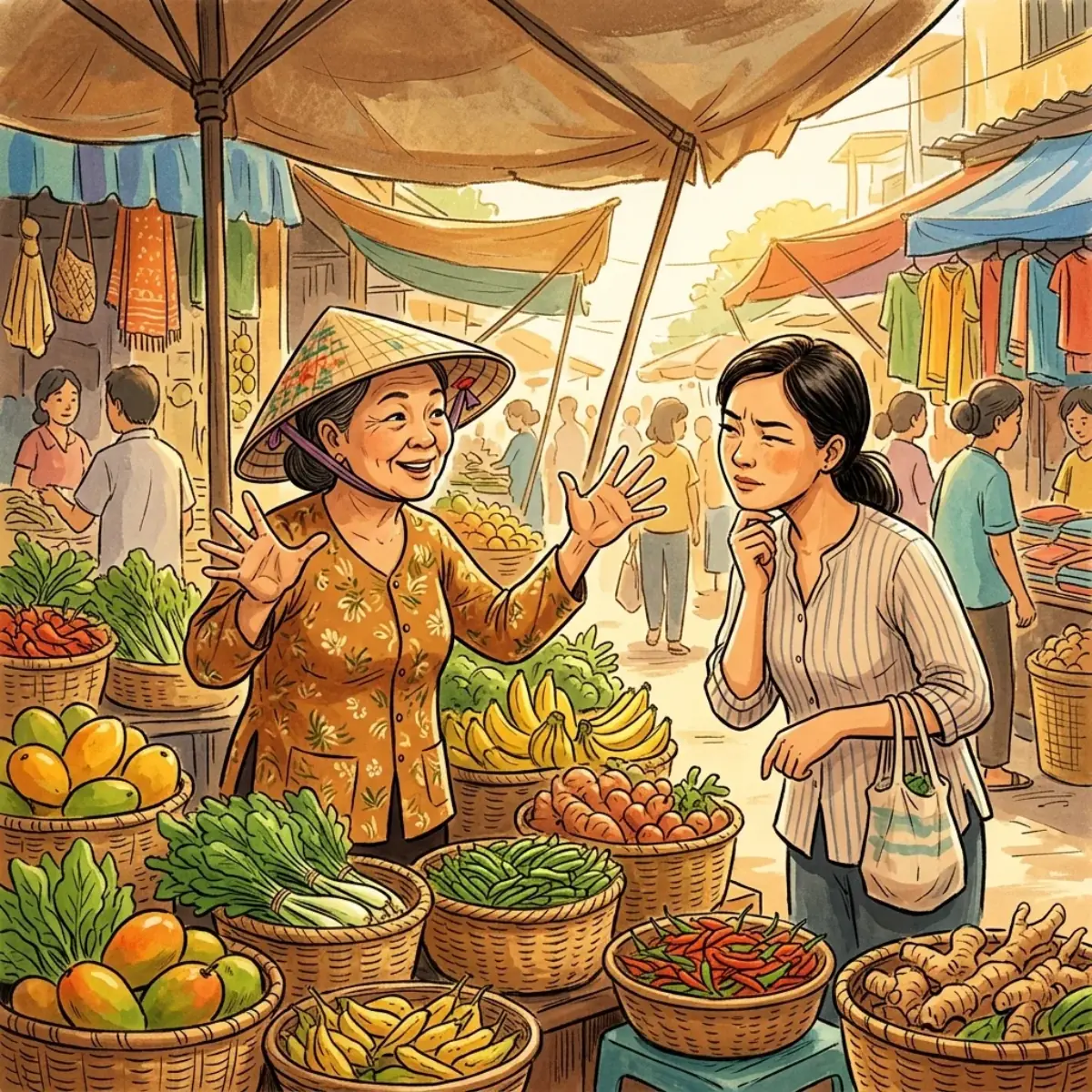
Here's something nobody warns you about: real Saigon conversation runs almost entirely on approximations. Ask a friend what time they'll arrive, how much rent they pay, how old their cousin is — you will almost never get a precise number back. You'll get cỡ, chừng, hơn, gần, and a shrug. Being vague isn't laziness here. It's the normal, polite, friendly default.
Quick answer: In Saigon, cỡ and chừng are your everyday "about", khoảng is the neutral one that works everywhere, hơn means a little over, gần means almost but not yet — and xấp xỉ is for the news, not for coffee.
The three everyday words: khoảng, chừng, cỡ
All three go straight in front of the number. Same slot, slightly different flavour.
Khoảng is the safe, neutral one — spoken, written, texting, whatever. Chừng is a touch softer and warmer, very common in speech. Cỡ is the most casual and the most Saigon of the three; it originally means "size", and you can hear that in it — it's like saying "in the ballpark of".
You'll also hear them stacked: khoảng chừng or cỡ chừng. It's not a mistake, it just makes the guess feel even fuzzier — the verbal equivalent of waving your hand.
hơn vs gần: just over vs almost
These two are the pair that trips learners up the most, and they're opposites.
Hơn = you've passed the number. Gần = you haven't got there yet. So gần bảy giờ is 6:45 and hơn bảy giờ is 7:10. Mix them up and you'll be sitting alone at a quán for twenty minutes.
Southern speakers also love putting hơn after the number when it's a clock time or a measurement. Bảy giờ hơn = "seven-something". It sounds even more relaxed than hơn bảy giờ.
Common mistake
Only hơn is allowed to sit after the number. Cỡ, chừng and khoảng always come in front, so bảy giờ cỡ is wrong — say cỡ bảy giờ or bảy giờ hơn. And don't feel you have to pile hedges on top of each other: hơn một trăm ngàn already means "over a hundred thousand" all by itself.
The Southern shortcut: leave the tail off
This is the one that makes you sound local. Instead of adding a word for "about", Saigon speakers just say the big number and then mấy — literally "a few" — instead of finishing the number.
Trăm mấy = a hundred and something. Hai chục mấy = twenty-something. Ba triệu mấy = three million and change. Hai mươi mấy tuổi = twenty-something years old. It's fast, it's everywhere, and it costs you one syllable.
Say two numbers in a row and mean "roughly"
Another native trick: stick two neighbouring numbers together. Hai ba ngày = two or three days. Năm mười phút = five or ten minutes. Bảy tám chục = seventy or eighty. No "or" needed, no comma, just say them.
The vague tag: gì đó
Gì đó gets stapled to the end of a number and means "or something / thereabouts". It's the single easiest upgrade to your spoken Vietnamese, because it lets you commit to a number without committing to a number.
Local tip
Vagueness is a social move, not just a numbers thing. When a friend asks which drink you want and you genuinely don't care, say Lấy đại đi, cái nào cũng được — "just grab whatever". Đại = do it without overthinking. Extremely Saigon.
Money, time, age, distance — a quick pass
Same words, different everyday situations. Notice how the pattern barely changes.
And then there's xấp xỉ (careful with this one)
Xấp xỉ does mean "approximately", and your dictionary will hand it to you first. But it belongs to reports, news broadcasts and presentations. Say it to the lady selling you mangoes and you'll sound like you're reading the evening bulletin.
Trên dưới ("above-below") is the nice middle ground — it's a bit formal but still normal in conversation about prices and numbers. And độ exists too, but in Saigon it reads slightly bookish or old-fashioned; cỡ is what your neighbour actually says.
Good to know
Because hơn also does the work of "more than" in comparisons, context does the sorting. Hơn hai chục ngàn = more than twenty thousand. Mắc hơn = more expensive. Nobody gets confused, because a number after hơn means quantity and an adjective before it means comparison.
South vs North
The grammar is shared, but the go-to words are not. This is one of the fastest ways to hear where someone grew up.
| Meaning | Southern (Saigon) | Northern (Hanoi) |
|---|---|---|
| casual "about" | cỡ, chừng | tầm, độ |
| "a hundred-something" | trăm mấy | hơn một trăm |
| thousand (money) | ngàn | nghìn |
| "a few / two or three" | vài ba, hai ba | dăm ba |
| "nearly" | gần | gần, ngót nghét |
| "or something" | gì đó | gì đấy |
Try it yourself
- Tell a friend you'll be there in about fifteen minutes.
- Say the coffee costs around thirty thousand, or something.
- Say it's already past nine o'clock.
- Say your older sister is thirty-something (use the mấy trick).
- Say the market is nearly two kilometres from here.
Answers: 1. Cỡ mười lăm phút nữa tui tới nha. · 2. Ly cà phê ba chục ngàn gì đó. · 3. Hơn chín giờ rồi. (or Chín giờ hơn rồi.) · 4. Chị tui ba mươi mấy tuổi. · 5. Từ đây tới chợ gần hai cây số.
Frequently asked questions
Is cỡ ever wrong to use?
Only in formal writing — a report, a contract, an email to a government office. There, use khoảng or xấp xỉ. In speech, texting and Zalo messages, cỡ is completely normal at any age.
What's the difference between chừng and khoảng, really?
Honestly, very little. Chừng feels a hair warmer and more spoken; khoảng is the neutral all-rounder. Swap them freely and nobody will blink.
Can I say "trăm mấy" for exactly 150?
No — that's trăm rưỡi ("a hundred and a half"). Trăm mấy means somewhere between 110 and 190 and you're not saying which. Rưỡi is precise, mấy is deliberately not.
Why does everyone answer my questions so vaguely?
Because a hard number is a promise. Saying cỡ bảy giờ leaves room for traffic, rain, and life — and nobody loses face if it slips. Once you notice this, a lot of Saigon conversation suddenly makes sense.
Does word order matter with hơn?
For clock times, both work: hơn tám giờ and tám giờ hơn. The second one is the more relaxed, spoken Southern version. For quantities, put hơn in front: hơn hai chục người.
Where can I practise this with a real person?
The fastest way is to talk. If you want to learn Southern Vietnamese online with teachers who use cỡ and gì đó without thinking about it, a live lesson beats a hundred flashcards.
Learn Southern Vietnamese online with people who actually speak it
SVFF is the school built entirely around the Southern (Saigon) dialect — native teachers from Ho Chi Minh City, since 2014.
- Listen to the SVFF podcast — real Southern Vietnamese, free.
- Book a free trial lesson — 30 minutes 1-on-1 with a native Saigon teacher.
- Browse our courses — structured A0–C1, all Southern dialect.
- Go Unlimited — every course and e-textbook, one payment.








0 Comments
Log in to leave a comment.