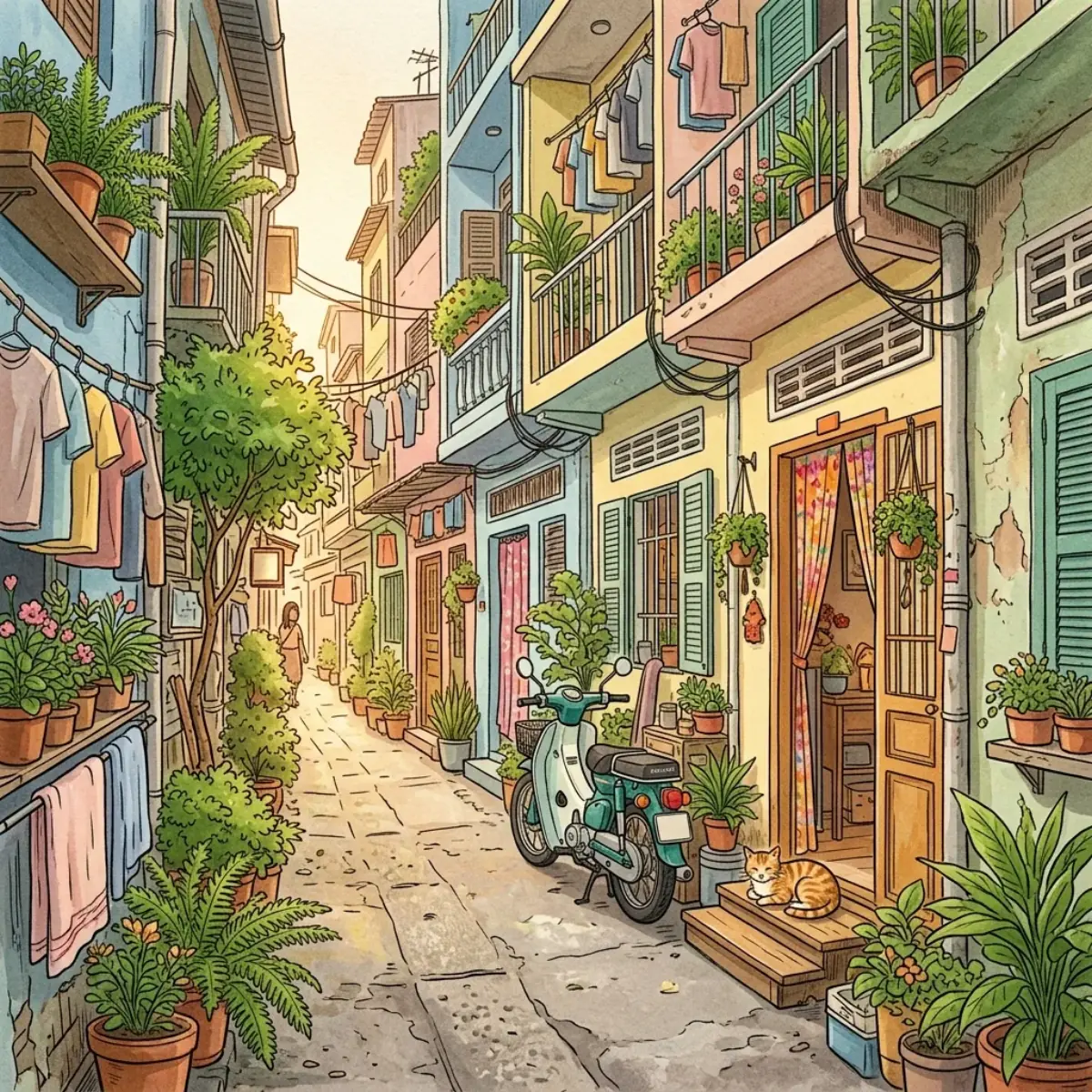
You order food. Twenty minutes later your phone rings and a man is asking you something very fast. You catch one word: hẻm. You panic. You say dạ three times and hope for the best. Every single person living in Saigon has had this exact phone call. Let's make sure it never happens to you again.
Quick answer: A Saigon address runs small to big — house number, street, ward, district — and every slash in that number means "turn into another alley."
The address ladder: small first, big last
English addresses go small to big too, but Vietnamese is stricter about it and nobody ever breaks the order. Here's the whole ladder in one card.
Notice there's no word for "street" in there. You don't need đường when the street name is obvious — you just say the number and the name, like 27 Nguyễn Thị Minh Khai. Put đường in when you want to be extra clear, especially on the phone.
Saigon districts come in two flavours: the numbered ones — quận 1, quận 3, quận 7, quận 10 — and the named ones like Bình Thạnh, Phú Nhuận, Tân Bình, Gò Vấp, Thủ Đức. In conversation people drop the word quận in front of the named ones and just say Tui ở Bình Thạnh.
Good to know
Paperwork changed recently: official documents now tend to list just phường and thành phố, with a lot of wards merged and renamed. But nobody re-learned how to talk. Ask anyone where they live and they'll still say quận 3 or Phú Nhuận like always. Learn the spoken version — that's the one people actually use with you.
Now the fun part: hẻm and all those slashes
Saigon is a city of alleys. A huge share of the population lives not on the street but trong hẻm — inside the alley network behind it. And the numbering system, once you see it, is genuinely elegant.
Take the address 123/45/6. Read it left to right as a set of turns:
So the number of slashes tells you how deep in you are. One slash, you're one turn off the street. Three slashes and honestly, send a photo.
How do you say the slash out loud? In Saigon, most people say xuyệt. You'll also hear sẹc from older folks. And plenty of people skip it entirely and just spell out the turns.
Local tip
House numbers are usually read as a normal number: 512 is năm trăm mười hai. But on a bad phone line, everyone switches to digit-by-digit: năm, một, hai. Nobody thinks that's weird — do it whenever the driver sounds confused.
Alley vocabulary you'll hear on the phone
Landmarks beat numbers every time
Here's the thing nobody tells you: Saigon runs on landmarks, not numbers. A driver would rather hear "opposite the pharmacy" than a four-part house number. Learn these and your life gets easier.
Now glue them together the way locals do:
Local tip
That last sentence is the single most useful line in this article. When the alley is a maze, stop explaining and go meet the person. Every Saigonese does this. Tui chạy ra liền — "I'll be right out."
Apartments, floors, and one number trap
Common mistake
In Saigon, the ground floor is tầng trệt and the next one up is lầu 1. So when someone says Nhà tui ở lầu 2, that's two flights of stairs, not one. Get this wrong at a friend's house and you'll be knocking on a stranger's door.
North vs South: same city map, different words
| Meaning | Southern (Saigon) | Northern (Hanoi) |
|---|---|---|
| alley | hẻm | ngõ |
| smaller alley off an alley | hẻm nhỏ | ngách, hẻm |
| ground floor | tầng trệt | tầng 1 |
| one floor up | lầu 1 | tầng 2 |
| roundabout | vòng xoay, bùng binh | vòng xuyến |
| go into the alley | đi vô hẻm | đi vào ngõ |
| look for the house | kiếm nhà | tìm nhà |
This is one of those areas where the two dialects really do part ways. If you're planning to live in the South, learning the Southern set from the start saves you a lot of confused faces. It's exactly why people come to us to learn Southern Vietnamese online instead of picking up the standard textbook version.
Putting it together on a real phone call
Try it yourself
- Say this address out loud in Vietnamese: 88/17 Cách Mạng Tháng Tám, Ward 5, District 3.
- How many turns off the main street is the address 210/9/4?
- Your friend says Nhà tui ở lầu 3. How many flights of stairs above the ground floor is that?
- Tell a driver: "Wait at the alley entrance, I'll run out right away."
- Tell someone your place is opposite the coffee shop, near the four-way intersection.
Answers: 1. 88 xuyệt 17 Cách Mạng Tháng Tám, phường 5, quận 3 · 2. Two — into alley 210, then into alley 9 · 3. Three · 4. Anh đứng đầu hẻm chờ chút, tui chạy ra liền nha · 5. Nhà tui đối diện quán cà phê, gần ngã tư đó
Frequently asked questions
Why does my address have two or three slashes in it?
Each slash is one turn deeper into the alley network. The first number is where the alley meets the street, and each following number is a house or a smaller alley inside. It's not messy — it's a map written as a number.
Do I say xuyệt or just read the numbers?
Both work. Xuyệt is the standard Saigon way to voice the slash. If the person sounds lost, switch to the plain version: Anh vô hẻm 123, tới số 45.
Is quận still correct after the recent administrative changes?
For spoken Vietnamese, absolutely. Official forms may now stop at ward and city level, but in everyday life people still say quận 1, quận 7, Bình Thạnh. Say it the way locals say it and you'll be understood everywhere.
What if the driver still can't find me?
Go outside. Genuinely — this is the standard local solution, not a failure. Say Em chạy ra đầu hẻm nha and wave. Two minutes and it's solved.
Where's the best place to practise this out loud?
With a real Saigon teacher who can play the shipper on the phone while you fumble through your address. That's exactly the kind of drill we run when students learn Southern Vietnamese online with us — small, practical, and based on situations you'll hit this week.
Learn Southern Vietnamese online with people who actually speak it
SVFF is the school built entirely around the Southern (Saigon) dialect — native teachers from Ho Chi Minh City, since 2014.
- Listen to the SVFF podcast — real Southern Vietnamese, free.
- Book a free trial lesson — 30 minutes 1-on-1 with a native Saigon teacher.
- Browse our courses — structured A0–C1, all Southern dialect.
- Go Unlimited — every course and e-textbook, one payment.








0 Comments
Log in to leave a comment.