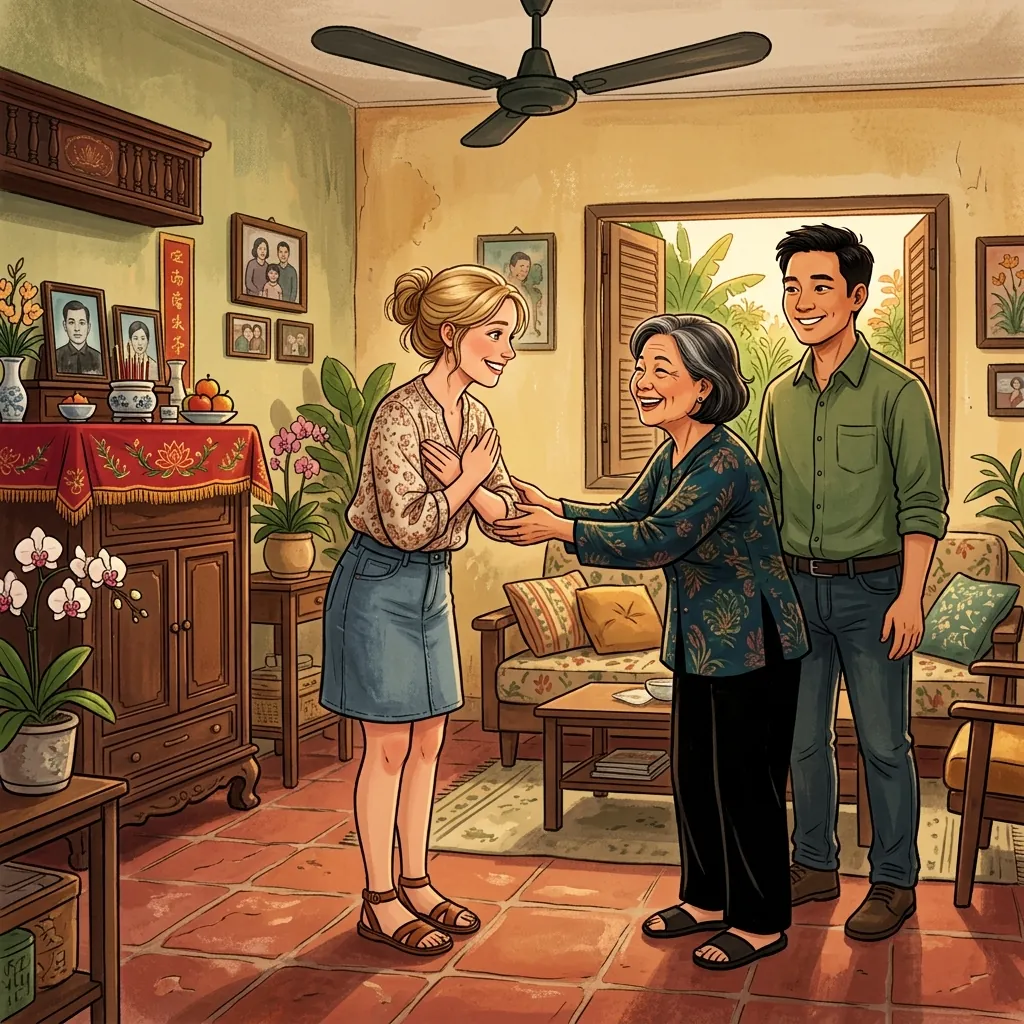
Here's a secret from hundreds of our students who married into Vietnamese families: you don't win over the in-laws with a massive vocabulary. You win them over with a handful of small phrases, said correctly, at the right moments. If your partner’s family is from the South, speaking textbook Northern Vietnamese might sound strangely formal or simply not land. Here is the shortlist of exactly what to say to build a real relationship.
Quick answer: The exact phrases and cultural rules that win over Southern Vietnamese in-laws revolve around getting the pronouns right (ba má, not bố mẹ), leading the mời (invitation) ritual at the dinner table, always greeting the oldest person first, and softening your sentences with polite particles like dạ and nha.
The pronoun system is the whole game
In Vietnamese, "I" and "you" change depending on who you're talking to. Calling your partner's mother the way you'd call a waitress is the classic foreigner mistake — and getting it right is disproportionately powerful. When you greet her as má or your partner's father with the correct term of respect, you're not just saying hello — you're telling them you understand your place in the family. Expect visible surprise the first time you do it.
If your in-laws are from Sài Gòn or the Mekong Delta (or emigrated from there — as most overseas Vietnamese families did), they speak Southern Vietnamese. The pronunciation differs enough from the Northern dialect taught in most apps that phrases you learned elsewhere may simply not work. For instance, parents are ba má, not the Northern bố mẹ.
When talking to your in-laws, you will refer to yourself as con (child). This is non-negotiable. It shows respect for the older generation. If you use the generic "I" (tôi), you will sound like you are speaking to them as an equal or a stranger, which is considered incredibly rude in a family setting.
Good to know
When you are talking about your in-laws to your partner, Southern Vietnamese has casual third-person pronouns: ổng (him) and bả (her). Between you and your partner, "Is your mom coming over?" can be "Bả có qua hông em?", and it sounds very local. But it is casual: never use it in front of your in-laws or about grandparents. The safe version is "Má có qua hông em?"
Beyond ba má, you will need to map out the extended family. Aunts and uncles aren't just "aunt" and "uncle." Depending on whether they are on the mother's or father's side, and whether they are older or younger than your partner's parents, you will use cô, chú, bác, dì, or cậu. Taking one lesson with a native teacher is usually enough to map your specific family tree onto the right pronouns. It is, without exaggeration, the highest-return hour in all of Vietnamese learning.
Greeting the house: Arriving and the order of operations
When you walk into a Vietnamese home, you don't just throw a general "Hello everyone" into the room. There is an order of operations, and it is strictly enforced by culture: you greet the oldest person first. A correct greeting to grandma outranks any advanced grammar you'll ever learn.
In the South, a respectful greeting is anchored by the word dạ. It is the ultimate polite particle. It doesn't just mean "yes"; it means "I am respectfully addressing someone older than me." You put it at the start of your sentence, fold your arms (or slightly bow your head), and address them by their title.
You can learn more about mastering these family terms in our guide to family words in Southern Vietnamese. But remember, the physical act of greeting matters just as much. Take off your shoes before entering the house, wait to be guided to the living room, and never sit higher than the elders if you can avoid it.
At the table: The invitation ritual
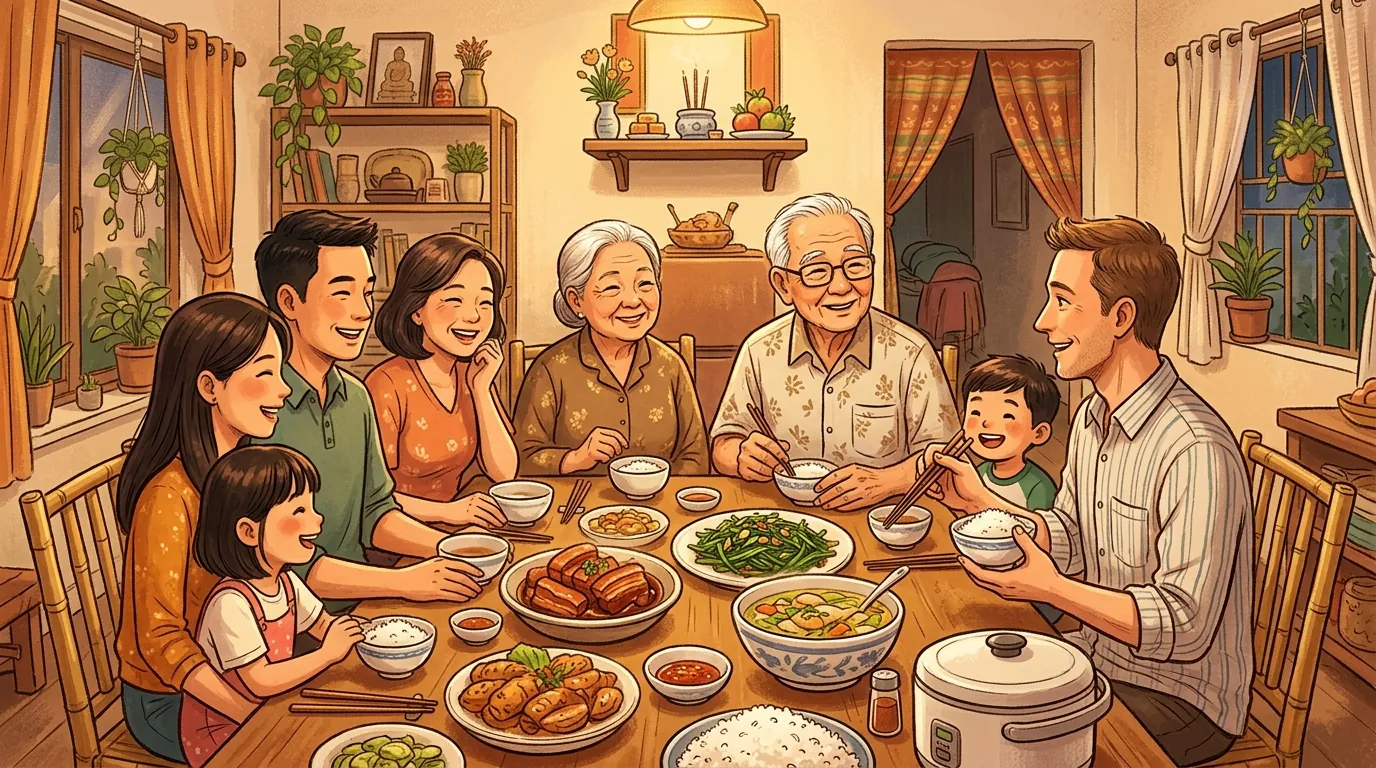
Vietnamese meals do not begin when the food hits the table, and they certainly don't begin when you feel hungry. They begin with the mời (invitation) ritual. Before anyone picks up their chopsticks, the youngest members of the family must "invite" the elders to eat. Joining it, even clumsily, says more than a hundred compliments.
You must invite people in descending order of age. You look at the grandparents first, then the parents, then older aunts and uncles, then older siblings. It sounds exhausting, but in practice, you just rattle them off in a sequence. If you do this unprompted, your mother-in-law might actually faint from pride.
Common mistake
Never stick your chopsticks vertically into your bowl of rice. In Vietnamese culture, this resembles incense sticks offered to the dead at an altar. It is considered a terrible omen, especially if you do it at the family dinner table. Always lay your chopsticks flat across your bowl or on a chopstick rest.
Praising the food (honestly and accurately)
The cook — almost always the mother-in-law or grandmother — is the person whose approval matters most. If she likes you, the rest of the family will fall in line. And the way to her heart is through her food. But just saying "delicious" (ngon) isn't enough. You need to learn two or three honest variations of praise.
In Southern Vietnamese, we often use the word quá (very / too much) at the end of the sentence to show enthusiasm. You can also compliment specific aspects of the dish, like the seasoning or the tenderness of the meat.
If they try to put more food in your bowl and you are absolutely full, do not just say "no" (không). That sounds harsh. Instead, use a soft refusal:
When you don't understand a word they're saying
Let's be realistic. Southern families speak fast. They use regional slang, they drop pronouns, and during a crowded dinner, multiple conversations happen at once. You are going to blank out. Knowing how to elegantly say "I don't understand" is a crucial survival skill.
Don't panic, and don't just smile and nod (which often leads to agreeing to things you didn't mean to). Use these phrases to slow the conversation down. Adding nha (a soft Southern particle) at the end makes your request sound friendly rather than demanding. You can learn more about the particle nha and other Southern words here.
Gifts, visits, and the art of leaving
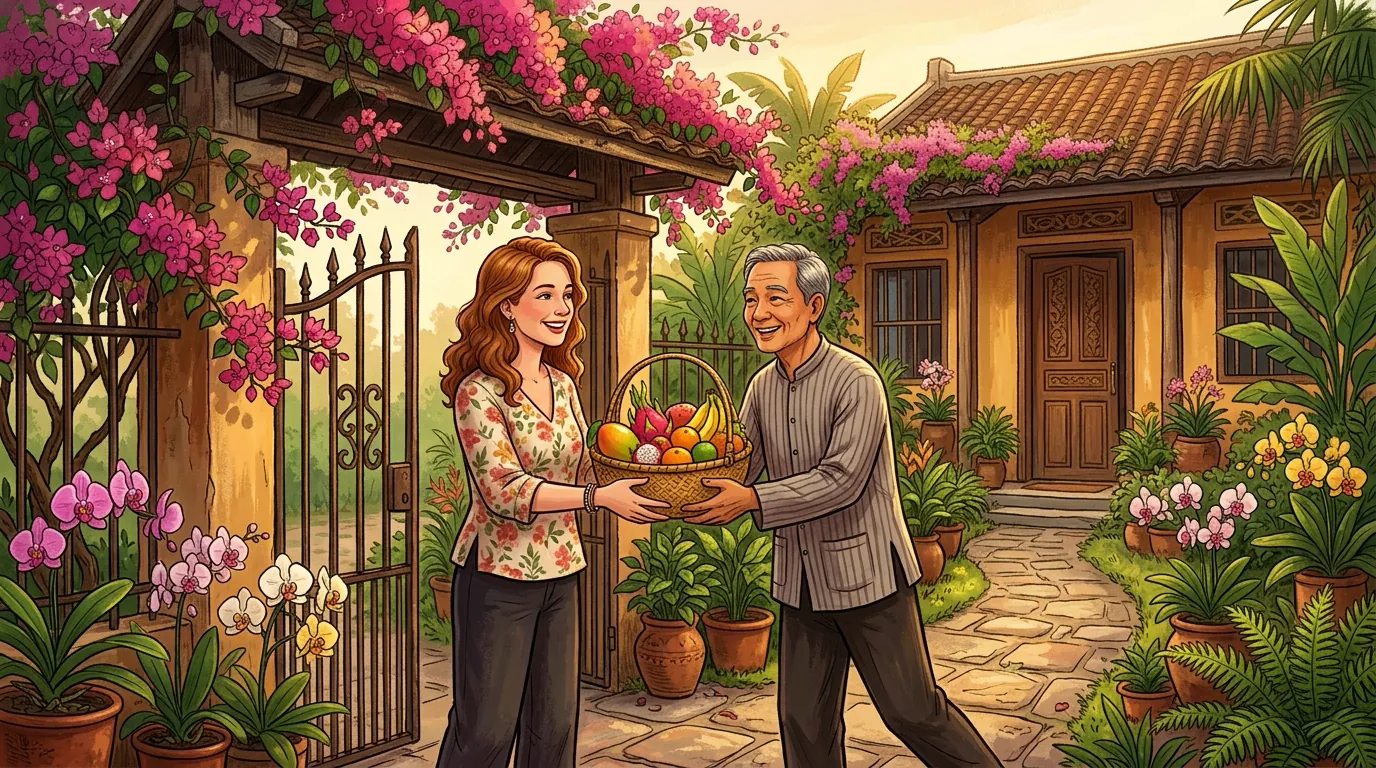
In Vietnamese culture, you never show up to your in-laws' house empty-handed, especially in the beginning. Fruit is always a safe bet — imported apples, grapes, or a nice pomelo. When you hand it over, use both hands and a respectful phrase.
Equally important is the exit. Vietnamese goodbyes are a whole round of the room. You do not just wave from the door. You must verbally excuse yourself to the elders before you leave. Leave time for it, and leave in Vietnamese.
Tết (Lunar New Year): The one wish that matters
Tết is the ultimate test of family dynamics. As a partner, you will be expected to wish the elders well before giving or receiving lucky money (lì xì). You don't need to memorise a five-minute poem. One memorized wish for health and prosperity, delivered to the elders with a sincere smile, makes you the story of the holiday.
In the South, we prioritize health and peace over grand declarations of wealth. Here is the bulletproof wish that works for any elder:
You can find more variations in our guide to Tết and Southern Vietnamese holidays.
A realistic 6-month picture
Fluency is a long game, but winning over the family happens in stages. Here is what a realistic, successful six-month timeline looks like for a partner learning Southern Vietnamese:
- Month 1: Greetings, pronouns, and table phrases. You master dạ and mời. The family is shocked you know the rules.
- Months 2–3: The standard relative-questions and your prepared answers. You can answer "How old are you?", "What do you do for work?", and "Do you like Vietnamese food?" Plus, listening practice so the dinner conversation stops being pure noise.
- Months 4–6: Short real exchanges. Asking your mother-in-law about her cooking, or teasing back when the uncles tease you (learning how Saigon friends roast each other is vital here).
That's 20–30 one-on-one sessions of steady, unheroic work — and it changes how the family sees you permanently. They stop seeing a foreign guest and start seeing a son or daughter.
Try it yourself
- How do you greet your partner's parents in the South?
- What is the first thing you must do before eating a meal with the family?
- How do you honestly compliment the food to your mother-in-law?
- What is the most polite word to start your sentence with when speaking to an elder?
- How do you excuse yourself to leave the house?
Answers: 1. Dạ, con chào ba má. · 2. Invite the elders to eat (mời) · 3. Dạ, món này ngon quá má ơi! · 4. Dạ · 5. Dạ, con xin phép ba má con về.
Frequently asked questions
Can I just call my in-laws by their first names?
Absolutely not. In Vietnamese culture, addressing an elder by their first name is considered highly disrespectful. Always use their title (ba, má, cô, chú, bác) combined with dạ.
What if I use the wrong pronoun by mistake?
Don't worry. As a foreigner, you have a massive grace period. If you accidentally call an older aunt chị (older sister) instead of cô, they will usually just laugh and gently correct you. The effort is what counts.
Why do my in-laws keep telling me to eat more?
Food is love in Vietnam. Pushing food onto your plate is their way of showing care and hospitality. If you are full, politely decline using "Dạ thôi, con no quá rồi", but leaving a tiny bit of rice at the bottom of your bowl also signals you are done.
Do I really have to invite everyone individually at the table?
Ideally, yes. Start with the oldest (grandparents), then parents, then older aunts/uncles. If there are 15 people, it can take a minute. If the group is massive, you can sometimes get away with a collective "Dạ, con mời cả nhà ăn cơm" (I invite the whole family to eat), but individual invitations are always appreciated more.
Is Southern Vietnamese really that different from what apps teach?
Yes. Most apps teach Northern Vietnamese (the Hanoi dialect). The vocabulary for family, food, and daily objects differs heavily in the South, and the pronunciation is significantly different. If your family is from Ho Chi Minh City or the Mekong Delta, you need to learn the Southern dialect to be understood naturally.
Learn Southern Vietnamese online with people who actually speak it
SVFF is the school built entirely around the Southern (Saigon) dialect — native teachers from Ho Chi Minh City, since 2014.
- Listen to the SVFF podcast — real Southern Vietnamese, free.
- Book a free trial lesson — 30 minutes 1-on-1 with a native Saigon teacher.
- Browse our courses — structured A0–C1, all Southern dialect.
- Go Unlimited — every course and e-textbook, one payment.




0 Comments
Log in to leave a comment.