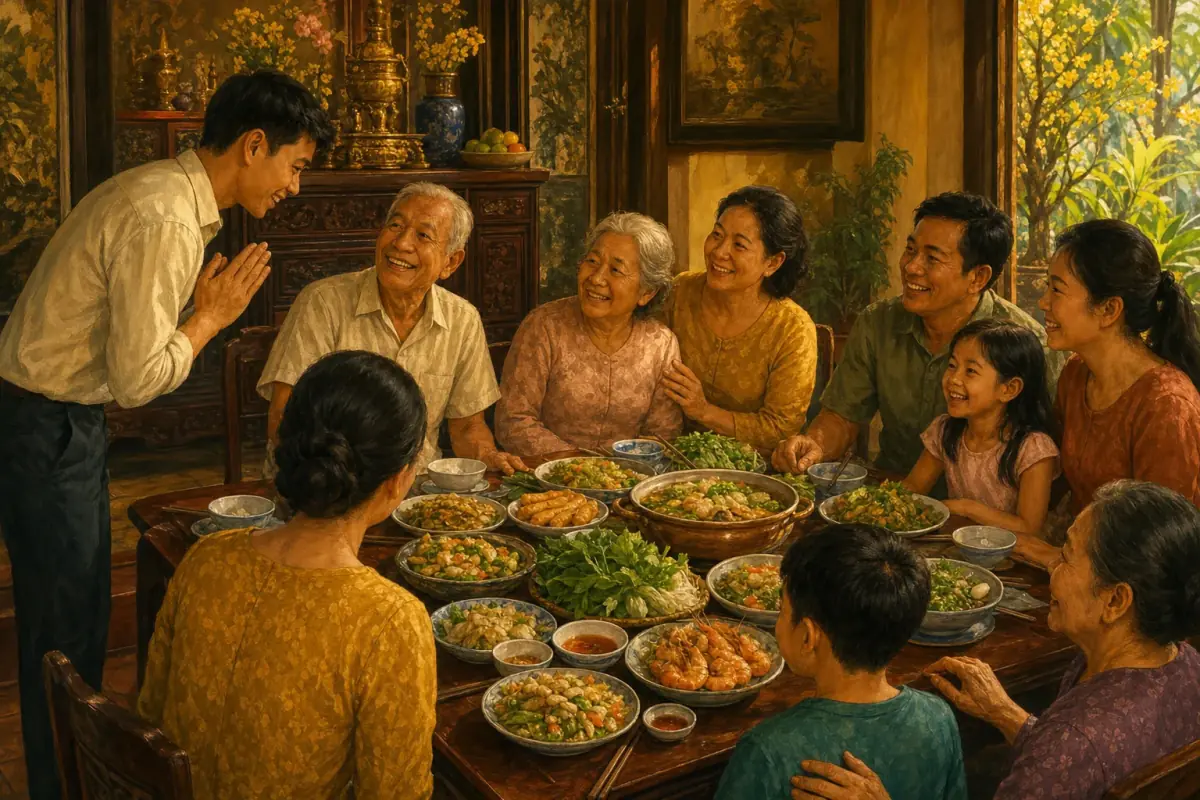
Okay. Deep breath. Your partner just parked the motorbike outside their parents' house in Gò Vấp, the door's open, and you can already smell something delicious cooking. Everyone's looking at you. This is the moment. And the good news? In the South, you can win this whole thing with about six phrases and a genuine smile. Let me walk you through the exact scene over an iced coffee, line by line.
Quick answer: Walk in, say "Dạ, con chào cô, con chào chú" with a little bow of the head, and you're already 80% of the way to being loved.
The trick isn't fancy grammar. It's two things: greeting each person by the right rank, and knowing how to say "no more food please" without anyone feeling rejected. That's the whole game. Let's play it out.
The scene: you walk in the door
Your partner (let's call them Linh) pushes you gently forward. The parents are right there. Go.
See what happened? You called yourself con (child) and called them cô and chú. That single choice tells them you understand your place in the family map — younger generation, showing respect. The dạ at the front is the soft Southern "yes" that makes everything sound polite and warm. Sprinkle it everywhere. Seriously, when in doubt, dạ.
Good to know
Why cô and chú and not something else? Cô is for a woman around your parent's age (or a bit younger); chú is for a man a bit younger than your dad. If they look older than your own parents, you'd switch to bác for either one. When unsure, ask Linh in the car beforehand: "Ba má em bao nhiêu tuổi rồi?" — how old are your parents?
Grandma's in the corner — don't forget her
There's almost always a bà ngoại (grandma on the mom's side) or bà nội (grandma on the dad's side) sitting somewhere, watching everything with sharp eyes. Go to her.
That hông at the end of "Bà khỏe hông bà?" is pure Saigon — it's the casual, friendly version of "or not?". And repeating bà at the end is a little affectionate habit down here. It sounds sweet, not weird.
The compliment volley (get ready to receive)
Southern families compliment fast and hard. Your job is not to argue — it's to deflect with charm.
This is the money move. "Dạ đâu có" ("oh no, not at all") is how you humbly wave off a compliment. You never just say "thank you" and accept praise flatly — that reads as a little full of yourself. Deflect first, then the warmth flows. That nha on the end softens it into something playful.
Local tip
Want to instantly delight them? Compliment the food or the house back: "Nhà cô đẹp quá cô ơi!" (Your home is so beautiful, auntie!) or "Trời ơi thơm quá, cô nấu gì mà thơm dữ vậy?" (Wow it smells amazing — what are you cooking?). Compliments bounce both ways here.
And now… the food ambush
This is the part nobody warns you about. In a Southern home, love is measured in bowls of rice. You will be fed. Then fed again. Then, right as you finish, a third helping lands in your chén (bowl) before you can blink.
Notice you refuse three times and you're still smiling. The polite refusal isn't a hard "no." It's "Dạ thôi cô ơi" ("oh please, auntie, that's enough") wrapped in gratitude and a compliment. You're not rejecting the food — you're praising it while gently tapping out. Big difference. And "ngon quá trời luôn" (delicious beyond the sky) is peak Saigon enthusiasm. Use it liberally.
Common mistake
Don't refuse with a flat "Không, cảm ơn" ("No, thanks") and a raised palm — it can feel cold and a little like you're rejecting their care. Always pad the refusal: gratitude + a reason ("no rồi", I'm full) + a compliment. That's the Southern recipe.
Two swap-in variations
Real families are different sizes. Here are quick swaps for the moment you meet them.
That second one? Offering to clear the chén with giùm ("do it for you as a favor") is a quiet superpower. They'll say "thôi thôi con để đó cô làm" ("no no, leave it, I'll do it") — but they'll remember that you offered. Guaranteed.
North vs South: the family words that differ
Most kinship words are shared, but a couple of everyday ones sound noticeably different, so here's where the dialect really splits:
| Meaning | Southern (Saigon) | Northern (Hanoi) |
|---|---|---|
| Mom / Dad | má / ba | mẹ / bố |
| "…or not?" (yes/no tag) | hông / hôn | không |
| Bowl (of rice) | chén | bát |
| Spoon | muỗng | thìa |
| Softener particle | nha / nghen / hen | nhé |
So when Linh's mom says "ăn thêm chén nữa" and offers you a muỗng, you're firmly in Southern territory. Match her words and you'll sound like you belong.
Try it yourself
- You walk in and greet a mom-aged woman and a dad-aged man. What do you say?
- Grandma compliments your Vietnamese. Deflect it politely.
- You're full but má is trying to give you one more bowl. Refuse warmly (three-part recipe: gratitude + reason + compliment).
- Offer to help clear the bowls after the meal.
Answers: 1) Dạ con chào cô, con chào chú ạ. 2) Dạ đâu có bà, con nói còn dở lắm. 3) Dạ con cảm ơn má, con no lắm rồi, đồ ăn ngon quá trời luôn! 4) Dạ để con phụ cô dọn chén giùm cho.
Frequently asked questions
Do I really have to call myself "con"?
Yes, and it's a good thing. Calling yourself con to your partner's parents signals respect and that you see yourself as part of the younger generation of the family. It's warm, not weird — they'll love it.
What if I mix up cô, chú, and bác?
Relax — nobody expects perfection from a learner, and they'll gently correct you. If you truly can't guess ages, whisper to your partner first, or default to cô and chú. Getting it slightly wrong with a big smile still beats staying silent.
Is it rude to actually stop eating?
Not at all. The food-pushing is a ritual of love, and your gracious refusal is part of the dance. Just keep it warm: thank them, say you're full, praise the food. They're happy you enjoyed it.
Should I bring a gift?
Absolutely — a basket of fruit, some pastries, or nice tea is perfect. Hand it over with both hands: "Dạ con có chút quà biếu cô chú ạ." (I brought a little gift for you.) They'll protest, then be thrilled.
What's the fastest way to get comfortable with all this?
Hearing it out loud, over and over, from real Saigon speakers. Reading the phrases is step one; saying them with a native teacher until they feel natural is what actually gets you through the front door with confidence. That's exactly what you can learn Southern Vietnamese online for — real conversations, real family scenes.
Learn Southern Vietnamese online with people who actually speak it
SVFF is the school built entirely around the Southern (Saigon) dialect — native teachers from Ho Chi Minh City, since 2014.
- Listen to the SVFF podcast — real Southern Vietnamese, free.
- Book a free trial lesson — 30 minutes 1-on-1 with a native Saigon teacher.
- Browse our courses — structured A0–C1, all Southern dialect.
- Go Unlimited — every course and e-textbook, one payment.








0 Comments
Log in to leave a comment.