
Ask our students why they started learning Vietnamese and one answer comes up more than any other: "my partner is Vietnamese." If you want to learn Vietnamese for your partner, you're not alone. Not travel, not business — love. But when you start looking for resources, you quickly realize that most apps and courses aren't built for family life. They teach you how to ask for the train station or negotiate a business deal, not how to talk to your future mother-in-law or survive a chaotic family dinner. If that's you, this guide is the honest version of what actually works, based on hundreds of learners in exactly your situation.
When you decide to learn Vietnamese for your partner, you have an unfair advantage: you live with a native speaker. But as you probably already know, that doesn't mean it's going to be easy. Learning the language of your significant other requires a specific strategy, a focus on spoken family dialect, and a lot of patience. Let's break down exactly what you should do.
1. The biggest mistake: learning the wrong dialect
This is the mistake that costs people months of time and frustration: most apps and textbooks teach Northern Vietnamese (the Hà Nội standard). But if your partner's family is from Sài Gòn, the Mekong Delta, or anywhere in the South — and the overwhelming majority of Vietnamese families in the US, Australia, Canada and Europe are — they speak Southern Vietnamese. This isn't just a slight accent difference. There is different pronunciation, different everyday words, and even different words for "yes" and "no".
Learners who studied Northern for a year often tell us the same heartbreaking story: they proudly said a sentence at the family table and got blank looks — or laughter. If you walk into a Southern family home and say "bố mẹ" (Northern for parents) instead of "ba má" (Southern), they will understand you, but it will sound like you learned English from Shakespeare. Start with the dialect your family actually speaks. For most overseas Vietnamese families, that means Southern.
Quick answer: To learn Vietnamese for your partner effectively, you must learn the dialect their family speaks (usually Southern). Focus on family pronouns first, skip the reading/writing drills, and hire a professional tutor instead of relying on your partner to teach you grammar.
Here are just a few examples of how different the everyday family words are between the two dialects. If you are learning for a Southern family, make sure your materials match.
Good to know
If you aren't sure which dialect your partner's family speaks, just ask them what they call their parents. If it's ba má, you need Southern Vietnamese. If it's bố mẹ, you need Northern.
2. Why your partner is (probably) a terrible teacher
You live with a native speaker. Most language learners would kill for that kind of access. But — and almost every couple discovers this the hard way — your partner is usually a terrible teacher. It's not their fault. They are a native speaker, which means they never had to think about why the language works. They just know what "sounds right."
When you ask them, "Why does the tone go up here but down there?" or "Why did you use đang instead of rồi?", they will likely stare at you blankly and say, "I don't know, we just say it that way." They can't explain the tones effectively to a beginner, and they don't know the logical order to introduce new vocabulary.
Even worse, lessons between partners have a funny way of turning into bickering. You feel frustrated that you aren't getting it, and they feel frustrated that you are overcomplicating something that is "so simple." The dynamic of a romantic relationship is very different from the dynamic of a teacher and student. When your partner corrects your pronunciation for the tenth time, it's easy to take it personally.
Local tip
The pattern that actually works: a professional teacher builds your foundation in structured lessons, and your partner becomes your practice partner. Let the teacher explain the grammar, and let your partner help you practice what you've already learned.
3. What to learn in the first 30 days: the family script
Standard courses start with the alphabet, the numbers up to one thousand, and colors. You don't need to count to a hundred at Sunday dinner. You need to know how to greet people, how to eat, and how to smile at the right time. Skip the textbook order and learn the family script first.
Master the pronouns
Vietnamese changes "you" and "I" depending on age, gender, and relationship. It is the core of the language. If you learn nothing else, learn how to address your partner's parents correctly. Greeting your partner's mother correctly is the single highest-impact thing you can learn. It shows immediate respect and effort.
If you need help with this, we have a full guide on family words in Southern Vietnamese.
Learn the food language
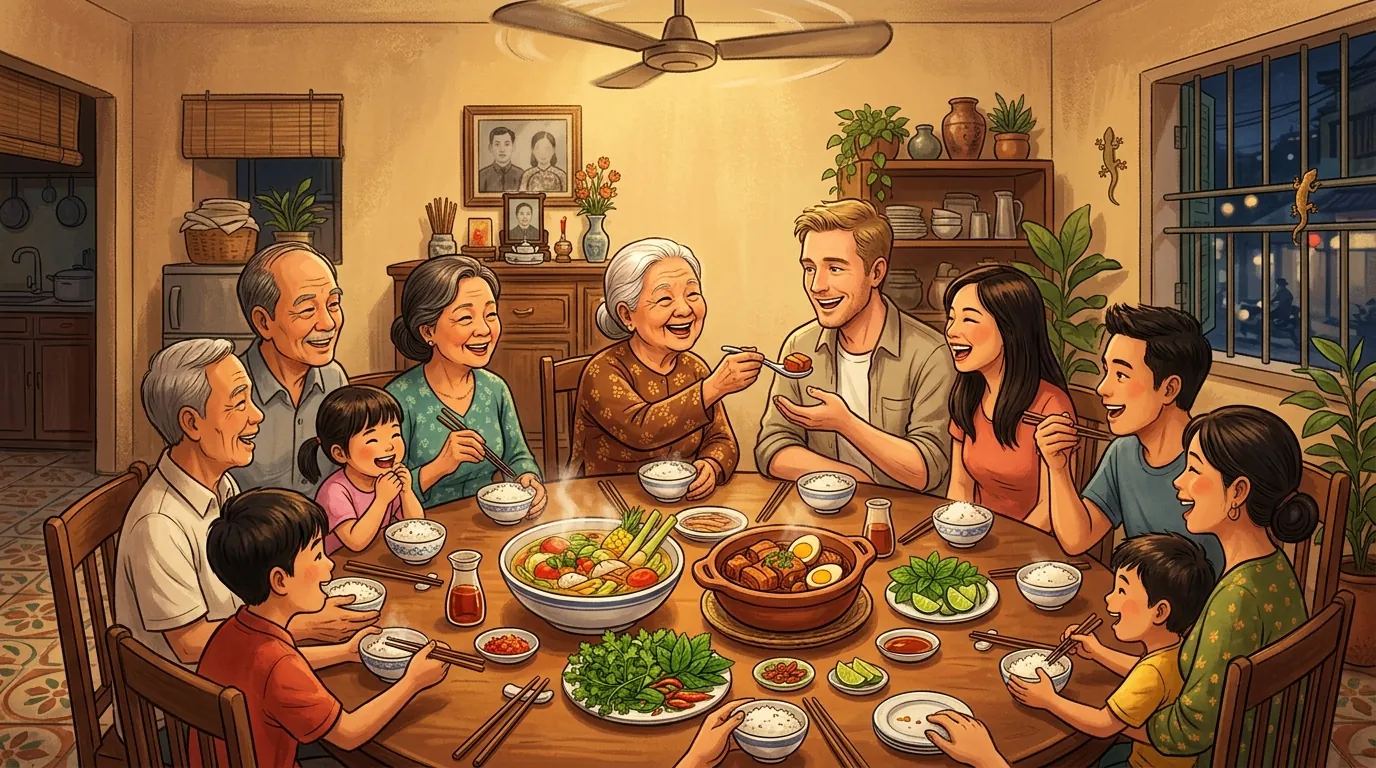
Half of Vietnamese family life happens at the dinner table. If you want to impress the family, learn how to participate in a meal. You need to know how to invite everyone to eat (a crucial polite custom), how to praise the cooking, how to ask for more rice, and how to say you are absolutely stuffed.
Common mistake
Don't just say Cảm ơn (Thank you) when someone hands you food. Vietnamese culture relies more on specific polite phrases, like inviting people to eat or complimenting the food enthusiastically. A simple Dạ goes a much longer way than a forced "thank you."
4. What to learn in the next 90 days: surviving the interrogation
Once you have the absolute basics down, your next goal is to survive the family gathering. Vietnamese relatives are famously inquisitive. They will ask you a lot of personal questions. You will hear these 20 questions on repeat, at every party, wedding, and Lunar New Year gathering. The trick is to prepare your answers once and reuse them forever.
Focus your learning on answering these core questions smoothly:
- Where are you from?
- What is your job?
- How old are you?
- How did you two meet?
- When are you two getting married? (If you are dating)
- When are you having kids? (If you are married)
For a detailed breakdown of how to handle these conversations, read our guide on talking to your Vietnamese in-laws.
5. What to skip entirely at the beginning
When you are learning Vietnamese for your partner, time is precious. You want to see results that you can actually use in your living room. Here is what you should actively avoid spending time on in your first few months:
- Writing and spelling: Yes, you need to read pinyin/quốc ngữ to use flashcards, but do not spend hours doing dictation or writing essays. You are learning this language to speak to your family.
- Complex numbers: Learn 1 to 10. You rarely need to say "eighty-four" at the dinner table. You can learn the big numbers later when you actually need to go shopping.
- Newspaper vocabulary: Words about politics, the economy, or history are useless right now. If a relative starts discussing the global economy, just smile, nod, and eat more food.
- Perfection: Do not wait until your tones are 100% perfect before you open your mouth. Your partner's family will be so thrilled that you are trying, they will forgive your wobbly tones.

6. A realistic timeline for learning
A lot of programs promise fluency in 30 days. Anyone promising fluency in 30 days is selling something. It takes time for your ear to tune into the tones and for your brain to process the unique grammar. Here is a realistic timeline for a learner taking regular one-on-one lessons with a native teacher (everyone moves at their own pace):
- Weeks 1–4: You master greetings, self-introduction, and table phrases. This is enough to make her mother smile and to survive the first ten minutes of a visit.
- Sessions 20–30: You start having real short conversations. This is often when the first "wait, you understood that?!" moment happens at the family table. You start catching familiar words in fast speech.
- Sessions 40–60: You reach an everyday conversational level (A2) for consistent beginners. You can follow the general thread of the dinner-table conversation and jump in with short comments. You can talk about your day, your feelings, and your plans.
This journey takes months, not days. Be patient with yourself. If you are preparing for a specific event, like meeting the family for the first time, check out our first-visit dialogue guide.
7. How your partner can actually help you
We already established that your partner shouldn't be your grammar teacher. So how can they help? They should be your low-pressure practice buddy. Here are three rules to set up with your partner:
1. Five minutes at dinner. Set a timer. For exactly five minutes while you are eating, you only speak Vietnamese. It forces you to use the food vocabulary in real time. When the timer goes off, you can switch back to English. It keeps the practice consistent without making the whole evening exhausting.
2. The "One Phrase a Day" rule. Ask your partner to teach you one random, useful, or funny phrase every day. It doesn't have to be grammar-focused. It could be slang, a complaint about the weather, or a way to say the dog is being annoying. Write it down and try to use it naturally later.
3. Inside jokes in Vietnamese. The best way to make a language stick is to tie it to positive emotions. If you have a silly catchphrase or an inside joke, ask your partner how to say it in Southern Vietnamese. Every time you use it, you are reinforcing the language in a way that feels natural and fun.
Try it yourself
- Write the greeting for your partner's parents (Southern style).
- Write the phrase to invite your partner's parents to eat.
- Write the phrase to say "I'm full".
- Write a simple answer to "What do you do for work?" assuming you are a teacher (giáo viên).
Answers: 1. Dạ, con chào ba má. · 2. Dạ, con mời ba má ăn cơm. · 3. Dạ, con no quá rồi. · 4. Dạ, con làm giáo viên.
8. Make it about them, not about grammar
Learning a tonal language as an adult is hard work. There will be weeks where you feel like you are going backwards, where you mix up all your tones and forget how to say basic words. The learners who stick with it aren't just the disciplined ones — they're the ones with a clear, emotional picture of why they are doing this.
Picture yourself ordering smoothly for the whole family at a busy Vietnamese restaurant. Picture yourself delivering a short, heartfelt toast in Vietnamese at your wedding using the right wedding vocabulary, bringing tears to your new in-laws' eyes. Picture your future kids hearing both languages in the house and being able to talk to their grandparents naturally.
Write your specific version of that picture down. On the lazy weeks, when you really don't want to review your flashcards or log into your lesson, that picture will do the work that pure discipline can't. You are not just learning a language; you are building a bridge to the people you love.
Frequently asked questions
Is it too late to learn if we've been married for years?
Absolutely not. Plenty of learners start after many years of marriage. Your in-laws will be just as surprised and delighted to hear you speak Vietnamese now as they would have been on day one.
Do I need to learn to read and write?
You need to learn the alphabet well enough to read pronunciation guides and type messages to your partner. But you do not need to spend hours handwriting essays. Focus 90% of your energy on speaking and listening.
Should I learn Northern Vietnamese if my partner's family is Southern?
No. If you want to connect with a Southern family, learn Southern Vietnamese. The vocabulary and pronunciation differences are significant enough that learning Northern will cause unnecessary confusion at the dinner table. If you're unsure which one they speak, read our guide on the differences.
How much Vietnamese does my partner need to speak at home?
You don't need to speak Vietnamese 24/7. Start small with a "Vietnamese-only dinner" for 5-10 minutes, or designated text messaging times. The goal is consistency, not total immersion, which can be exhausting for both of you.
What if I say the wrong pronoun?
You will say the wrong pronoun. Everyone does. The family will usually find it endearing or funny, and they will gently correct you. As long as you are trying to be polite, they will appreciate the effort. Just smile, apologize with a quick dạ, and try again.
Can I just use an app like Duolingo?
Apps are great for building a daily habit, but they almost exclusively teach Northern Vietnamese and focus on written translations. They won't teach you the Southern family terms you actually need to talk to your in-laws.
Learn Southern Vietnamese online with people who actually speak it
SVFF is the school built entirely around the Southern (Saigon) dialect — native teachers from Ho Chi Minh City, since 2014.
- Listen to the SVFF podcast — real Southern Vietnamese, free.
- Book a free trial lesson — 30 minutes 1-on-1 with a native Saigon teacher.
- Browse our courses — structured A0–C1, all Southern dialect.
- Go Unlimited — every course and e-textbook, one payment.





0 Comments
Log in to leave a comment.