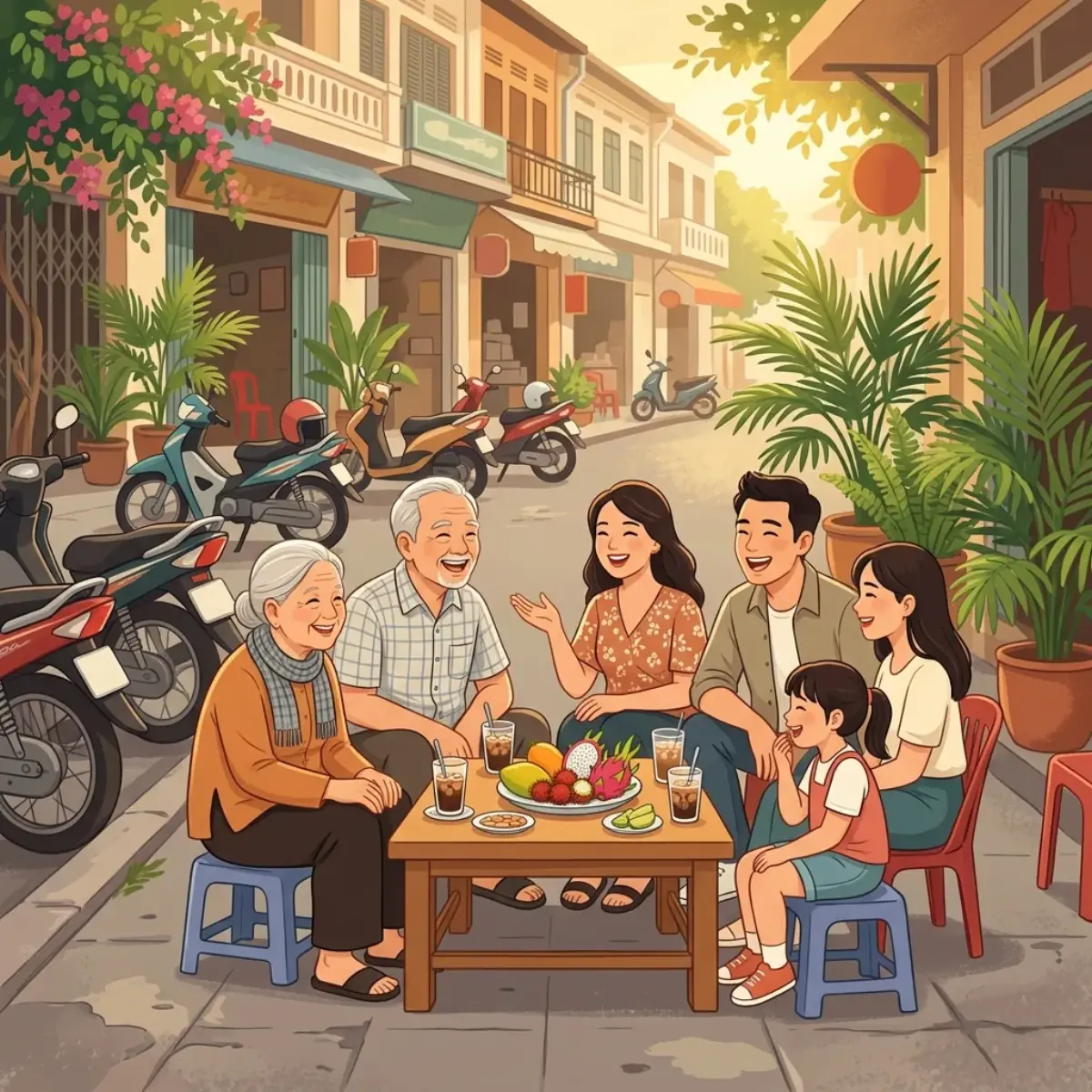
Here's the thing nobody warns you about when you start learning Vietnamese: there is no single word for "I" and no single word for "you." Instead, you pick words based on who you're talking to — their age, and your relationship to them. It feels strange for about a week, and then it becomes one of the most beautiful, human things about the language. This guide walks you through the whole Southern system, step by step, with plenty of Saigon-style examples.
Quick answer: In Southern Vietnamese you don't say a fixed "I" or "you." You address people by their relationship to you — anh (older brother), chị (older sister), em (younger person), cô/chú (aunt/uncle), con (child) — and you call yourself by the matching term. In casual Saigon speech, locals also say tui for "I" and tụi mình for "we."
Why Vietnamese "pronouns" work this way
In English, a 20-year-old and an 80-year-old both say "I" and "you" to each other. Vietnamese finds that a little cold. Instead, the language builds respect and warmth right into every sentence: you position yourself relative to the other person, like a temporary family. Talk to someone a bit older and you become their "younger sibling"; talk to someone your grandparent's age and you become their "grandchild." Same person, different words, depending on who's in front of you.
The core pairs you'll use every day
Start with these five. Ninety percent of everyday conversation runs on them.
| Word | Who it means | You use it for… |
|---|---|---|
| anh | an older brother / a man a bit older than you | "you" (to him) & "I" (if you're the older man) |
| chị | an older sister / a woman a bit older than you | "you" (to her) & "I" (if you're the older woman) |
| em | a younger person (brother, sister, or just younger) | "you" (to them) & "I" (when talking to someone older) |
| cô | a woman about your parent's age; a female teacher | "you" / "she" |
| chú | a man about your parent's age (younger than your parent) | "you" / "he" |
The key move: the same word is both "I" and "you," depending on who's speaking. If a woman slightly older than you is talking, she is chị and you are em. When you reply, you keep the same pair.
Talking to different people — real situations
To someone clearly older (your parents' age)
Use cô (woman) or chú (man), and call yourself con (literally "child") — this is warm and respectful.
To a friend your own age
Use bạn (neutral "you/friend") and mình ("I"), or the very casual Saigon tui.
To a server, a driver, a shopkeeper
Judge their age. Younger → em. Around your age → anh/chị. Older → cô/chú. A friendly ơi ("hey/excuse me") gets their attention.
The Southern flavor: tui, tụi, ba/má, cưng
These are the words that make you sound like you're actually from Saigon, not reading a national textbook.
Local tip
When you don't know someone's exact age, anh (to a man) and chị (to a woman) is the safe, polite default in Saigon — flattering someone as slightly older is never rude.
"We" and "you all" — the Southern way
Vietnamese builds plurals by adding a group word. In the South you'll hear tụi constantly.
| Meaning | Southern (Saigon) | More standard / Northern |
|---|---|---|
| we / us | tụi mình, tụi tui | chúng mình, chúng tôi |
| you all | tụi em, mấy em, tụi bây (casual) | các bạn, các em |
| they | tụi nó, mấy người đó | họ, chúng nó |
Two mistakes almost every learner makes
Mistake 1 — using tôi for everything
Textbooks teach tôi as "I," so beginners use it with everyone. It's not wrong, but it sounds distant and businesslike — like calling everyone "sir/madam." With a friendly server or a new friend, switch to anh/chị/em or tui, and watch people warm up.
Mistake 2 — forgetting to switch when the person changes
You are em to your older colleague but anh/chị to the intern. The word for "I" changes with every conversation. That's the skill — and it clicks faster than you'd expect.
Try it yourself
- You're buying fruit from a woman about your mom's age. What do you call her, and yourself?
- A younger waiter asks what you want. How do you address him?
- Text a friend "Where are you? I'm here already" using bạn and tui.
Answers: 1. Her = cô, you = con. 2. Him = em, you = anh/chị. 3. Bạn ở đâu? Tui tới rồi nè.
Southern vs Northern, at a glance
| Meaning | Southern (Saigon) | Northern (Hanoi) |
|---|---|---|
| casual "I" | tui | tớ, mình |
| dad / mom | ba / má | bố / mẹ |
| we | tụi mình | chúng mình |
| term of endearment | cưng | cưng (less common) |
Frequently asked questions
Do I really have to guess people's ages?
You get a feel for it fast, and no one is offended by a polite guess. When unsure, anh/chị is the friendly safe bet in the South.
Is tui rude?
No — it's casual and friendly, perfect with friends, peers and in relaxed shops. For formal settings (a job interview, an email) use tôi.
What about "you" for a romantic partner?
Couples often use anh (him) and em (her) regardless of exact age, plus sweet words like cưng. It's one of the warmest parts of the language.
Learn Southern Vietnamese online with people who actually speak it
Pronouns are the one thing you truly learn by using them with a real person. SVFF teaches the Southern (Saigon) dialect with native teachers from Ho Chi Minh City, since 2014.
- Listen to the SVFF podcast — hear pronouns used naturally, free.
- Book a free trial lesson — 30 minutes 1-on-1 with a native Saigon teacher.
- Browse our courses — structured A0–C1, all Southern dialect.
- Go Unlimited — every course and e-textbook, one payment.








0 Comments
Log in to leave a comment.