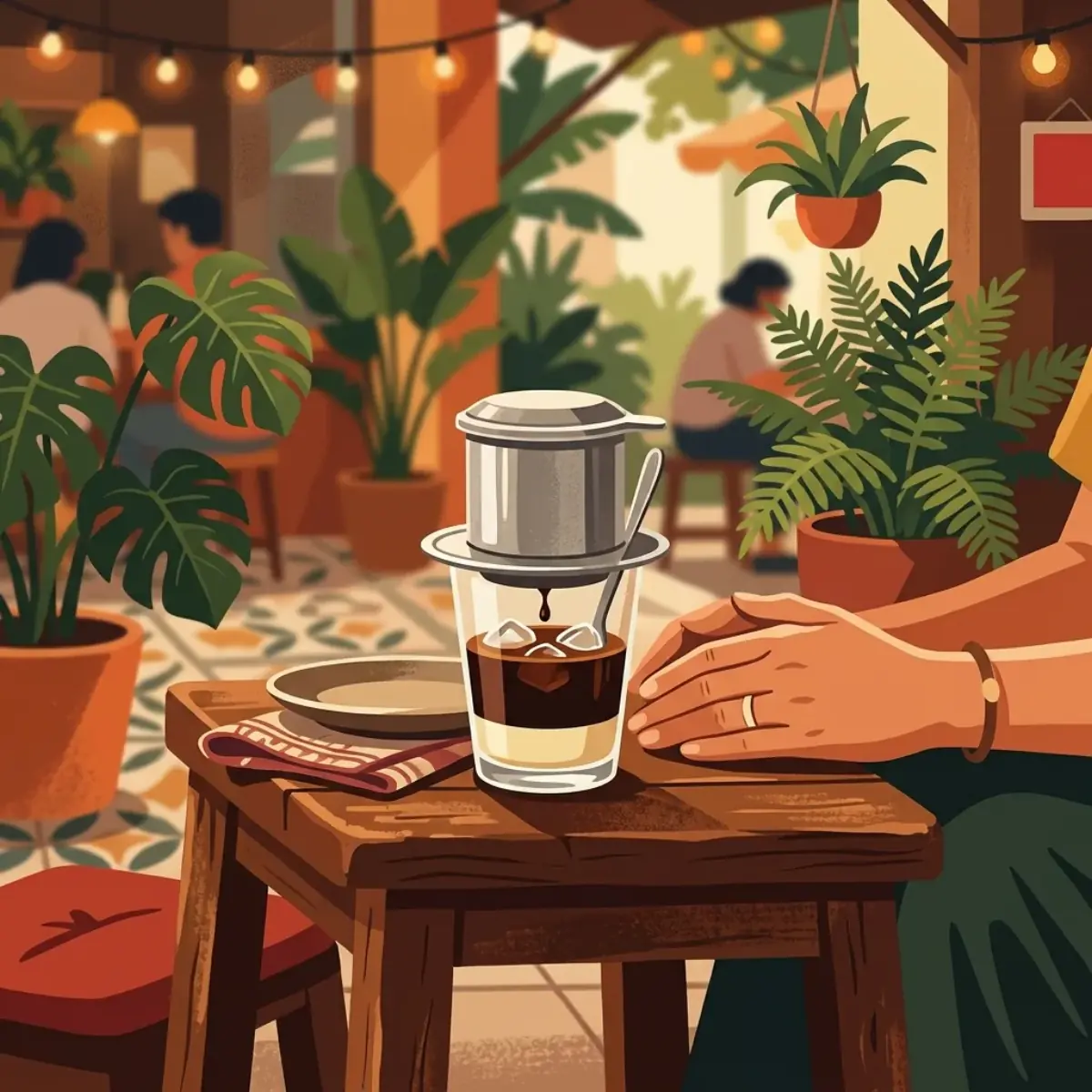
There's a particular kind of happiness in a Saigon morning: a low plastic stool on the sidewalk, motorbikes humming past, and a small glass of cà phê sữa đá sweating in the heat while the phin filter drips its last slow drops. Ordering that glass is one of the first truly useful things you can say in Vietnamese — and in the South, it has its own warm, easygoing flavor. Let's walk into a café together.
Quick answer: To order the classic Saigon iced milk coffee, just say "Cho tui một ly cà phê sữa đá nha" — "Give me one glass of iced milk coffee, please." Add ít đường (less sugar) or nhiều đá (more ice) to make it yours.
First, a real Saigon café scene
Here's how it actually sounds when you sit down at a neighborhood quán cà phê. Read it once for the music of it, then we'll break every line down.
Notice how soft it all is — the dạ at the start of your sentences, the nha and nghen at the end, and calling the owner cô (auntie) while calling yourself con (child). That's Saigon warmth built right into the grammar. Let's unpack the building blocks.
The coffee menu, decoded
Vietnamese coffee is strong, dark robusta, brewed one glass at a time through a metal drip filter called a phin. Everything on the menu is a variation on how much milk, ice, and sugar goes with it.
That last one, bạc xỉu, is deeply Southern — a Saigon Chinatown creation, the name borrowed from Cantonese. Order it and you'll sound like a local instantly. If the coffee's too intense for you, it's the gentle way in.
Good to know
Đá means "ice" (also "stone"), and nóng means "hot." So any drink can be đá or nóng. A hot black coffee is cà phê đen nóng; iced is cà phê đen đá. Same pattern every time.
Making it exactly how you like it
Saigon baristas expect you to customize. These little add-on phrases are where you stop sounding like a textbook and start sounding like a regular.
Local tip
The word giùm (do it for me / as a favor) is pure Southern gold. Tack it onto almost any request — "Tính tiền giùm con nha" (check, please) — and it softens everything into a friendly favor instead of a demand. Northerners would say giúp; in Saigon it's giùm.
"Ngồi lại" — the art of staying
Coffee in Saigon isn't a to-go transaction. It's an invitation to ngồi lại — to sit and stay, sometimes for hours, over one small glass. Nobody rushes you. This whole culture has its own vocabulary.
That trà đá — free iced tea — usually comes with your coffee at no charge, and refills are part of the deal. A glass of coffee might cost you hai mươi lăm ngàn (25,000 đồng) at a street stall, and you can nurse it all afternoon. When you hear the price, remember Southerners say ngàn for "thousand" where the North says nghìn.
Southern vs. Northern coffee talk
Coffee culture exists everywhere in Vietnam, but the words around it shift as you travel. Here's where Saigon speech parts ways with Hanoi.
| Meaning | Southern (Saigon) | Northern (Hanoi) |
|---|---|---|
| a glass (of coffee) | ly | cốc |
| thousand (for prices) | ngàn | nghìn |
| do it for me (favor) | giùm | giúp / hộ |
| no / not | hông / hổng | không |
| friendly sentence ender | nha / nghen | nhé |
| spoon (for stirring) | muỗng | thìa |
| the very milky coffee | bạc xỉu (common) | nâu đá (their own version) |
Common mistake
Don't order a "cốc" of coffee in Saigon — a cốc here suggests a big mug or a beer glass, not the little coffee glass. Ask for a ly. And if you say nâu (the Hanoi word for milk coffee, literally "brown"), a Saigon barista may just blink at you. Stick with cà phê sữa.
Your Saigon coffee cheat-sheet
Screenshot these. Point at them if you have to. Each one is ready to use exactly as written.
Try it yourself
- You want one iced milk coffee, and you'd like it a bit strong. What do you say?
- The coffee looks too sweet for you. Ask for less sugar in Southern style.
- You're settling in with your laptop and want to check the wifi and stay a while. Ask both.
- You're done and want the check. What's the friendly Saigon phrase?
Answers: 1) Cho tui một ly cà phê sữa đá, đậm đậm chút nha. 2) Cho ít đường thôi nha cô. 3) Ở đây có wifi hông cô? Cho tui ngồi lại chút nha. 4) Tính tiền giùm con nha cô.
Frequently asked questions
What exactly is bạc xỉu, and how is it different from cà phê sữa?
Both are coffee with sweetened condensed milk, but bạc xỉu is milk-forward — mostly milk with just a small amount of coffee, so it's paler, sweeter, and much gentler. Cà phê sữa is the reverse: strong coffee with milk added. If robusta hits you too hard, start with bạc xỉu.
Why does my coffee come with a little metal cup on top?
That's the phin, the drip filter. The ground coffee sits inside and hot water slowly filters through into your glass. It's not decoration — it's still brewing. Wait for it to finish dripping, lift it off, then stir in the ice and milk with your muỗng (spoon).
Do I have to tip or pay right away?
Tipping isn't expected at local cafés. At a street stall you often pay when you leave; at a nicer quán the staff may bring a bill. Either way, just say "Tính tiền giùm con nha" when you're ready.
Is the free iced tea really free?
Usually yes. Most Saigon cafés bring trà đá alongside your coffee at no charge, and they'll refill it if you ask: "Cho xin thêm ly trà đá nha." It's part of the sit-and-stay hospitality.
What's the best way to actually get comfortable with all this?
Hearing it out loud, in a real Saigon accent, is what makes it stick — the soft dạ, the melodic nha, the way hông replaces không. That's exactly why people choose to learn Southern Vietnamese online with native Saigon teachers rather than from a generic textbook. A few sessions of role-playing a café order and it becomes automatic.
Learn Southern Vietnamese online with people who actually speak it
SVFF is the school built entirely around the Southern (Saigon) dialect — native teachers from Ho Chi Minh City, since 2014.
- Listen to the SVFF podcast — real Southern Vietnamese, free.
- Book a free trial lesson — 30 minutes 1-on-1 with a native Saigon teacher.
- Browse our courses — structured A0–C1, all Southern dialect.
- Go Unlimited — every course and e-textbook, one payment.








0 Comments
Log in to leave a comment.