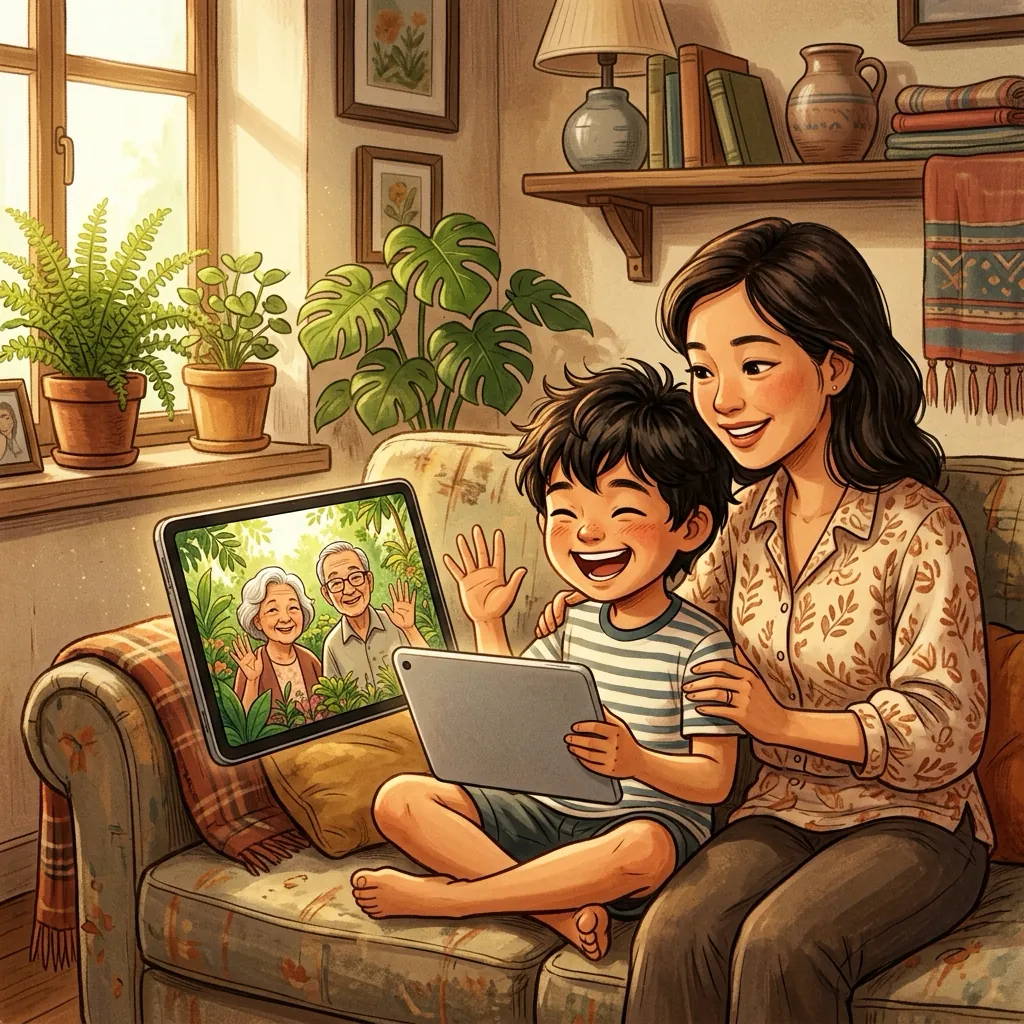
Every heritage family knows the scene: the weekly video call with Bà Ngoại where your child smiles, waves, says a quick "hi"… and then immediately looks at you to translate. The grandparents' Vietnamese is full of love, but it has nowhere to go. Helping your half-Vietnamese kids talk to their grandparents is often the exact moment parents decide they need to do something. Usually, it is a parent who genuinely wishes their own parents had insisted on teaching them, writing to us to make sure their children don't miss out on that irreplaceable family connection.
It can be heartbreaking to watch the two generations struggle to communicate. But you are not alone in this, and there is a clear path forward that doesn't involve tears over grammar books.
Quick answer: To help heritage kids learn Vietnamese, shift from treating it like a school subject to a living relationship. Focus on the exact Southern dialect their family speaks, use one-on-one lessons with a native speaker they connect with, and prepare them with specific, simple phrases before every grandparent call.
Why kids resist — and why it isn't just laziness
For a kid growing up in an English-speaking country, learning Vietnamese can easily feel like homework for a subject none of their friends take. Weekend language school with twenty kids and a stack of worksheets rarely survives contact with a busy season of soccer, dance recitals, and regular school homework. The resistance you see isn't actually to the language itself — it is to learning that feels pointless and social pressure that feels very real.
When kids don't see an immediate, practical use for the words they are memorizing, their motivation drops to zero. Many heritage families assume their child is just being difficult or lazy. But imagine being five or ten years old: if the only time you use a language is to struggle through a confusing worksheet or be sternly corrected by an adult, you would avoid it too. The key is removing the friction and tying the language to joy, not obligation.
Kids are incredibly pragmatic. If they can get what they want in English, they will use English. You have to give them a compelling, enjoyable reason to switch their brain into Vietnamese mode. It has to be fun, and it has to be about connecting with people they actually like talking to.
Good to know
When kids push back, it is often a sign of performance anxiety. They do not want to sound "wrong" or silly in front of their fluent relatives. Lowering the stakes and celebrating tiny wins — like just getting the greeting right — builds the confidence they need to keep trying without fear.
The dialect detail most families completely miss
If the grandparents are from Southern Vietnam — Sài Gòn, the Mekong Delta, or the large wave of families who emigrated from the South — they speak Southern Vietnamese. Teaching kids the Northern pronunciation from mainstream apps means teaching them a version of the language their own grandmother finds slightly foreign. Some everyday words and the accent differ: Northern uses bố mẹ while Southern uses ba má. Northern uses vâng while Southern uses dạ.
For half-Vietnamese children, the whole point of learning is family connection, so they absolutely must learn the dialect their family actually speaks. If they use Northern vocabulary with a Southern grandma, it creates a weird distance rather than bridging the gap. That is exactly why we focus exclusively on Southern Vietnamese. It is the only dialect we teach, because it is the one your family needs.
Even small words matter immensely. Learning to say nha at the end of a sentence makes a child sound like they belong to the family, not a textbook. So does calling the grandparents ông bà nội or ông bà ngoại, never the casual ổng / bả, which would sound rude from a grandchild. Or simply ending a question with vậy makes it sound so naturally Southern.
The power of a person, not a curriculum
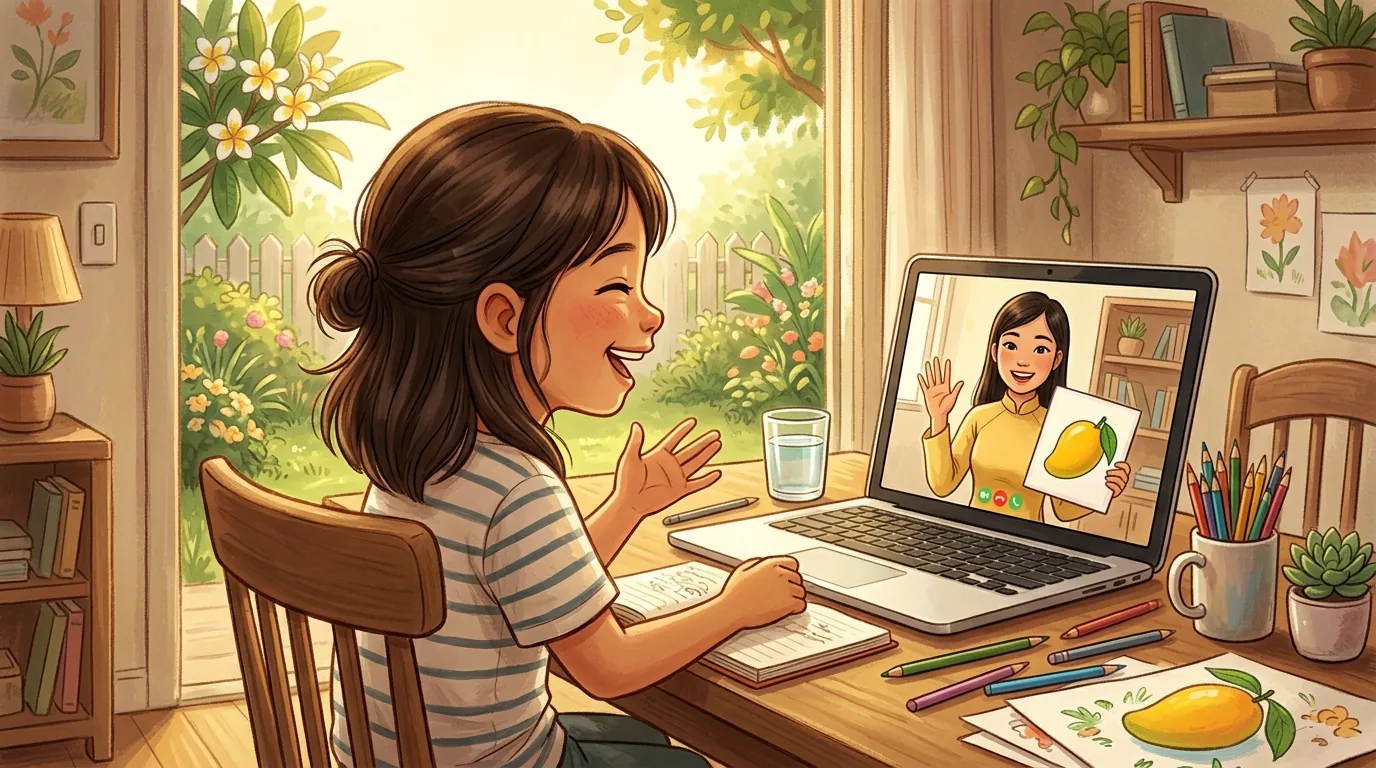
What actually flips the switch for resistant kids? A person, not a curriculum. When lessons are one-on-one with a warm native teacher who talks about their life — their games, their food, their pets, their cousins — Vietnamese stops being a boring school subject and becomes a real relationship.
In our lessons we see it again and again: kids learn best when they genuinely like the person talking to them across the screen. A Southern Vietnamese teacher who knows how to make a child laugh, who asks them about Minecraft, or who remembers the name of their dog, makes the language a tool for play. They aren't studying; they are just chatting with their cool friend in Vietnam.
And when that bond forms, the first real phone conversation with grandma happens naturally. The motivation problem usually solves itself because the child now wants to communicate. The language is no longer an abstract concept; it is the bridge to someone they care about.
Local tip
Instead of announcing, "It is time for your Vietnamese lesson," try saying, "It is time to talk to Cô Tâm!" Shifting the focus entirely from the academic subject to the human being makes kids much more eager to log on and participate.
What works by age: from toddlers to teenagers
Every age group needs a slightly different approach to learning Vietnamese successfully. What works for a toddler will absolutely bore a teenager, and what challenges a teen will completely overwhelm a five-year-old. Here is what we have seen work best across different stages of childhood.
Toddlers and Preschoolers (Ages 2-5): At this early age, it is all about pure immersion and play. You don't need formal lessons yet. Use basic parenting vocabulary like ăn cơm (eat rice), đi ngủ (go to sleep), and tắm (bathe) every single day. Sing Vietnamese nursery rhymes together. Their brains are like sponges, so the more they hear the natural rhythm and melodies of the Southern tones in a loving context, the better their pronunciation will be later on.
Primary Schoolers (Ages 6-11): This is when resistance usually peaks because they notice their peers at school don't speak Vietnamese. The solution? Give it a mission. "You are learning so you can tell Bà Ngoại about your birthday party yourself." Kids run on purpose, not on grammar points. Short and regular beats long and rare. Two 45–60 minute one-on-one sessions a week heavily outperform a single marathon Saturday class — and they fit much more easily around school schedules.
Teenagers (Ages 12+): Teens need autonomy and relevance. They might want to learn so they can travel to Vietnam independently one day, understand Vietnamese pop music and movies, or connect with cousins on social media. Let them steer the topics. If they want to learn internet slang, teach them slang. If they want to talk about video games or fashion in Vietnamese, let them. The goal is to make the language theirs, not yours.
Daily routines: how the non-Vietnamese parent can support learning
A common misconception in mixed-heritage families is that only the Vietnamese parent can or should teach the language. In reality, the non-Vietnamese parent's attitude is a massive, defining factor. If the non-Vietnamese parent shows enthusiasm, tries to learn a few words themselves, and normalizes the language at home, the child feels incredibly supported.
The golden rule is: Let the teacher carry the structure, and keep home fun. Play Vietnamese music during family dinners, put on Vietnamese cartoons on YouTube on Saturday mornings, and introduce a "one phrase a day" routine in the car on the way to school. Home reinforces what the lessons teach.
Even if the non-Vietnamese parent just learns basic family words or simple greetings, it shows the child that Vietnamese is a unified family project, not just a chore assigned exclusively to them. It validates the language's importance in the household.
Making calls with grandparents succeed (show-and-tell)
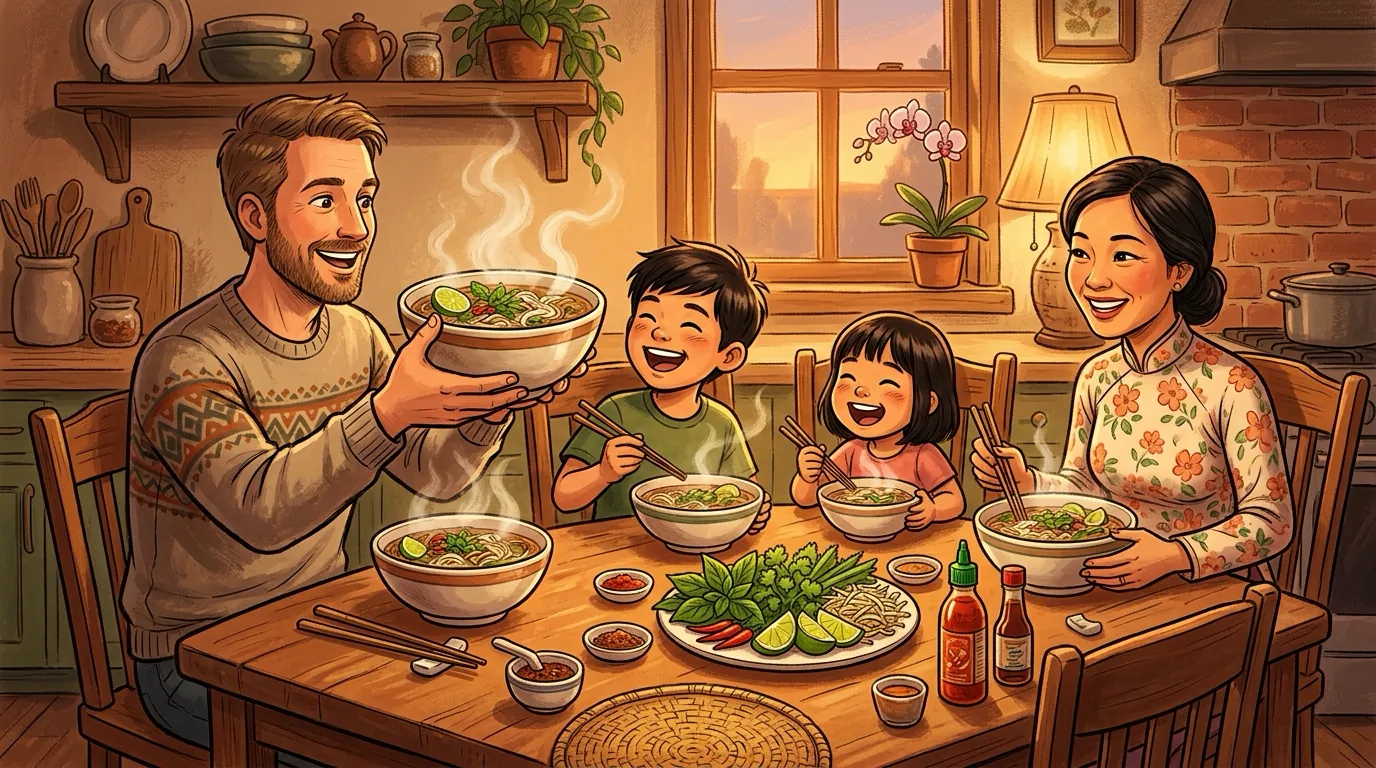
The dreaded weekly video call doesn't have to be an awkward silence where everyone just stares at the screen. The secret to a successful call is preparation. Before dialing the number, sit down with your child and prepare one or two specific things they can say or show. We call this the "Show and Tell" method, and it works wonders.
If they drew a picture that day, help them practice saying "Ông bà nhìn nè, con vẽ con mèo!" (Look grandpa and grandma, I drew a cat!). Giving them a physical prop takes the immense pressure off making small talk and gives the grandparents something concrete and delightful to react to.
Crucially, put the grandparents in the loop. Text them beforehand: "We just learned how to talk about our favorite foods. Ask him what his favorite fruit is." When the grandparents ask exactly those prepared questions and the child actually understands and answers correctly, it is pure magic. Nothing fuels a child's desire to learn quite like the feeling of being truly understood by the people they love.
Common mistake
Do not force your child to translate on the spot during the call. Saying "Tell grandma you like school!" in English and waiting for them to translate it to Vietnamese causes instant panic and resentment. Instead, practice the specific Vietnamese phrase before the call even starts.
What real progress looks like
For heritage families who commit to steady lessons and supportive, low-pressure home habits, the timeline is actually very encouraging. What does real progress look like from the families who did it?
Within the first month: They master the correct greetings and the names of the foods they love to eat. The deer-in-the-headlights freeze response when spoken to starts to fade away.
Within a school term of steady one-on-one lessons: You start hearing little, genuine exchanges on the family video call. They might independently ask "Ông bà khỏe hông?" (Are you well?) without you whispering it in their ear. And the very first time grandma laughs out loud at something your child said in Vietnamese, you will know exactly why you started this journey. Speaking always comes first; reading and writing can follow once talking feels natural and good.
Try it yourself
Help your child practice these easy, high-impact phrases for their next call with the Southern grandparents:
- The polite "Yes" you always use: ____
- Hello Grandpa (paternal): Dạ, con chào ____.
- Hello Grandma (maternal): Dạ, con chào ____.
- Are you well?: Ông bà ____ hông?
- Look here! (showing a drawing or toy): Ông bà nhìn ____!
Answers: 1. Dạ · 2. ông nội · 3. bà ngoại · 4. khỏe · 5. nè
Frequently asked questions
Is it too late to start teaching my child if they are already 10 or 12 years old?
No, it is never too late. Older children actually have the cognitive ability to grasp grammar rules and vocabulary much faster than toddlers. The focus simply shifts from pure immersion to engaging them through their personal interests, hobbies, and a desire for independence.
Should we teach them reading and writing at the same time as speaking?
For heritage kids, speaking and listening absolutely must come first. The immediate, urgent goal is connecting with family and feeling confident. Once they are comfortable talking and can understand basic conversations, introducing the alphabet and tones becomes significantly easier because they already know how the words are supposed to sound in their head.
What if my child complains that Vietnamese is just too hard?
Acknowledge their feelings honestly. Vietnamese is a challenging language with its tones and new sounds! Remind them of their specific, tangible goal, like talking to Ông bà ngoại. Also, reconsider the lesson format: short, fun, conversational sessions with a warm teacher are much less overwhelming than long, grammar-heavy classes that feel like a chore.
Can the non-Vietnamese parent really make a difference?
Absolutely. The non-Vietnamese parent is crucial for normalizing the language in the house. If they show genuine curiosity, ask the child to "teach" them a new word, or simply learn to say "thank you" (cám ơn) and "delicious" (ngon quá) at dinner, it shows the child that the whole family values Vietnamese, not just one side.
How often should they really have a lesson to see progress?
Consistency beats intensity every single time. Two 45-minute sessions a week is the proven sweet spot for most school-aged kids. It is frequent enough to build real momentum and memory retention, but short enough to keep their attention sharp and easily fit into a busy modern family schedule.
Learn Southern Vietnamese online with people who actually speak it
SVFF is the school built entirely around the Southern (Saigon) dialect — native teachers from Ho Chi Minh City, since 2014.
- Listen to the SVFF podcast — real Southern Vietnamese, free.
- Book a free trial lesson — 30 minutes 1-on-1 with a native Saigon teacher.
- Browse our courses — structured A0–C1, all Southern dialect.
- Go Unlimited — every course and e-textbook, one payment.




0 Comments
Log in to leave a comment.