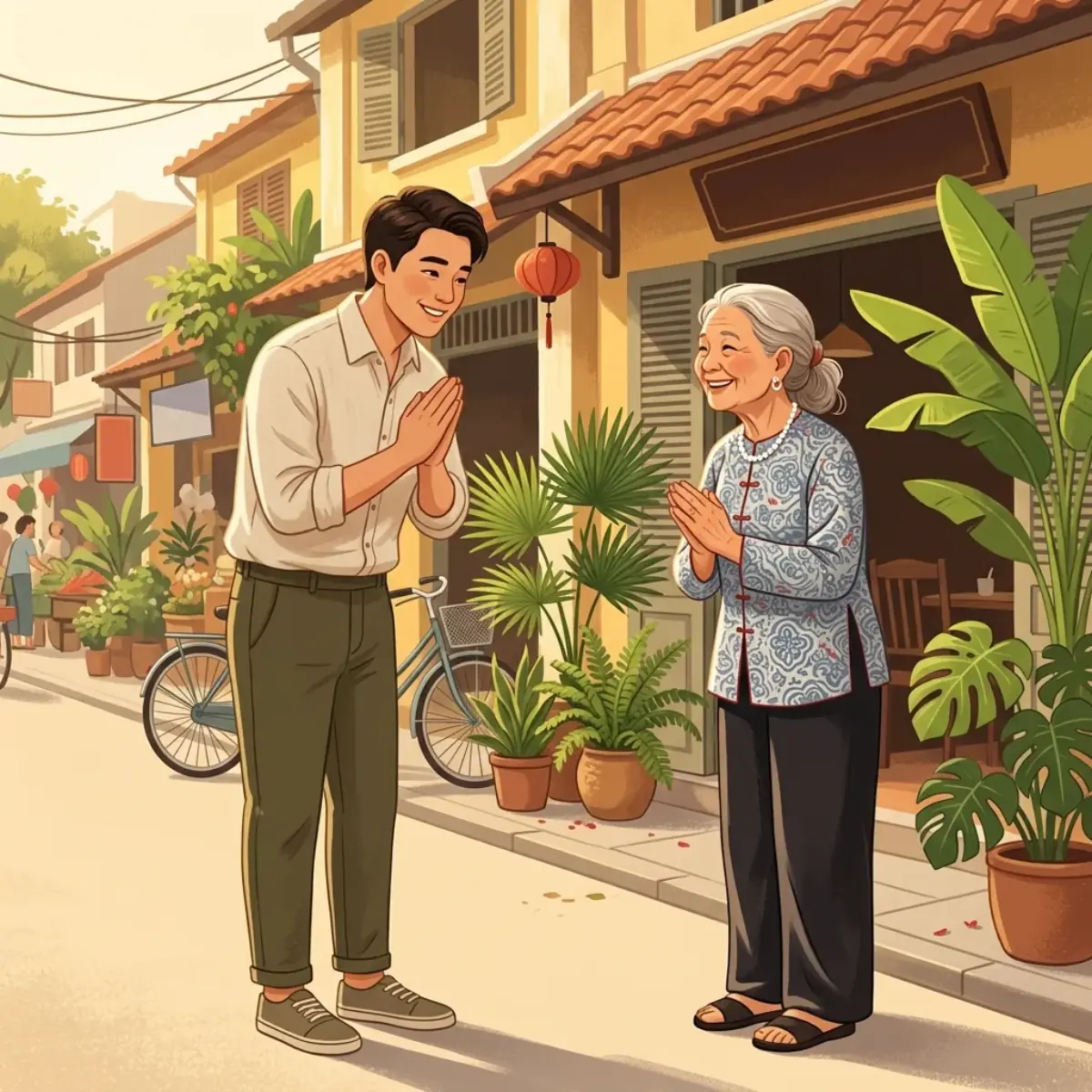
If you learn only one word this week, make it dạ. In Southern Vietnamese it's the tiny sound that wraps almost everything you say in politeness and warmth. Locals in Ho Chi Minh City start replies with it without even thinking — and the moment a foreigner uses it correctly, people relax and treat you like you actually belong here.
Quick answer: In Southern Vietnamese, dạ is a politeness word you put at the start of a reply to sound respectful and friendly — a bit like a soft "yes…" or "yes ma'am / yes sir." It works with a "yes" answer, a "no" answer, or no answer at all. Northern speakers lean on vâng for polite agreement, but in Saigon, dạ is king.
What does dạ actually mean?
Here's the part that surprises learners: dạ doesn't really mean "yes." It means "I'm answering you respectfully." That's why you can put it in front of a "no" and it stays polite. Think of it as a politeness switch you flick on before you say anything to someone you respect — an elder, a customer, a teacher, a stranger, your partner's parents.
The three ways locals use it
1. As a polite "yes"
- Dạ, con cảm ơn. — Yes, thank you. (to someone older)
- Dạ, đúng rồi. — Yes, that's right.
2. In front of a "no" — still polite
This is the trick that makes learners sound instantly natural:
- Dạ không. — No (politely). A bare không can sound blunt; dạ không is gentle.
- Dạ, con chưa ăn. — No, I haven't eaten yet.
3. As a soft "yes?" when someone calls you
- Someone calls your name — you answer Dạ? — Yes? / I'm here.
Southern vs Northern politeness
| Situation | Southern (Saigon) | Northern (Hanoi) |
|---|---|---|
| Polite "yes" | Dạ / Dạ vâng | Vâng |
| Polite "no" | Dạ không | Không ạ |
| Answering when called | Dạ? | Dạ? / Vâng? |
Both dialects value politeness — they just reach for different words. In the South, sprinkling dạ generously is the norm, and no one will ever think you're being too polite.
A tiny habit that changes everything
For one day, start every reply to anyone older than you with dạ. "Dạ, dạ, dạ…" It feels like a lot at first, then it becomes automatic — and that's exactly the point. It's the single most efficient way to sound respectful in Southern Vietnamese without memorising a single grammar rule.
Frequently asked questions
Is dạ only for talking to older people?
It's most important with elders, customers, teachers and strangers, but it's never wrong to use it. Among close friends of the same age you can drop it, the same way you'd drop "sir" with a buddy.
What's the difference between dạ and vâng?
Both are polite, but dạ is the Southern default and vâng is Northern. If you're learning for life in Ho Chi Minh City, build the dạ habit.
Can I really put dạ before "no"?
Yes — that's what makes it special. Dạ signals respect, not agreement, so dạ không is a polite, soft "no."
Learn Southern Vietnamese online with people who actually speak it
SVFF is the school built entirely around the Southern (Saigon) dialect — native teachers from Ho Chi Minh City since 2014.
- Listen to the SVFF podcast — real Southern Vietnamese, free.
- Book a free trial lesson — 30 minutes 1-on-1 with a native Saigon teacher.
- Browse our courses — structured A0–C1, all Southern dialect.
- Go Unlimited — every course and e-textbook, one payment.








0 Comments
Log in to leave a comment.